Divorce Process

Transgender Divorce in Florida: Why Privacy and Control Matter More Than Ever

Going through a divorce is hard enough. When you are transgender, it can feel even heavier. You may worry about being judged, misunderstood, or reduced to a label at the very moment you need stability and respect. You may also fear losing control over decisions that will shape your future, your finances, and your relationship with your children.

In Florida’s current political and cultural climate, many transgender clients feel under constant scrutiny. In that context, privacy is not just comforting. It is essential.

At Family Diplomacy: A Collaborative Law Firm, we have extensive experience helping transgender clients across Florida choose a divorce process that protects dignity, discretion, and self-determination. We have offices by appointment in Tampa, St. Petersburg, and Sarasota, and we utilize Zoom so we can accept clients in every county in Florida.

Quick Answer

If you are transgender and going through divorce in Florida, Collaborative Divorce allows you to protect your privacy, avoid being judged by a court, and keep control over parenting and financial decisions, with experienced guidance from Family Diplomacy and Adam B. Cordover.

Read more

FAQs – Collaborative Divorce in Florida: What You Need to Know

When you or your spouse is a professional going through a divorce, your priorities are clear. You want to protect your family and privacy, avoid the public spectacle of a courtroom, and ensure that your complex financial life is handled with care. Collaborative Divorce offers an approach designed with those very concerns in mind. Below are answers to some of the most frequently asked questions about Collaborative Divorce that you may be wondering about.

Why is there a Disqualification Clause, and How does it Help You?

One of the things that makes Collaborative Divorce unique is the disqualification clause. In essence, this means that if either spouse decides to go to court or end the process, both Collaborative Attorneys and other team members must withdraw. At first glance, you may wonder why this makes sense. In reality, it’s a protective measure. The clause creates a strong incentive for everyone involved to stay committed to reaching an agreement rather than end up where nobody wants to go: fighting in court. Instead of treating Collaboration as a stepping-stone to litigation, you and your spouse know that the only path forward with your lawyers is to resolve matters respectfully and privately by agreement.

In my experience, this clause is one of the strongest safeguards against escalation. It helps keep conversations solution-focused and mitigates against the likelihood that the case will spin out of control into the courtroom battles you hear about on the news.

Read more

Divorcing Wealthy in Florida

What is the best way to end up wealthy after divorce?  It is by being even wealthier before divorce.  The truth is that divorce is not cheap.  But there are things that you can do to help preserve your wealth even if your marriage is ending.

Retain a Neutral Financial Professional

One of the biggest challenges when going through divorce is that one spouse typically knows more about the family finances than the other spouse.  If you are the spouse with the knowledge, this can be frustrating because you feel you are making reasonable proposals that would benefit your spouse, and yet your spouse is outright rejecting them or refuses to make a decision, costing your family even more time and money.  If you are the spouse without knowledge of the family finances, you feel like your spouse is trying to control you by badgering you to agree to their proposal, but how can you even make a decision that could have disastrous consequences for your long term financial future?

This is where a Neutral Financial Professional comes in.

Read more

Defining “Collaborative Mediation”

If you do a Google search for “Collaborative Mediation,” you will get all sorts of results, many of which have nothing to do with one another.  Many articles simply point out the differences between Collaborative Divorce and Mediation (one of my blog posts would be included with this group).

Other articles will use the term to be a synonym with Collaborative Divorce, referring to neutral professionals (typically a financial professional and licensed mental health professional) as mediators, even if those professionals have not been trained as mediators.  This seems misleading to me.   Still, other articles use the term to mean a friendly mediation or an interdisciplinary co-mediation where lawyers are optional.  I have concerns about those articles because, despite using the term “collaborative,” what they describe is not a Collaborative Law Process as defined by the Florida Statutes or Uniform Collaborative Law Act/Rules.  Again, this is misleading.

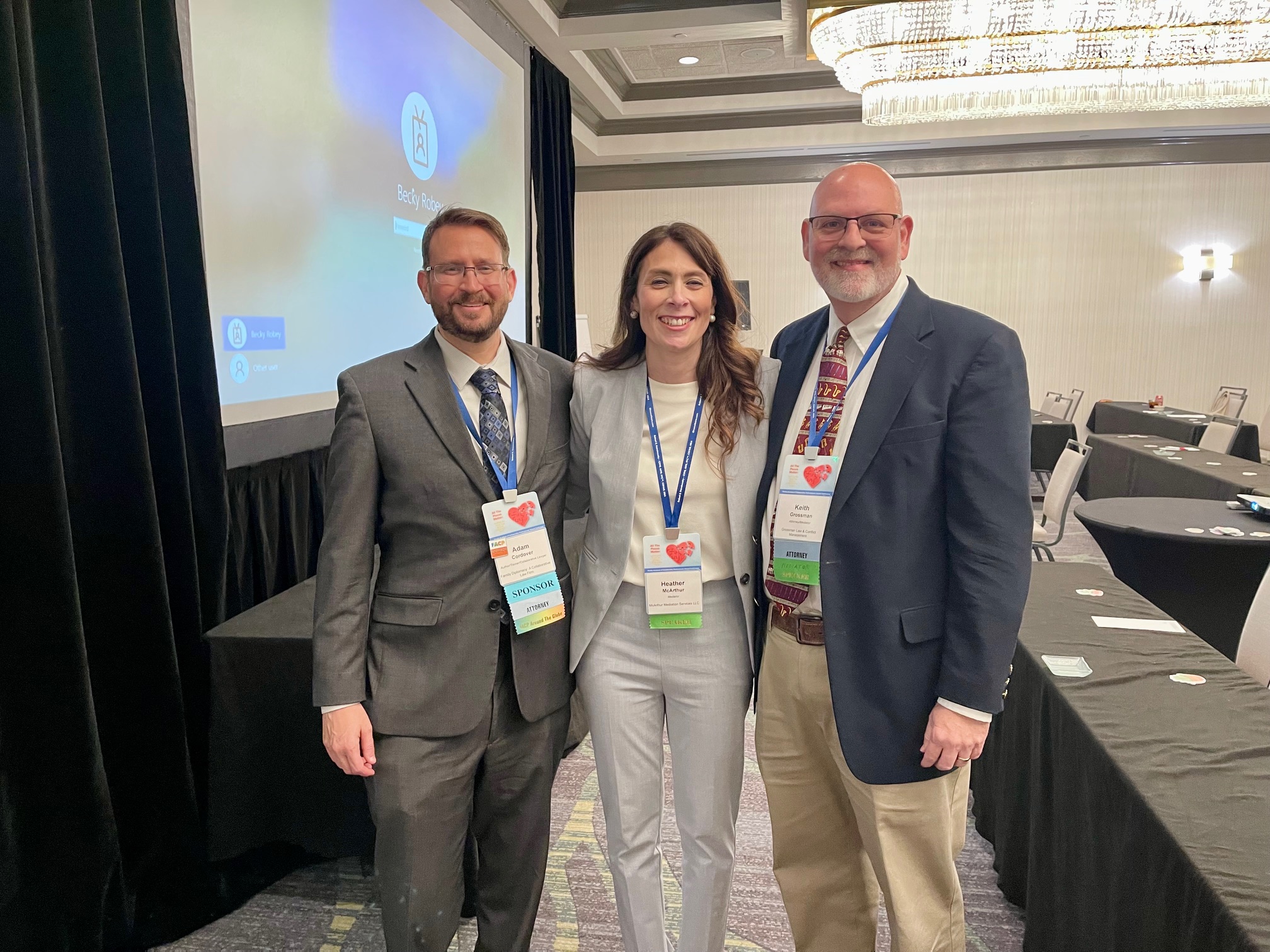
I recently was at the 12th Annual Conference of the Florida Academy of Collaborative Professionals (“FACP”) where I presented on the topic of “Collaborative Mediation: Engaging Mediators in the Collaborative Process.”  My co-presenters were Heather McArthur, co-founder and president of Collaborative Professionals of Central Florida and Florida Supreme Court Certified Family Law Mediator, and Keith Grossman, a Florida Supreme Court Approved Primary Family Mediation Trainer and president of the Southwest Florida Collaborative Professionals Association.

As I have not found a good definition anywhere else, one of my goals in co-presenting on this topic (and writing this article) was to define the term “Collaborative Mediation.”  Additionally, I hoped to shed light on this distinct model of Collaborative Practice, find a way to better engage mediators in the Collaborative Process, and offer an option under certain circumstances that could bring more clients and lawyers into the Collaborative Method.

Read more

Child Support in Florida

Child support in Florida is the financial obligation aimed to provide a fair and consistent means of sharing the costs of raising a child between separated parents. There’s a Collaborative Law process that offers an alternative way to address child support matters. This approach emphasizes cooperation, open communication, and prioritizing your child’s well-being. In this post, we’ll take you through the fundamentals of child support in Florida and the benefits of pursuing child support solutions through the Collaborative Process.

CALCULATING CHILD SUPPORT

In Florida, you’ll find child support guidelines laid out in Florida Statutes §61.30. You’ll notice that the calculation takes into account key factors like your income and your partner’s income, the number of children involved, and the time each of you spends with them. It’s essential to understand that the state utilizes a specific formula incorporating these elements to calculate the exact amount of child support owed.  Though you may deviate from these calculations under certain circumstances, the child support guidelines determine the default amount you can expect to pay or be paid.

CONSIDERING YOUR INCOMES

Remember, both your incomes play a pivotal role in calculating child support. It’s worth noting that not all types of income are straightforward (for example, income from a private business). Additionally, it’s important to keep in mind that if either of you is voluntarily unemployed or not fully utilizing your earning capacity, income may be attributed to you based on your potential earning capacity.

Read more

Can I Get A Discount For Virtual Divorce Legal Services?

If you are facing divorce and have done your research, you probably realize how expensive divorce can be.  Not only are you charged for your attorney’s time spent engaging in the actual legal work, but it is also common practice for you to be charged for travel time to go to hearings, mediation sessions, or Collaborative Divorce meetings at the lawyer’s regular hourly rate.  Further, firms that practice mainly in person incur additional expenses including leasing larger office space, renting additional equipment, and purchasing additional office snacks, drinks, and supplies.  And, of course, those expenses get passed on to you, the client.

But what if you were comfortable working with your lawyer through Zoom, telephone calls, e-mails, and other virtual means, and you did not feel the need to meet in person?  Since it ends up costing less for the law firm, shouldn’t you get a discount for virtual divorce legal services?

Read more

quickie divorce

A Quicker Way To Divorce – Quickie Divorce

One of the most painful aspects of the traditional divorce process is that it seems to drag on forever. Clients are hauled through case management conferences, temporary relief hearings, depositions, motion hearings, pre-trial conferences, and, finally, oftentimes years later, trial.

But this does not need to be the way you go through one of the toughest times of your life.  There is a quicker way to divorce.

Read more

Divorce Lawyer Reviews: “I felt empowered and more in control of my life and my divorce.”

Divorce can be one of the most turbulent times in your life, and so it makes me feel good when I can help clients gain a sense of empowerment and stability.

Lawyer Adam Cordover | Lawyer Divorce

In a recent review on Avvo.com, a former client of mine discusses how our firm and the collaborative process helped her take back control of her life.

FLORIDA BAR NOTICE:  Please note that every case is different, and that you may not receive the same or similar results.

Read more

Four Questions to Ask a Collaborative Divorce Lawyer

More and more people are deciding that they want to avoid the traditional adversarial divorce court system and instead handle their family law matter privately and respectfully via the collaborative process.  In collaborative divorce, each spouse receives independent legal advice from his or her own attorney, and the attorneys are retained solely for the purpose of reaching an out-of-court agreement.  Oftentimes, experts will be brought in to help with parenting or financial issues.

collaborative divorce lawyer

As collaborative divorce is becoming more popular and since Florida Governor Rick Scott signed the Collaborative Law Process Act in March 2016, more attorneys who are steeped in the old system of divorce court are now advertising that they offer collaborative services.  The issue is that the skillset needed to successfully help clients reach dignified agreements in collaborative practice is very different than the skillset needed to be an aggressive trial lawyer.

Below are four questions you should ask any attorney you are interviewing to possibly represent you in the collaborative divorce process.

Read more

Divorce Lawyer Client Review: A Complicated Divorce Goes Collaborative

Recently, I came across a very complicated divorce matter where two women had been battling in the court system for six years, even before the State of Florida recognized their marriage.  One of the women ended up firing her aggressive trial attorney and hiring me because I offered an alternative: collaborative divorce.  Once everyone agreed to stop fighting, we were able to reach an agreement within just a few months’ time.

Lawyer Adam Cordover | Top Attorney Divorce

That client, Pattie, recently wrote a touching review about my paralegal, Jennifer, and I at avvo.com.  You can find the review below.

As I am required to note by the Florida Bar, please understand that every case is different, and you may not receive the same or similar results.

The Law Firm of Adam B. Cordover & Staff are amazing, professional caring people. Please know that I don’t mean for this review to be long or boring, my intent is to shed hope & shine light into your present life from my past experience and situation.

My situation was very complicated from the start being a same sex marriage which for years was not recognized in the State of Florida until January 2015 and two properties involved.

Read more