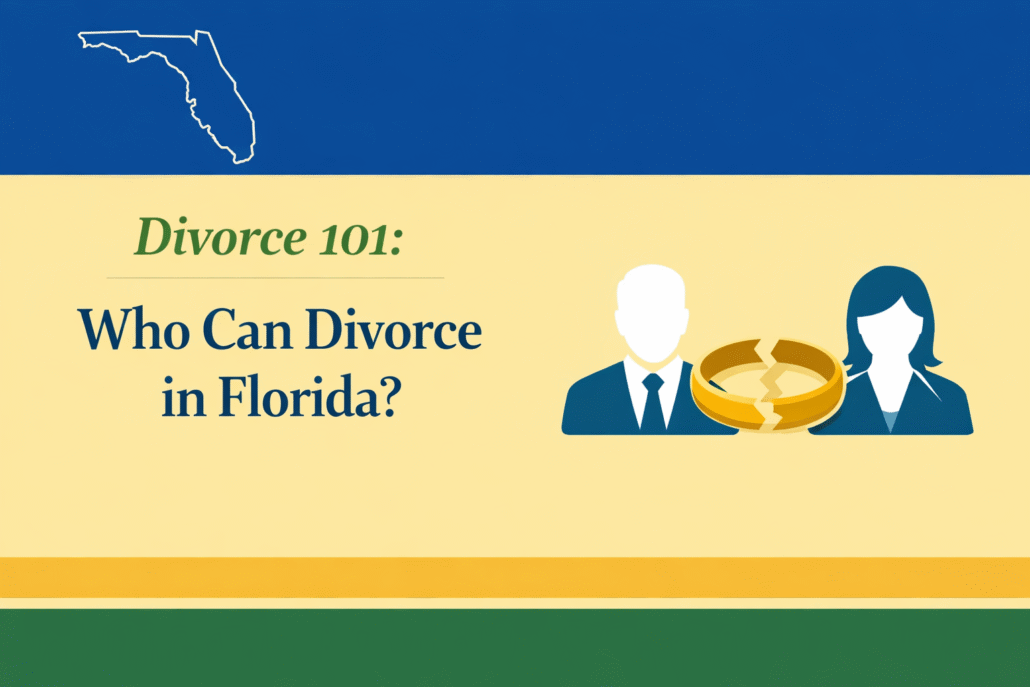
Divorce 101 Video: Who Can Divorce In Florida?
Quick Answer
At least one spouse must have lived in Florida for at least six months before filing for divorce.
Who Can Divorce in Florida?
If you are asking who can divorce in Florida, you are likely thinking about timing, privacy, and how to move forward without unnecessary disruption to your life and career.
As a physician, executive, business owner, military officer, or other professional, you may not want your personal life dragged through a public courtroom. You want clarity. You want control. And you want to make the right move at the right time.
Summary Box / Key Takeaways
- You or your spouse must meet a 6-month Florida residency requirement
- It does not matter where you were married or where your spouse lives
- Temporary absences, including military or work travel, may still qualify
- You can begin negotiating your divorce before the 6-month mark
- Collaborative Divorce allows for private, efficient resolution once eligible
Video: Who Can Divorce in Florida?
Below is a video and transcript with a full explanation of the residency requirement and how it applies in real life:
“Are you wondering if you can file for divorce in Florida? I’m Adam B. Cordover, a Collaborative Family Law attorney based out of Tampa Bay. In Florida, at least one spouse must live in the state for at least 6 months before filing for divorce.
This residency requirement means that you or your spouse must have physically lived in Florida for the 6 months right before the case is filed with the intent to remain here. It does not matter where you were married. It doesn’t matter where your spouse lives now. What matters is that one of you meets that 6 months requirement.
But there are some important exceptions to understand. If you are temporarily outside of Florida, you may still qualify as a Florida resident. This often comes up with generals, admirals, and other military service members whom we serve. It can also apply if you are away for work, school, or leisure, but still consider Florida your home. In those situations, you may still meet the residency requirement, even if you are not physically here every day.
Another situation we often see is when someone has just moved to Florida. They’re ready to move forward with divorce, but they have not yet reached that six-month mark. In my work with families across Florida, we often begin the process anyway.
We help clients negotiate the terms of their divorce in advance. That can include parenting plans, child support, alimony, and property division. Then, once a spouse reaches the six-month residency requirement, we file with the courts and can usually get things finalized within a few days. This approach can save time and reduce stress. It also gives you more control over the outcome, especially when using collaborative divorce.
If you want to learn more about Florida’s requirements, we’re here for you. We invite you to reach out and schedule a virtual planning meeting by calling us at (813) 443-0615 or visiting our website at familydiplomacy.com. We work with clients in every county in Florida and we have offices available by appointment in Tampa, St. Petersburg, and Sarasota.
When discretion matters, count on us.”
Does It Matter Where I Got Married?
No, it doesn’t matter where you got married. Florida law focuses on residency, not where your marriage took place.
You can file for divorce in Florida if:
- You have lived in Florida for at least six months before filing, or
- Your spouse has lived in Florida for at least six months before filing
This is about intent as much as physical presence. You must show that Florida is your home with the intent to remain here.
In practice, this is often proven through:
- A Florida driver’s license
- Voter registration
- Testimony or an affidavit
For professionals relocating to Tampa, St. Petersburg, or elsewhere in Florida, this timing can be critical. Filing too early can delay your case. Filing at the right time can move everything forward efficiently.
Are There Exceptions for Travel, Military, and Temporary Absences?
Yes, there are exceptions. Many high-income professionals travel frequently. Some split time between states. Others are deployed or assigned out of state.
The good news is that temporary absence does not necessarily break residency.
You may still qualify if:
- You are in the military but maintain Florida as your home base
- You are traveling for work but intend to return to Florida
- You are attending school or temporarily living elsewhere
- You are on an extended vacation or split times between homes but Florida is your primary residence
The key question is simple: do you still consider Florida your permanent home?
If the answer is yes, you may still meet the requirement.
What If You Have Not Lived in Florida for 6 Months Yet?
If you have not lived in Florida for at least 6 months, you still may have options. This is where strategic planning becomes powerful.
If you recently moved to Florida and want to move forward now, you do not have to wait passively.
Instead, you can:
- Begin negotiating the terms of your divorce
- Work through financial disclosures
- Develop a parenting plan if you have children
- Structure support and property division
Then, once the six-month requirement is met, your agreement can be filed and finalized quickly.
This approach is especially valuable for professionals who want to minimize disruption and avoid prolonged uncertainty.
How Collaborative Divorce Gives You More Control
What Is Collaborative Divorce?
Collaborative Divorce is a private, structured process designed to help you reach a resolution without fighting in court.
Here is how it works:
- You and your spouse each have your own separate lawyer who provides independent legal advice
- The attorneys and any neutral professionals work together only to reach an out-of-court agreement
- If either spouse decides to go to court, all Collaborative professionals must withdraw and cannot continue in litigation
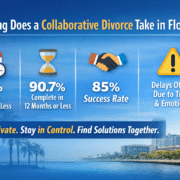
- A recent analysis of Florida Collaborative cases from 2014 to 2024 showed about an 85 percent full resolution rate
- No outcome can ever be guaranteed, but the process is designed to give you the best chance at a thoughtful resolution
For many of my clients in Tampa Bay and across Florida, this process offers something the court system cannot: privacy, control, and a team-based approach.
We often include a neutral financial professional to help both spouses make informed decisions and a facilitator, who is a licensed mental health professional, to help manage communication and keep discussions productive.
That matters because divorce is not just a legal process. It is a human one.
Why Timing and Process Matter More Than You Think
Meeting the six-month residency requirement is just the starting point.
The real question is how you want your divorce to unfold.
You can:
- Wait, file, and let a judge control the pace and outcome after years of litigation
- Or plan ahead, resolve issues privately, and file only when you are ready
For high-net-worth individuals, the difference can be significant. And Collaborative Divorce is a path to control your own destiny.
Privacy can be preserved. Financial decisions can be more thoughtful. And your professional reputation can remain intact.
FAQ: Florida Divorce Residency Requirements
Can I file for divorce in Florida if my spouse lives in another state?
Yes. As long as you meet the six-month residency requirement, Florida courts can handle your divorce.
Does it matter where we were married?
No. Florida only cares about residency, not the location of your marriage.
What proof do I need for residency?
Common proof includes a Florida driver’s license, voter registration, or an affidavit by a disinterested third party confirming your residence.
Can I start the divorce process before six months?
Yes. You can begin negotiations and prepare your agreement, then file once the requirement is met.
How long does it take after filing?
If your agreement is already complete, your divorce may be finalized within days of filing if all other requirements are met.
Take the Next Step
If you are considering divorce in Florida and want to protect your privacy, your finances, and your peace of mind, we are here to help you plan the right approach. We have offices in Tampa, St. Petersburg, and Sarasota, and we accept clients regardless of where you or your spouse reside in Florida.
We invite you to schedule a private virtual planning meeting or contact Family Diplomacy: A Collaborative Law Firm by calling (813) 443-0615 or clicking the button below.
When discretion matters, count on us.