Family Diplomacy | A Collaborative Law Firm
  • Practice Areas
    • Collaborative Divorce
    • Adoption
    • Divorce
    • Legal Name Change
    • LGBTQ+ Family Law
    • Mediation
    • Prenuptial and Postnuptial Agreements
  • Attorney Profile
    • Adam B. Cordover – Attorney Profile
    • Jennifer Gunnin – Executive Paralegal & Client Care Specialist Profile
    • Isamar Abudeye – Welcome Services Liaison Profile
  • Reach Out to Us
  • Locations
    • Tampa Collaborative Family Law Office
    • Saint Petersburg Collaborative Family Law Office
    • Sarasota Collaborative Family Law Office
  • Education Center
    • Blog
    • Free Florida CLE for Lawyers: Learn When to Refer Clients to Collaborative Divorce
    • FAQs
      • Resources
  • Click to open the search input field Click to open the search input field Search
  • Menu Menu
CONTACT US - 813.443.0615
Dall·e 2025 01 12 10.14.26 A Visually Simple And Professional Header Image For A Wordpress Blog About Simplifying Divorce For High Net Worth Individuals. The Design Features A C - Family Diplomacy | A Collaborative Law Firm

Simplifying Divorce for High Net Worth Individuals: Working With Your CPA or Financial Advisor

January 12, 2025/in Speed Up Divorce, Business, Collaborative Divorce, Florida Family Law Rules of Procedure, Marital Assets //Tags: accountant, collaborative divorce, collaborative family law, Collaborative Law, collaborative practice, dissolution of marriage, division of assets, divorce, equitable distribution, financial planner, florida divorce, mandatory disclosure, Tampa Bay Collaborative Divorce, Tampa Bay Collaborative Family Lawby Adam

The Challenge of Divorce for High Net Worth Individuals

Navigating a divorce is never easy, and for high net worth individuals, the process can feel even more overwhelming. Between managing the complexities of Florida Family Law Rule of Procedure 12.285—commonly known as mandatory disclosure—and safeguarding your financial future, it’s natural to want to simplify the experience and delegate much of the work. That’s where a skilled family law attorney can be invaluable. By working closely with your CPA or financial advisor, we can streamline the disclosure process and minimize the demands on your time and energy.

Understanding Mandatory Disclosure

Mandatory disclosure requires each party in a divorce to provide detailed financial documentation. For high net worth individuals, this often includes extensive information about investments, business interests, real estate holdings, and more. The sheer volume of documentation can be daunting, but it doesn’t have to be. If you already have a trusted CPA or financial advisor, they are likely familiar with much of your financial landscape. Our team can work directly with them to gather and organize the required information, so you don’t have to get bogged down in the details.
Read more →

https://familydiplomacy.com/wp-content/uploads/2025/01/DALL·E-2025-01-12-10.14.26-A-visually-simple-and-professional-header-image-for-a-WordPress-blog-about-simplifying-divorce-for-high-net-worth-individuals.-The-design-features-a-c.webp 1024 1792 Adam https://familydiplomacy.com/wp-content/uploads/2016/12/Family-Diplomacy-Logo.jpg Adam2025-01-12 10:23:052025-01-12 10:23:05Simplifying Divorce for High Net Worth Individuals: Working With Your CPA or Financial Advisor

Video: Collaborative Professionals Discuss New Collaborative Law & Rules

July 7, 2017/in Collaborative Divorce, Florida Family Law Rules of Procedure, Florida Statutes //Tags: collaborative divorceby Adam

Facp Vert Outline Mobile - Family Diplomacy | A Collaborative Law FirmIn the video below, from the Florida Academy of Collaborative Professionals, attorneys, mental health professionals, and financial professionals discuss the new collaborative divorce statutes and rules:

Read more →

https://familydiplomacy.com/wp-content/uploads/2016/12/Family-Diplomacy-Logo.jpg 0 0 Adam https://familydiplomacy.com/wp-content/uploads/2016/12/Family-Diplomacy-Logo.jpg Adam2017-07-07 07:51:312017-07-06 20:09:53Video: Collaborative Professionals Discuss New Collaborative Law & Rules
Collaborative Law Rules At Florida Supreme Court

Collaborative Divorce Attorneys Held To A Higher Standard

July 3, 2017/in Collaborative Divorce, Florida Family Law Rules of Procedure //Tags: collaborative divorce, therapeutic jurisprudence, therapeutic justiceby Adam

Collaborative divorce attorneys have traditionally gone through specialized training that teaches them cutting edge methods in peaceful and private dispute resolution.  As part of this training, we have taken to heart the Florida Supreme Court’s call to provide families facing matrimonial disputes with “therapeutic  justice,” which the Court described as follows:

Collaborative Divorce AttorneysTherapeutic justice is a process that attempts to address the family’s interrelated legal and nonlegal problems to produce a result that improves the family’s functioning. The process should empower families through skills development, assist them to resolve their own disputes, provide access to appropriate services, and offer a variety of dispute resolution forums where the family can resolve problems without additional emotional trauma.

In re Report of the Family Law Steering Committee, 794 So. 2d 518, 522 (Fla. 2001).

Just this past weekend, on July 1, 2017, Rule 4-1.19 of the Rules Regulating the Florida Bar went into effect.  The Rule, concerning the Collaborative Law Process in Family Law, holds collaborative divorce attorneys to a higher standard than divorce lawyers who do not offer collaborative services.  But for those of us who have been practicing this form of therapeutic justice, we have already been meeting these standards up until now on a voluntary basis.

Higher Standards for Collaborative Divorce Attorneys

Unlike traditional divorce lawyers, Rule 4-1.19 requires collaborative attorneys to do the following:

  • Explain to clients that they have choices (such as litigation, mediation, and collaborative law) in how to divorce;

Read more →

https://familydiplomacy.com/wp-content/uploads/2017/02/Collaborative-Rules-at-Florida-Supreme-Court.png 637 1134 Adam https://familydiplomacy.com/wp-content/uploads/2016/12/Family-Diplomacy-Logo.jpg Adam2017-07-03 07:45:592017-07-02 18:25:00Collaborative Divorce Attorneys Held To A Higher Standard
Collaborative Law Rules At Florida Supreme Court

Collaborative Law Rules Approved by Florida Supreme Court

May 22, 2017/in Collaborative Divorce, Case Law Update, Florida Family Law Rules of Procedure, Florida Statutes, Legislative Update //Tags: collaborative attorney, collaborative divorce, collaborative family law, Collaborative Law, Collaborative Law Process Act, collaborative practice, collaborative process, collaborative rules, dissolution of marriage, divorce, Family Law News, florida divorce, Florida Statutes, participation agreement, Tampa Bay Collaborative Divorceby Adam

On May 18, 2017, the Florida Supreme Court published an opinion approving collaborative law rules.  The collaborative law rules are the last step necessary before Florida’s Collaborative Law Process Act goes into effect.
Florida Supreme Court Seal 2014 - Family Diplomacy | A Collaborative Law Firm

The opinion approves Rule Regulating the Florida Bar 4-1.19 and Florida Family Law Rule of Procedure 12.745.

Rule Regulating the Florida Bar 4-1.19

Florida Bar Rule 4-1.19 is a rule of professional conduct.  It creates certain obligations of attorneys representing clients within the collaborative process.  Among other things, the rule requires collaborative lawyers to do the following when contemplating collaborative practice with a client:

  • Provide sufficient information about the benefits and risks of the collaborative process;
  • Explain alternatives to the collaborative process, including litigation and mediation;

Read more →

https://familydiplomacy.com/wp-content/uploads/2017/02/Collaborative-Rules-at-Florida-Supreme-Court.png 637 1134 Adam https://familydiplomacy.com/wp-content/uploads/2016/12/Family-Diplomacy-Logo.jpg Adam2017-05-22 07:45:502017-05-22 10:13:43Collaborative Law Rules Approved by Florida Supreme Court
Collaborative Law Rules At Florida Supreme Court

Collaborative Law Rules Oral Arguments at Florida Supreme Court

February 13, 2017/in Collaborative Divorce, Florida Family Law Rules of Procedure, Florida Statutes, Legislative Update //Tags: collaborative divorce, collaborative rulesby Adam

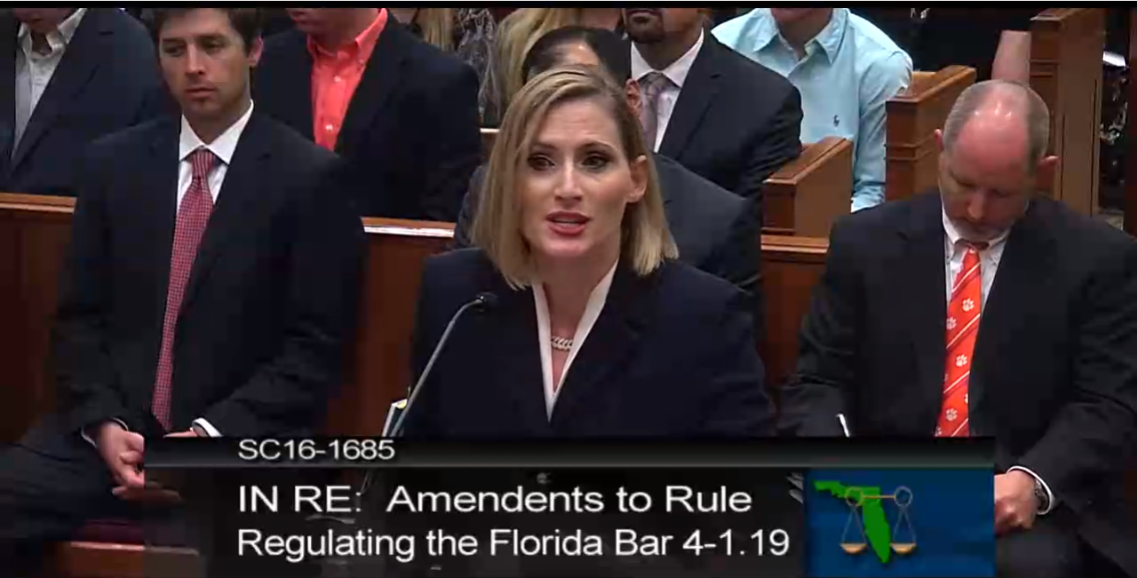
On February 9, 2017, the Honorable Laurel M. Lee, Circuit Court Judge of the 13th Judicial Circuit in Hillsborough County and Chair of the Family Law Rules Committee of the Florida Bar Family Law Section, along with collaborative attorney Robert Merlin, Vice Chair of the Committee and a Board Member of the International Academy of Collaborative Professionals, stood before the Florida Supreme Court (video) to argue in favor of the adoption of collaborative law rules of procedure and professional conduct.

In 2016, Florida Governor Rick Scott signed into law the Collaborative Law Practice Act, but the Act does not go into effect until the Florida Supreme Court approves rules.  The Act creates a framework for collaborative family law, which is a private form of dispute resolution where attorneys focus solely on helping clients reach an out-of-court agreement.

Judge Lee explained to the Supreme Court Justices that the process is voluntary: “It is entirely a voluntary process by the litigants and families that choose to engage in the collaborative law process.  It can be terminated by either of the parties at any time.”

Judge Laurel Lee At Florida Supreme Court Arguing In Favor Of Collaborative Law Rules

Judge Laurel Lee at Florida Supreme Court Arguing In Favor of Collaborative Law Rules

When asked if collaborative practice could help those with modest means, Judge Lee told the Supreme Court justices how she first came to learn about collaborative divorce:

“I first became aware of the collaborative process when a case came to my trial court in which all of the collaborative team – including the attorneys, the mental health professional, and the financial professional – had taken the case pro bono. I know in my circuit there is a group of collaborative professionals who take low cost or reduced fee cases so that parties do have access to this process even if they are not families of great financial means.”

Upon being asked by Justice Ricky Polston what effect collaborative practice has on mediation, Judge Lee replied, “They are not mutually exclusive.  Collaborative is a process that the parties can choose to engage in but does not preclude the use of any other alternative dispute resolution methods.  So [mediation] could certainly remain an option for litigants.”

Read more →

https://familydiplomacy.com/wp-content/uploads/2017/02/Collaborative-Rules-at-Florida-Supreme-Court.png 637 1134 Adam https://familydiplomacy.com/wp-content/uploads/2016/12/Family-Diplomacy-Logo.jpg Adam2017-02-13 07:45:352017-02-13 07:57:36Collaborative Law Rules Oral Arguments at Florida Supreme Court

Proposed Collaborative Divorce Professional Conduct Rule Published in Florida Bar News

September 9, 2016/1 Comment/in Collaborative Divorce, Florida Family Law Rules of Procedure, Florida Statutes, Legislative Update //Tags: Collaborative Law Process Act, Uniform Collaborative Law Actby Adam

In March of 2016, Florida Governor Rick Scott signed into law the Collaborative Law Process Act (“CLPA”).  The CLPA, among other things, protects communications within the collaborative process so that participants can be more open in their discussions and can rest assured that proposals and comments made while trying to reach agreement cannot later be used against them.

However, the CLPA does not go into effect until after the Florida Supreme Court adopts Rules of Professional Conduct and Rules of Procedure.

Florida Supreme Court Seal 2014 - Family Diplomacy | A Collaborative Law Firm

Proposed rules have been approved by the Florida Board of Governors, and they have been published in the August 15, 2016 edition of the Florida Bar News for comment.  Once the comment period is over, the Florida Supreme Court will determine whether it will approve the rules.

You can find the proposed Rule of Professional Conduct (4-1.19) after the jump (the proposed Rule of Procedure is published in a separate post):

Read more →

https://familydiplomacy.com/wp-content/uploads/2016/12/Family-Diplomacy-Logo.jpg 0 0 Adam https://familydiplomacy.com/wp-content/uploads/2016/12/Family-Diplomacy-Logo.jpg Adam2016-09-09 09:25:182016-09-10 06:50:39Proposed Collaborative Divorce Professional Conduct Rule Published in Florida Bar News

Proposed Collaborative Law Procedural Rule Published in Florida Bar News

September 7, 2016/0 Comments/in Collaborative Divorce, Florida Family Law Rules of Procedure, Florida Statutes, Legislative Update //Tags: Collaborative Law Process Act, Uniform Collaborative Law Actby Adam

In March of 2016, Florida Governor Rick Scott signed into law the Collaborative Law Process Act (“CLPA”).  The CLPA, among other things, protects communications within the collaborative process so that participants can be more open in their discussions and can rest assured that proposals and comments made while trying to reach agreement cannot later be used against them.

However, the CLPA does not go into effect until after the Florida Supreme Court adopts Rules of Professional Conduct and Rules of Procedure.

Florida Supreme Court Seal 2014 - Family Diplomacy | A Collaborative Law Firm

Proposed rules have been approved by the Florida Board of Governors, and they have been published in the August 15, 2016 edition of the Florida Bar News for comment.  Once the comment period is over, the Florida Supreme Court will determine whether it will approve the rules.

You can find the proposed Family Law Rule of Procedure (12.475) after the jump (the Rule of Conduct is published in a separate post):

Read more →

https://familydiplomacy.com/wp-content/uploads/2016/12/Family-Diplomacy-Logo.jpg 0 0 Adam https://familydiplomacy.com/wp-content/uploads/2016/12/Family-Diplomacy-Logo.jpg Adam2016-09-07 09:25:552016-09-10 06:49:11Proposed Collaborative Law Procedural Rule Published in Florida Bar News

Florida Family Law: Mandatory Disclosure

August 23, 2014/0 Comments/in Florida Family Law Rules of Procedure, Divorce, Divorce Documents //Tags: alimony, bridge-the-gap alimony, child support, child support hearing officer, collaborative financial professional, dissolution of marriage, divorce, durational alimony, equitable distribution, family law, family law attorney, family law procedure, financial affidavit, Florida alimony, Florida alimony laws, Florida family law pleadings, Florida petition, long term alimony, lump sum alimony, mandatory disclosure, modification of final judgment, obligee, obligor, permanent periodic alimony, petition for dissolution of marriage, post-judgment modification, property division, rehabilitative alimony, separate maintenance, service of process, spousal support, support unconnected with dissolution of marriage, support unconnected with divorce, temporary alimonyby Adam B. Cordover, Attorney-at-Law

When you file and serve a petition in a Florida family law case that involves financial issues such as child support, alimony, or the division of property in debts, a clock starts ticking.  Within 45 days of the initial pleadings being served on the respondent, each party is required to provide the other party with a whole host of financial documents and information.

This is what is known as Mandatory Disclosure, and it is governed by Rule 12.285, Florida Family Law Rules of Procedure.

The following are a list of documents that are required to be exchanged:

(1) A financial affidavit in substantial conformity with Florida Family Law Rules of Procedure Form 12.902(b) if the party’s gross annual income is less than $50,000, or Florida Family Law Rules of Procedure Form 12.902(c) if the party’s gross annual income is equal to or more than $50,000, which requirement cannot be waived by the parties. The financial affidavits must also be filed with the court. A party may request, by using the Standard Family Law Interrogatories, or the court on its own motion may order, a party whose gross annual income is less than $50,000 to complete Florida Family Law Rules of
Procedure Form 12.902(c).

(2) All federal and state income tax returns, gift tax returns, and intangible personal property tax returns filed by the party or on the party’s behalf for the past 3 years.

(3) IRS forms W-2, 1099, and K-1 for the past year, if the income tax return for that year has not been prepared. Read more →

https://familydiplomacy.com/wp-content/uploads/2016/12/Family-Diplomacy-Logo.jpg 0 0 Adam B. Cordover, Attorney-at-Law https://familydiplomacy.com/wp-content/uploads/2016/12/Family-Diplomacy-Logo.jpg Adam B. Cordover, Attorney-at-Law2014-08-23 08:59:522017-07-12 22:11:59Florida Family Law: Mandatory Disclosure

Consequences of Not Paying Florida Child Support

May 27, 2014/0 Comments/in Collaborative Divorce, Florida Family Law Rules of Procedure, Florida Statutes //Tags: child support, collaborative attorney, collaborative divorce, collaborative facilitator, collaborative family law, collaborative financial professional, Collaborative Law, collaborative mental health professional, collaborative practice, contempt, enforcement, Tampa Bay Collaborative Family Lawby Adam B. Cordover, Attorney-at-Law

If a court orders you to pay child support, I have two words for you: Pay It.  Child support is taken so seriously by the Florida and federal government that it is one of the few types of debts that cannot be discharged in bankruptcy proceedings, and it can be enforced against you no matter which state in this country you live in or move to.

The Florida Statutes and Florida Family Law Rules of Procedure provide several consequences of not paying support.

Read more →

https://familydiplomacy.com/wp-content/uploads/2016/12/Family-Diplomacy-Logo.jpg 0 0 Adam B. Cordover, Attorney-at-Law https://familydiplomacy.com/wp-content/uploads/2016/12/Family-Diplomacy-Logo.jpg Adam B. Cordover, Attorney-at-Law2014-05-27 20:00:032016-03-11 15:51:59Consequences of Not Paying Florida Child Support

Florida Divorce, Financial Affidavits, and Privacy

November 5, 2013/0 Comments/in Collaborative Divorce, Divorce, Florida Family Law Rules of Procedure, Private Divorce //Tags: alimony, child support, collaborative attorney, collaborative divorce, collaborative facilitator, collaborative family law, collaborative financial professional, Collaborative Law, collaborative mental health professional, collaborative practice, dissolution of marriage, financial affidavit, Florida alimony, International Academy of Collaborative Professionals, paternity, post-judgment modification, postmarital agreement, postnuptial agreement, premarital agreement, prenuptial agreement, Tampa Bay Collaborative Divorce, Tampa Bay Collaborative Family Lawby Adam B. Cordover, Attorney-at-Law

In almost any Florida family law matter that involves financial issues, such as child support, alimony, division of property and debt, or attorney’s fees, parties are required to exchange and file Florida Family Law Financial Affidavits.  Financial Affidavits outline each party’s source(s) of income, as well as expenses, assets, and liabilities.

And, when they are filed, they become part of the public record, accessible by anyone.

Most people, for any number reasons, do not want their financial profile to become public.  And yet, when people go through the traditional litigated divorce, that’s exactly what happens.

But it does not need to be that way.

Read more →

https://familydiplomacy.com/wp-content/uploads/2016/12/Family-Diplomacy-Logo.jpg 0 0 Adam B. Cordover, Attorney-at-Law https://familydiplomacy.com/wp-content/uploads/2016/12/Family-Diplomacy-Logo.jpg Adam B. Cordover, Attorney-at-Law2013-11-05 21:47:372019-04-03 09:27:28Florida Divorce, Financial Affidavits, and Privacy
Page 1 of 212
Search Search

Categories

  • Divorce
  • Money & Property
  • Collaborative Divorce
  • Kids & Divorce
  • Mediation
  • LGBT Family Law Matters
  • Adoption
  • Case Law Update
  • Family Law News
  • FAQs
  • Florida Family Law Rules of Procedure
  • Florida Statutes
  • Legislative Update
  • Legal Name Change
  • Unbundled Legal Services

Archives

Recent Posts

  • How Do Taxes Affect Retirement Accounts in a Florida Divorce?
  • Birth Certificate Amendments and Corrections: When You May Need a Legal Name Change in Florida
  • What is Equitable Distribution in Florida?
  • What Is Collaborative Divorce? 3 Defining Elements.
  • Sarasota Divorce Law Firm Review: “[The] Team You Want In Your Corner”

Want to Learn More?

When Discretion Matters, Count On Us

Reach Out to Us

Lawyer Adam Cordover | Lawyer Divorce
Lawyer Adam Cordover | Top Attorney Divorce

Our Offices (by appointment)

TAMPA - 3030 North Rocky Point Drive, Suite 150, Tampa, FL 33607

SAINT PETERSBURG - 475 Central Avenue, Suite 205, St. Petersburg, FL 33701

SARASOTA - 1858 Ringling Boulevard, Suite 110, Sarasota, FL 34236

Accepting Clients Throughout the State of Florida

Want to Learn More? When Discretion Matters, Count On Us.

Reach Out to Us

Recent Posts

  • How Do Taxes Affect Retirement Accounts in a Florida Divorce? July 8, 2026
  • Birth Certificate Amendments and Corrections: When You May Need a Legal Name Change in Florida July 1, 2026
  • What is Equitable Distribution in Florida? June 15, 2026
  • What Is Collaborative Divorce? 3 Defining Elements. June 9, 2026
  • Sarasota Divorce Law Firm Review: “[The] Team You Want In Your Corner” June 2, 2026
© 2025 FAMILY DIPLOMACY: A COLLABORATIVE LAW FIRM. ALL RIGHTS RESERVED
  • Link to Facebook
  • Link to X
  • Link to LinkedIn
  • Link to Rss this site
  • Home
  • Practice Areas
  • Attorney Profile
  • Schedule a Consultation or Learn More
  • Locations
  • Blog
  • FAQ
  • Make A Payment
Scroll to top Scroll to top Scroll to top