Tag Archive for: collaborative family law

Does Florida’s Collaborative Divorce Statute Protect Confidentiality?

When you face divorce in Florida, you may worry that your financial information, business details, or parenting struggles could become part of a public court file. If you or your spouse are a doctor, lawyer, executive, business owner, or anyone who values privacy, the idea of those details becoming public can feel overwhelming. You want a process that keeps your information protected and puts you, not a judge, in control.

Collaborative Divorce offers that protection. One of the most common questions clients ask is whether Florida’s Collaborative Law statute truly protects confidentiality.

Quick Answer

Yes. Florida’s Collaborative Divorce Statute (specifically, Fla. Stat. §61.58) protects confidentiality by, with narrow exceptions, keeping Collaborative communications private and preventing them from being used in court. The statute also protects nonparty participants (for example, a Neutral Financial Professional or Neutral Facilitator) so the professional team can help you make informed decisions without fear that exploratory discussions meant for informal discussions will later become evidence in a trial.

Key Takeaways

  • Collaborative communications are confidential and generally cannot be used against you in court.
  • The confidentiality and privilege belongs to the spouses and, in certain instances, nonparty participants.
  • Neutral Financial Professionals and Neutral Facilitators are nonparty participants who receive protections so they can work freely and creatively.
  • Fla. Stat. §61.58 has narrow exceptions, such as threats of harm or information that must be reported under other laws.
  • The process supports open problem-solving and protects privacy, which can be especially helpful for high-asset families.

Read more

Florida’s Save Our Homes Portability Benefit and Divorce: Is it a Marital Asset?

If you are going through a Florida divorce, you may worry about how to protect your home, your long-term tax burdens, and your financial stability. Many high-income professionals focus on dividing the home itself, but Florida’s Save Our Homes Portability Benefit also carries real value. If you have established a homestead in Tampa, St. Petersburg, Sarasota, or elsewhere in Florida, this benefit can reduce your future property taxes, yet it is often overlooked during divorce. When you understand how it works, you can make better decisions and avoid losing tax advantages that could protect your financial future.

Quick Answer: Is Florida’s Save Our Homes Portability Benefit a Marital Asset?

Yes. Florida’s Save Our Homes Portability Benefit is usually treated as a marital asset because it grows during the marriage and can reduce future property taxes for one or both spouses. It has a value that can be taken into consideration when reaching a divorce agreement.

Key Takeaways

What the Save Our Homes Portability Benefit Actually Is

Florida’s Save Our Homes law limits how fast your homestead’s assessed value can rise. Even when the market value increases sharply, the assessed value can only increase by 3% or the Consumer Price Index, whichever is lower. This creates a gap between market value and assessed value, known as the assessment difference. Over time, this difference becomes meaningful because it reduces your property taxes year after year.

Portability allows you to take up to $500,000 of that assessment difference with you when you establish a new Florida homestead. This lower starting assessment can reduce your taxes for many years, especially if you plan to stay in your new home long-term.

Read more

How Lawyers Can Make Divorce Less Traumatic

If you are facing the prospect of divorce, there is a little discussed truth that you should know: The lawyer each of you choose will have a dramatic effect on whether your divorce becomes (i) a traumatic, drawn-out battle for the next several years or (ii) a thoughtful plan developed over several months that sets you and your family up for the next chapter of your lives.

Quick Answer: Yes, Your Choice of Lawyer Has a Major Impact on Your Divorce Experience

Different lawyers follow different philosophies. Traditional divorce lawyers often follow a system built for conflict (even if the lawyer genuinely is trying to help settle disputes), while Collaborative Divorce Attorneys focus on privacy, transparency, respect, and the family’s wellbeing.

Why Traditional Lawyers Often Turn Divorce Into a Battle

It is important to understand this from the start: traditional divorce lawyers are not trying to create trauma. They are not acting out of malice. They are doing exactly what they were trained to do. For generations, lawyers have been taught that the first step in a divorce is to draft a petition that asks for every possible form of relief. The logic is simple. In law school and in practice, attorneys learn that if they do not ask for something in the petition, a judge may refuse to award it later at trial.

But here is the problem: Very few families ever actually go to trial. More than 80 to 90 percent or more of Florida divorces end through settlement. And even if a case does go to trial, Florida law makes it clear that petitions can almost always be amended ahead of time. So the fearful approach of “ask for everything now or risk losing it forever” does far more harm than good.

The result is a petition that looks extreme and feels personal. You may see allegations you disagree with, requests for every type of alimony, demands for more than half the marital estate, and even demands that you pay all attorney’s fees. None of this sets a healthy tone.

Read more

Do My Business Bank Accounts Get Divided In A Florida Divorce?

If you own a business and are facing divorce, you may be wondering whether your business bank accounts—the checking, savings, operating, or money market accounts tied to your company—could be considered “marital assets” and divided.

For many professionals, these accounts represent far more than just money. They reflect years of effort, payroll obligations, and the foundation of your financial life. Understanding how Florida law treats business bank accounts can help you protect what you’ve built and choose the right path forward.

Quick Answer: Can Business Bank Accounts Be Divided in a Florida Divorce?

Yes. Business bank accounts can be divided in a Florida divorce depending on when and how the business was created, how the accounts were funded, and whether marital income or marital efforts contributed to their growth. Under Florida’s equitable distribution law, the court can treat those funds as marital property even if the accounts are in only one spouse’s name or owned by the business.

How Florida Law Treats Business Bank Accounts in Divorce

Under Section 61.075, Florida Statutes, courts must divide marital assets and debts fairly, though not necessarily equally. Marital assets generally include property or income acquired during the marriage—regardless of whose name is on the account.

That means if your business was formed or operated during the marriage, the funds in its business bank accounts could be considered marital.

If your business predated the marriage, those accounts might begin as nonmarital. Still, any increase in their balance or new deposits during the marriage can be at least partly marital—especially if marital income was added or your marital efforts contributed to the business’ success and growth.

Read more

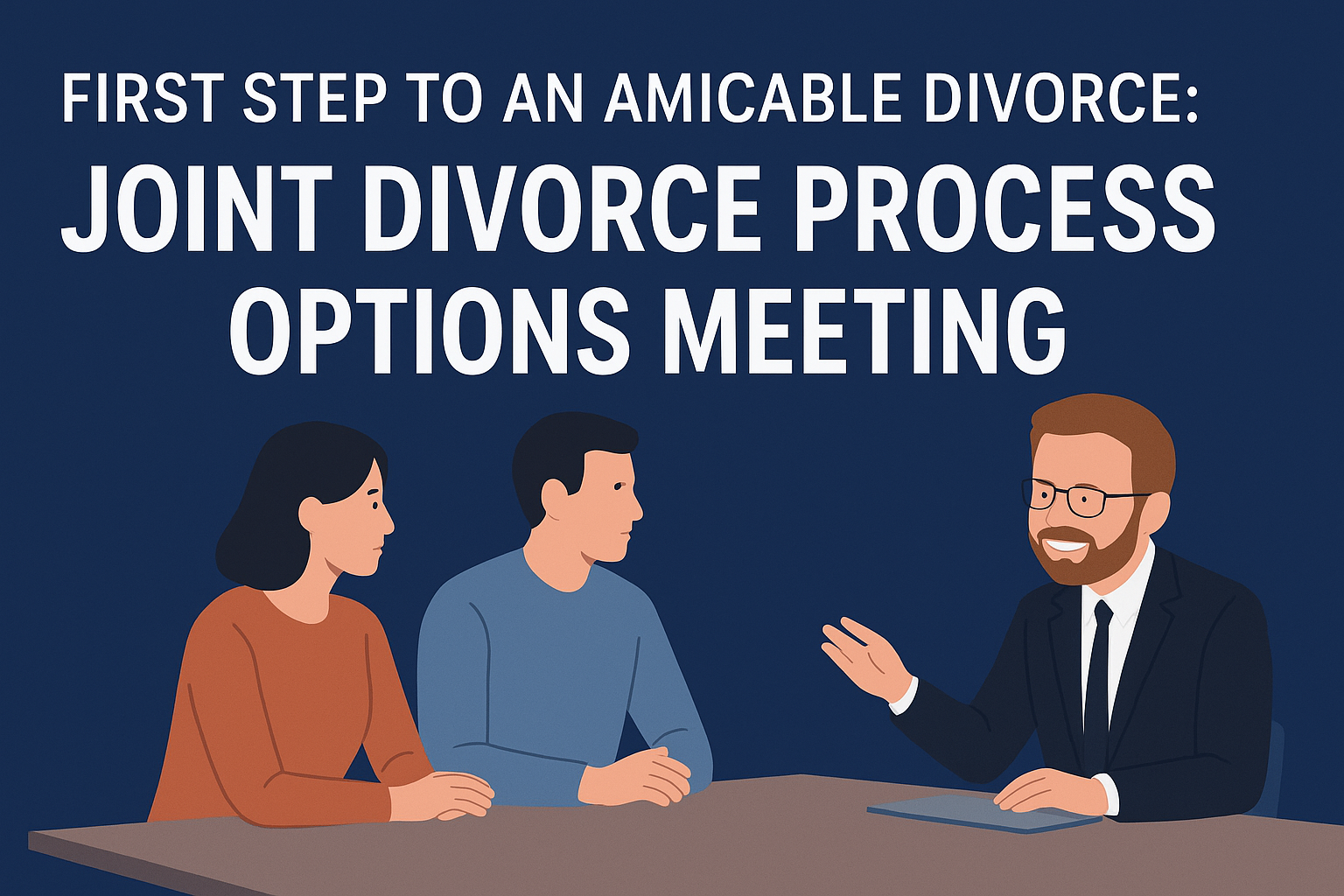
First Step To An Amicable Divorce: Joint Divorce Process Options Meeting

If you and your spouse are considering divorce in Florida, you may be worried about where to begin. Most separating families aren’t looking for a court battle; they just want to move forward, protect their privacy, and make sure they (and their kids, if any), are okay.

That’s exactly why Family Diplomacy offers a Joint Divorce Process Options Meeting, sometimes called a joint divorce consultation or amicable divorce options meeting. It’s a calm, informative way for both spouses to learn about their main divorce options – litigation, mediation, and Collaborative Divorce – before making any major decisions.

How the Joint Divorce Process Options Meeting Works

This meeting is a one-time, educational conversation with both spouses together. We meet on Zoom to discuss the main process options for divorce in Florida. It just costs our normal hourly rate, and you’ll learn what each option looks like, the pros and cons, and what level of privacy, cooperation, and support each allows.  By the end of the meeting, you likely will be able to make a decision about which option your family wishes to pursue.

Before the meeting, we send out a Joint Process Options Meeting waiver for both spouses to sign confirming three important things:

  1. We will not give legal advice or represent either spouse during this meeting; we are only discussing process options.
  2. The discussion is not confidential since both spouses are present and a process option is not yet chosen.
  3. If one spouse chooses to hire Family Diplomacy to represent them, it will only be the spouse who first contacted our office; we cannot represent both spouses.

This clear structure eliminates confusion and maintains fairness. You’ll leave with reliable information, not pressure or legal posturing.

Read more

Professional Athletes and Seasonal Custody Schedules

For professional athletes, your life does not follow a standard calendar. Half the year may be spent training, traveling for games, or living in another city during the season. The other half may finally bring you back home with more flexible time. That rhythm is part of your career, but it also brings unique challenges when it comes to raising children. If you are going through a divorce, paternity matter, or otherwise establishing parenting rights or a time-sharing schedule, you need a process that respects your schedule, your privacy, and your children’s well-being.

Why Florida’s Standard Parenting Plans Often Fail for Professional Athletes

Typical custody schedules assume both parents live in the same area with relatively predictable routines. They rarely account for long stretches where one parent is away for work. For athletes, sticking to a week-on, week-off plan is impossible when games, travel, and training dominate half the year. Further, generic parenting plans don’t take into account what happens if you are traded or when you retire from professional sports.  Without flexibility and anticipation of future changes, you risk missing meaningful parenting time and leaving your children caught in the middle of scheduling conflicts.

Read more

Conscious Uncoupling and Collaborative Divorce: A Different Way to End a Marriage

For many, the word divorce brings to mind courtrooms, conflict, and chaos. But there’s a growing movement—both philosophical and legal—toward a different way. One that emphasizes respect, empathy, and forward-looking resolution. This is where the concept of conscious uncoupling intersects with the legal process of Collaborative Divorce.

What Is Conscious Uncoupling?

Conscious uncoupling is the idea that a relationship can end without destroying the people involved. Popularized in part by public figures like Gwyneth Paltrow and Chris Martin, the term speaks to the real possibility of ending a marriage with mindfulness, emotional intelligence, and compassion.

In a 2024 PEOPLE article, Paltrow reflected on being “proud” of having used the term when they announced their split in 2014. Another article in Business Insider describes how she and Martin discovered the phrase during their separation, and how they used it to frame their transition in a healthier way.

Rather than blaming one another or escalating tension, couples who choose conscious uncoupling acknowledge that the relationship has served its purpose and now deserves a dignified conclusion. They focus on preserving their individual wellbeing and the wellbeing of any children involved. It’s about moving forward, not tearing each other down.

But philosophy alone only goes so far. That’s where Collaborative Divorce comes in.

Read more

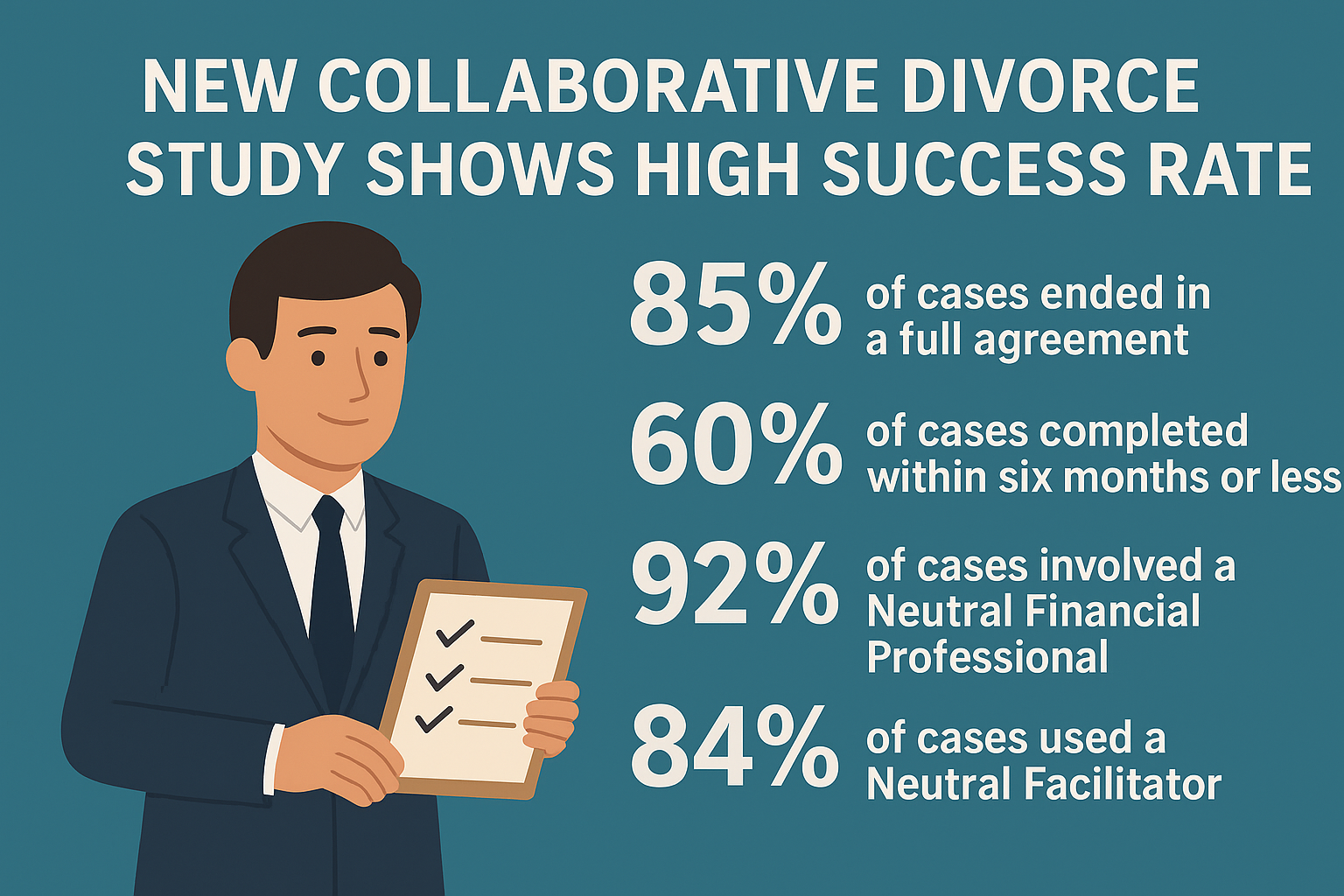
New Collaborative Divorce Study Shows High Success Rate

A newly published study about Statistics on Collaborative Divorce in Florida sheds light on why more families are turning to this private, respectful alternative to traditional courtroom divorce—because it works.

The article, co-authored by Family Diplomacy’s managing attorney Adam B. Cordover and Dr. Randy Heller, a professor at Nova Southeastern University and fellow leader in this field of alternative dispute resolution, was featured in the Florida Bar Family Law Section’s Commentator magazine,  Volume XLV, Issue 1, 2025. We are proud of Adam’s continued leadership in the Collaborative Divorce field, both here in Florida and internationally, and of the insights this study provides for lawmakers, judges, and professionals evaluating the efficacy of this process and families considering their options.

Key Statistics on Collaborative Divorce in Florida from the Study

The numbers, based on responses to a Florida Academy of Collaborative Professionals research survey filled out by Collaborative Professionals from 2014 to 2024 at the end of their cases, tell a powerful story about the effectiveness of Collaborative Divorce in Florida:

  • 85% of cases ended in a full agreement. This mirrors a 2010 study by the International Academy of Collaborative Professionals, which found an 86% resolution rate. In other words, the vast majority of couples who begin the Collaborative Process reach a complete resolution without having to fight in court.

Read more

FAQs – Collaborative Divorce in Florida: What You Need to Know

When you or your spouse is a professional going through a divorce, your priorities are clear. You want to protect your family and privacy, avoid the public spectacle of a courtroom, and ensure that your complex financial life is handled with care. Collaborative Divorce offers an approach designed with those very concerns in mind. Below are answers to some of the most frequently asked questions about Collaborative Divorce that you may be wondering about.

Why is there a Disqualification Clause, and How does it Help You?

One of the things that makes Collaborative Divorce unique is the disqualification clause. In essence, this means that if either spouse decides to go to court or end the process, both Collaborative Attorneys and other team members must withdraw. At first glance, you may wonder why this makes sense. In reality, it’s a protective measure. The clause creates a strong incentive for everyone involved to stay committed to reaching an agreement rather than end up where nobody wants to go: fighting in court. Instead of treating Collaboration as a stepping-stone to litigation, you and your spouse know that the only path forward with your lawyers is to resolve matters respectfully and privately by agreement.

In my experience, this clause is one of the strongest safeguards against escalation. It helps keep conversations solution-focused and mitigates against the likelihood that the case will spin out of control into the courtroom battles you hear about on the news.

Read more

Best Collaborative Divorce Lawyer in Florida – How to Choose

When you are facing divorce, the lawyer and process you choose can make all the difference. If privacy, respect, and control over the process are important to you, then Collaborative Divorce may be the right path. But not every attorney who calls themselves “collaborative” has the same training or experience. So how do you know you are choosing the best Collaborative Divorce lawyer in Florida?

Below are the key questions you should ask any attorney you are considering.

Has the Lawyer taken the 14-Hour Introductory Collaborative Divorce Training?

The International Academy of Collaborative Professionals (“IACP”) has set Minimum Standards for Collaborative Practitioners which include a requirement to take a 14-hour introductory training.  The IACP has further created standards for what must be included in the training.This 14-hour training ensures the lawyer understands not only the legal aspects of divorce, but also how to work effectively with mental health professionals and financial professionals on your team.

Ask your potential lawyer: Did you take the 14-hour Introductory training? Who were your trainers? Have you gone beyond the basics with advanced training?

For example, Adam B. Cordover, Managing Attorney of Family Diplomacy: A Collaborative Law Firm, completed his Introductory Training in 2011 with the Lone Star Trainers, one of the most respected groups in the field. Since 2014, he has himself been teaching the 14-hour course as well as multi-day advanced trainings throughout the United States, Canada, Israel, and France.  Further, Adam has served as a Board Member of the International Academy of Collaborative professionals and as chair of the IACP Ethics & Standards Committee.

Read more