Family Diplomacy | A Collaborative Law Firm
  • Practice Areas
    • Collaborative Divorce
    • Adoption
    • Divorce
    • Legal Name Change
    • LGBTQ+ Family Law
    • Mediation
    • Prenuptial and Postnuptial Agreements
  • Attorney Profile
    • Adam B. Cordover – Attorney Profile
    • Jennifer Gunnin – Executive Paralegal & Client Care Specialist Profile
    • Isamar Abudeye – Welcome Services Liaison Profile
  • Reach Out to Us
  • Locations
    • Tampa Collaborative Family Law Office
    • Saint Petersburg Collaborative Family Law Office
    • Sarasota Collaborative Family Law Office
  • Education Center
    • Blog
    • Florida Divorce 101 Video Library
    • Free Florida CLE for Lawyers: Learn When to Refer Clients to Collaborative Divorce
    • FAQs
      • Resources
  • Click to open the search input field Click to open the search input field Search
  • Menu Menu
CONTACT US - 813.443.0615

Tag Archive for: private divorce process

Collaborative Divorce Timeline In Florida Showing Most Cases Resolve Within 3 To 12 Months

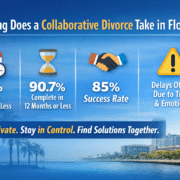
How Long Does Collaborative Divorce Take in Florida?

March 22, 2026/in Collaborative Divorce //Tags: amicable divorce Florida, collaborative divorce, Collaborative Divorce Florida, confidential divorce, divorce for professionals, divorce planning, divorce timeline Florida, divorce without court, family law Florida, Florida Collaborative Law, high net worth divorce, how long divorce takes, private divorce process, St. Petersburg divorce attorney, Tampa Divorce Lawyerby Adam

If you are considering a Collaborative Divorce, one of your first questions is likely about timing. “How long does collaborative divorce take?” You want clarity, but you also want privacy, control, and a process that protects your family and your financial future in a timely manner.

Quick Answer: How Long Does Collaborative Divorce Take?

According to a recent study of nearly 300 Collaborative Family Law matters in Florida, approximately 30% concluded in 3 months or less, 60% in 6 months or less, and 90% in 12 months or less

Read more →

https://familydiplomacy.com/wp-content/uploads/2026/03/How-Long-Does-Collaborative-Divorce-Take-In-Florida.png 1024 1536 Adam https://familydiplomacy.com/wp-content/uploads/2016/12/Family-Diplomacy-Logo.jpg Adam2026-03-22 17:32:562026-05-11 18:05:05How Long Does Collaborative Divorce Take in Florida?
Income Withholdings - Family Diplomacy | A Collaborative Law Firm

Why Cordover Advises Divorce Clients to Avoid Income Withholding Orders

March 3, 2026/in Collaborative Divorce //Tags: alimony Florida, central government depository Florida, child support Florida, collaborative divorce, collaborative family law, divorce for professionals, family law Florida, Florida Department of Revenue child support, florida divorce, florida divorce lawyer, Florida income withholding order, high net worth divorce, income withholding order, out of court divorce, private divorce process, Sarasota divorce attorney, St. Petersburg divorce lawyer, Tampa Bay divorce, Tampa divorce attorneyby Adam

Florida Income Withholding Orders (“IWOs”) are the default method for paying child support and alimony.  However, if you are a doctor, lawyer, executive, business owner, or other professional reaching an agreement through Collaborative Divorce or another method, you may be better off avoiding IWOs.

If you have helped build your family’s wealth in Tampa Bay or anywhere in Florida, you likely value privacy, joint control of outcome with your spouse (rather than a judge), and efficiency. The last thing you want is unnecessary government involvement in your financial life when you and your spouse have already reached a thoughtful agreement.

Let’s talk about why.

Quick Answer

In Florida, Income Withholding Orders are required by default for child support and often used for alimony, but when you reach a voluntary agreement through a private process like Collaborative Divorce, you can usually choose to exchange payments directly and avoid unnecessary employer involvement and bureaucratic complications.

Read more →

https://familydiplomacy.com/wp-content/uploads/2026/03/Income-Withholdings.jpg 720 1280 Adam https://familydiplomacy.com/wp-content/uploads/2016/12/Family-Diplomacy-Logo.jpg Adam2026-03-03 09:07:382026-05-11 18:02:43Why Cordover Advises Divorce Clients to Avoid Income Withholding Orders
Do My Business Bank Accounts Get Divided In A Florida Divorce - Family Diplomacy | A Collaborative Law Firm

Families Don’t Belong In Court

February 2, 2026/in Collaborative Divorce //Tags: adversarial divorce, child-focused divorce, collaborative divorce, confidential divorce, divorce mediation alternatives, divorce without court, family law alternatives, family law litigation, florida divorce, high net worth divorce, private divorce process, Sarasota Collaborative Divorce, St Petersburg Collaborative Divorce, Tampa collaborative divorceby Adam


Families don’t belong in court, especially when privacy, dignity, and the best interests of children matter to you. Yet for decades, lawyers have treated the courtroom as the default place to resolve divorce.

Court is built to impose an outcome after pitting parties against each other. Divorce is about navigating a family transition. Those are not the same thing, and when we confuse them, families often pay the price.

Quick Answer

Families don’t belong in court because the adversarial system escalates conflict, makes private matters public, and allows a judge to impose life-shaping decisions.  It is a terrible forum if you want to protect privacy, preserve dignity, or support children during a family transition.

Read more →

https://familydiplomacy.com/wp-content/uploads/2026/02/Do-My-Business-Bank-Accounts-Get-Divided-In-A-Florida-Divorce.jpg 720 1280 Adam https://familydiplomacy.com/wp-content/uploads/2016/12/Family-Diplomacy-Logo.jpg Adam2026-02-02 13:46:292026-05-11 18:11:43Families Don’t Belong In Court
Divorce Statute 1 - Family Diplomacy | A Collaborative Law Firm

Does Florida’s Collaborative Divorce Statute Protect Confidentiality?

December 8, 2025/in Collaborative Divorce, Business, Florida Statutes, Private Divorce, Public Record, Sell Business //Tags: business valuation divorce, collaborative attorney, collaborative divorce, Collaborative Divorce Florida, collaborative facilitator, collaborative family law, collaborative financial professional, Collaborative Law, collaborative mental health professional, collaborative practice, confidentiality in Collaborative Divorce, dissolution of marriage, divorce, divorce privacy Florida, Fla Stat 61.58, Florida Collaborative Law, florida divorce, Florida Statutes, high asset divorce Florida, private divorce, private divorce Florida, private divorce process, St Petersburg Collaborative Divorce, Tampa Bay Collaborative Divorce, Tampa Bay Collaborative Family Law, Tampa collaborative divorceby Adam

When you face divorce in Florida, you may worry that your financial information, business details, or parenting struggles could become part of a public court file. If you or your spouse are a doctor, lawyer, executive, business owner, or anyone who values privacy, the idea of those details becoming public can feel overwhelming. You want a process that keeps your information protected and puts you, not a judge, in control.

Collaborative Divorce offers that protection. One of the most common questions clients ask is whether Florida’s Collaborative Law statute truly protects confidentiality.

Quick Answer

Yes. Florida’s Collaborative Divorce Statute (specifically, Fla. Stat. §61.58) protects confidentiality by, with narrow exceptions, keeping Collaborative communications private and preventing them from being used in court. The statute also protects nonparty participants (for example, a Neutral Financial Professional or Neutral Facilitator) so the professional team can help you make informed decisions without fear that exploratory discussions meant for informal discussions will later become evidence in a trial.

Key Takeaways

  • Collaborative communications are confidential and generally cannot be used against you in court.
  • The confidentiality and privilege belongs to the spouses and, in certain instances, nonparty participants.
  • Neutral Financial Professionals and Neutral Facilitators are nonparty participants who receive protections so they can work freely and creatively.
  • Fla. Stat. §61.58 has narrow exceptions, such as threats of harm or information that must be reported under other laws.
  • The process supports open problem-solving and protects privacy, which can be especially helpful for high-asset families.

Read more →

https://familydiplomacy.com/wp-content/uploads/2025/12/Divorce-Statute-1.jpg 720 1280 Adam https://familydiplomacy.com/wp-content/uploads/2016/12/Family-Diplomacy-Logo.jpg Adam2025-12-08 14:13:372026-03-17 11:25:05Does Florida’s Collaborative Divorce Statute Protect Confidentiality?
Do My Business Bank Accounts Get Divided In A Florida Divorce 1 1 - Family Diplomacy | A Collaborative Law Firm

How Lawyers Can Make Divorce Less Traumatic

November 24, 2025/in Collaborative Divorce //Tags: Adam B. Cordover, collaborative attorney, collaborative divorce, collaborative facilitator, collaborative family law, collaborative financial professional, Collaborative Law, collaborative mental health professional, collaborative practice, dissolution of marriage, divorce, divorce lawyer St. Petersburg, divorce lawyer Tampa, divorce trauma prevention, Family Diplomacy, Florida Collaborative Attorney, florida divorce, Florida Statutes, high net worth divorce, interest based negotiation, low conflict divorce, private divorce process, Tampa Bay Collaborative Divorce, Tampa Bay Collaborative Family Lawby Adam

If you are facing the prospect of divorce, there is a little discussed truth that you should know: The lawyer each of you choose will have a dramatic effect on whether your divorce becomes (i) a traumatic, drawn-out battle for the next several years or (ii) a thoughtful plan developed over several months that sets you and your family up for the next chapter of your lives.

Quick Answer: Yes, Your Choice of Lawyer Has a Major Impact on Your Divorce Experience

Different lawyers follow different philosophies. Traditional divorce lawyers often follow a system built for conflict (even if the lawyer genuinely is trying to help settle disputes), while Collaborative Divorce Attorneys focus on privacy, transparency, respect, and the family’s wellbeing.

Why Traditional Lawyers Often Turn Divorce Into a Battle

It is important to understand this from the start: traditional divorce lawyers are not trying to create trauma. They are not acting out of malice. They are doing exactly what they were trained to do. For generations, lawyers have been taught that the first step in a divorce is to draft a petition that asks for every possible form of relief. The logic is simple. In law school and in practice, attorneys learn that if they do not ask for something in the petition, a judge may refuse to award it later at trial.

But here is the problem: Very few families ever actually go to trial. More than 80 to 90 percent or more of Florida divorces end through settlement. And even if a case does go to trial, Florida law makes it clear that petitions can almost always be amended ahead of time. So the fearful approach of “ask for everything now or risk losing it forever” does far more harm than good.

The result is a petition that looks extreme and feels personal. You may see allegations you disagree with, requests for every type of alimony, demands for more than half the marital estate, and even demands that you pay all attorney’s fees. None of this sets a healthy tone.

Read more →
https://familydiplomacy.com/wp-content/uploads/2025/11/Do-My-Business-Bank-Accounts-Get-Divided-In-A-Florida-Divorce-1-1.jpg 720 1280 Adam https://familydiplomacy.com/wp-content/uploads/2016/12/Family-Diplomacy-Logo.jpg Adam2025-11-24 11:17:532026-03-17 11:26:40How Lawyers Can Make Divorce Less Traumatic
Search Search

Categories

  • Divorce
  • Money & Property
  • Collaborative Divorce
  • Kids & Divorce
  • Mediation
  • LGBT Family Law Matters
  • Adoption
  • Case Law Update
  • Family Law News
  • FAQs
  • Florida Family Law Rules of Procedure
  • Florida Statutes
  • Legislative Update
  • Legal Name Change
  • Unbundled Legal Services

Archives

Recent Posts

  • How Do I Adopt My Grandchild in Florida?
  • Divorce 101: How Does Alimony Work in a Florida Divorce?
  • Are Florida Divorce Records Public? How Your Divorce Lawyer Could Be Exposing Your Financial Information to Competitors.
  • How Do Taxes Affect Retirement Accounts in a Florida Divorce?
  • Birth Certificate Amendments and Corrections: When You May Need a Legal Name Change in Florida

Want to Learn More?

When Discretion Matters, Count On Us

Reach Out to Us

Lawyer Adam Cordover | Lawyer Divorce
Lawyer Adam Cordover | Top Attorney Divorce

Our Offices (by appointment)

TAMPA - 3030 North Rocky Point Drive, Suite 150, Tampa, FL 33607

SAINT PETERSBURG - 475 Central Avenue, Suite 205, St. Petersburg, FL 33701

SARASOTA - 1858 Ringling Boulevard, Suite 110, Sarasota, FL 34236

Accepting Clients Throughout the State of Florida

Want to Learn More? When Discretion Matters, Count On Us.

Reach Out to Us

Recent Posts

  • How Do I Adopt My Grandchild in Florida? July 21, 2026
  • Divorce 101: How Does Alimony Work in a Florida Divorce? July 15, 2026
  • Are Florida Divorce Records Public? How Your Divorce Lawyer Could Be Exposing Your Financial Information to Competitors. July 14, 2026
  • How Do Taxes Affect Retirement Accounts in a Florida Divorce? July 8, 2026
  • Birth Certificate Amendments and Corrections: When You May Need a Legal Name Change in Florida July 1, 2026
© 2025 FAMILY DIPLOMACY: A COLLABORATIVE LAW FIRM. ALL RIGHTS RESERVED
  • Link to Facebook
  • Link to X
  • Link to LinkedIn
  • Link to Rss this site
  • Home
  • Practice Areas
  • Attorney Profile
  • Schedule a Consultation or Learn More
  • Locations
  • Blog
  • FAQ
  • Make A Payment
Scroll to top Scroll to top Scroll to top