Tag Archive for: Florida Collaborative Law

Do My Business Bank Accounts Get Divided In A Florida Divorce - Family Diplomacy | A Collaborative Law Firm

What Is Collaborative Divorce? 3 Defining Elements.

Collaborative Divorce in Florida: The 3 Defining Elements That Make It Different

Collaborative Divorce in Florida is not just any peaceful divorce, private negotiation, or settlement-minded process. It has three defining elements:

  1. Each spouse has a separate Collaborative attorney;
  2. The spouses sign a written Participation Agreement; and
  3. The Participation Agreement includes a disqualification clause that keeps the lawyers and other professionals out of contested court litigation.

If you are a physician, lawyer, executive, business owner, public figure, or professional with complex finances, those details matter. You may want privacy. You may want control. You may want your divorce handled thoughtfully, without a judge making the most personal decisions of your life.

Collaborative Divorce gives you a structured way to do that.

Quick Answer: What Are the 3 Defining Elements of Collaborative Divorce in Florida?

The three defining elements of Collaborative Divorce are (i) separate Collaborative attorneys for each spouse, (ii) a written participation agreement, and (iii) a disqualification clause that prevents the Collaborative lawyers and other professionals from engaging in contested litigation.
Read more

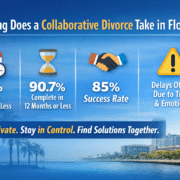
Collaborative Divorce Timeline In Florida Showing Most Cases Resolve Within 3 To 12 Months

How Long Does Collaborative Divorce Take in Florida?

If you are considering a Collaborative Divorce, one of your first questions is likely about timing. “How long does collaborative divorce take?” You want clarity, but you also want privacy, control, and a process that protects your family and your financial future in a timely manner.

Quick Answer: How Long Does Collaborative Divorce Take?

According to a recent study of nearly 300 Collaborative Family Law matters in Florida, approximately 30% concluded in 3 months or less, 60% in 6 months or less, and 90% in 12 months or less

Read more

Divorce Statute 1 - Family Diplomacy | A Collaborative Law Firm

Does Florida’s Collaborative Divorce Statute Protect Confidentiality?

When you face divorce in Florida, you may worry that your financial information, business details, or parenting struggles could become part of a public court file. If you or your spouse are a doctor, lawyer, executive, business owner, or anyone who values privacy, the idea of those details becoming public can feel overwhelming. You want a process that keeps your information protected and puts you, not a judge, in control.

Collaborative Divorce offers that protection. One of the most common questions clients ask is whether Florida’s Collaborative Law statute truly protects confidentiality.

Quick Answer

Yes. Florida’s Collaborative Divorce Statute (specifically, Fla. Stat. §61.58) protects confidentiality by, with narrow exceptions, keeping Collaborative communications private and preventing them from being used in court. The statute also protects nonparty participants (for example, a Neutral Financial Professional or Neutral Facilitator) so the professional team can help you make informed decisions without fear that exploratory discussions meant for informal discussions will later become evidence in a trial.

Key Takeaways

  • Collaborative communications are confidential and generally cannot be used against you in court.
  • The confidentiality and privilege belongs to the spouses and, in certain instances, nonparty participants.
  • Neutral Financial Professionals and Neutral Facilitators are nonparty participants who receive protections so they can work freely and creatively.
  • Fla. Stat. §61.58 has narrow exceptions, such as threats of harm or information that must be reported under other laws.
  • The process supports open problem-solving and protects privacy, which can be especially helpful for high-asset families.

Read more