
Tag Archive for: high net worth divorce

Do My Business Bank Accounts Get Divided In A Florida Divorce - Family Diplomacy | A Collaborative Law Firm

What Is Collaborative Divorce? 3 Defining Elements.

Collaborative Divorce in Florida: The 3 Defining Elements That Make It Different

Collaborative Divorce in Florida is not just any peaceful divorce, private negotiation, or settlement-minded process. It has three defining elements:

  1. Each spouse has a separate Collaborative attorney;
  2. The spouses sign a written Participation Agreement; and
  3. The Participation Agreement includes a disqualification clause that keeps the lawyers and other professionals out of contested court litigation.

If you are a physician, lawyer, executive, business owner, public figure, or professional with complex finances, those details matter. You may want privacy. You may want control. You may want your divorce handled thoughtfully, without a judge making the most personal decisions of your life.

Collaborative Divorce gives you a structured way to do that.

Quick Answer: What Are the 3 Defining Elements of Collaborative Divorce in Florida?

The three defining elements of Collaborative Divorce are (i) separate Collaborative attorneys for each spouse, (ii) a written participation agreement, and (iii) a disqualification clause that prevents the Collaborative lawyers and other professionals from engaging in contested litigation.

Read more

Identity Theft 4 - Family Diplomacy | A Collaborative Law Firm

Florida Divorce: Preventing Identity Theft Through Collaborative Divorce

Florida divorce proceedings can unintentionally expose sensitive financial and personal information to the public, increasing identity theft and privacy risks for professionals, executives, business owners, physicians, lawyers, and other high-net-worth individuals. Collaborative Divorce can help you keep more of your financial and family information private by reducing unnecessary public court filings and avoiding public courtroom litigation whenever possible.

If you are going through divorce in Florida, one of the most important questions you should ask is not just how your divorce will end, but how public the process will become along the way.

Many people are surprised to learn that even amicable divorces resolved through mediation or direct negotiation often still result in sensitive documents being placed in the public court file.

That may include:

  • Financial Affidavits
  • Parenting Plans
  • Marital Settlement Agreements
  • Responses to Requests for Production of Documents

For many families in Tampa Bay and statewide throughout Florida, this level of exposure feels unnecessary and risky.

Quick Answer

Collaborative Divorce can help reduce potential exposure to identity theft and privacy risks by allowing many sensitive financial and parenting documents to remain outside the public court file whenever possible. Unlike traditional divorce litigation and many standard mediated divorces, Collaborative Divorce can be intentionally structured around privacy, discretion, and confidential problem-solving.

Definition: Private Divorce in Florida

A private divorce process in Florida generally refers to resolving divorce issues outside of public courtroom litigation and keeping your private information out of the public court file whenever possible. Collaborative Divorce is the preeminant example because it emphasizes confidential negotiations, private financial disclosure, and reduced public filings.  A judge is still required to grant the divorce and your final judgment of divorce is of public record, but the amount of personal and sensitive information is stripped down to bare bones.

Read more

Collaborative Divorce In Florida Infographic Showing Private Divorce Process, Separate Lawyers, And Solutions-Focused Out-Of-Court Resolution

What Is Collaborative Divorce?

If you are exploring Collaborative Divorce in Florida, you are likely looking for a way to protect your privacy, preserve your wealth, and avoid a judge controlling your future.  The video and transcript below explains how it works and why many professionals in Tampa Bay and throughout Florida choose this approach.

Quick Answer

Collaborative Divorce is a private, out-of-court process where you and your spouse work with your own lawyers and a professional team to reach a resolution without fighting in court.

Key Takeaways

  • Collaborative Divorce keeps your personal and financial details out of the public record
  • You and your spouse remain in control of the outcome, not a judge
  • Each spouse has their own lawyer for independent legal advice
  • The process uses a team approach, including a Facilitator and Financial Professional
  • If the process breaks down, the Collaborative attorneys must withdraw
  • About 85% of Florida Collaborative cases in a 2014–2024 analysis reached full resolution
  • It is especially well-suited for professionals who value privacy, efficiency, and control

Read more

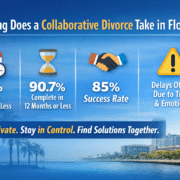
Collaborative Divorce Timeline In Florida Showing Most Cases Resolve Within 3 To 12 Months

How Long Does Collaborative Divorce Take in Florida?

If you are considering a Collaborative Divorce, one of your first questions is likely about timing. “How long does collaborative divorce take?” You want clarity, but you also want privacy, control, and a process that protects your family and your financial future in a timely manner.

Quick Answer: How Long Does Collaborative Divorce Take?

According to a recent study of nearly 300 Collaborative Family Law matters in Florida, approximately 30% concluded in 3 months or less, 60% in 6 months or less, and 90% in 12 months or less

Read more

Income Withholdings - Family Diplomacy | A Collaborative Law Firm

Why Cordover Advises Divorce Clients to Avoid Income Withholding Orders

Florida Income Withholding Orders (“IWOs”) are the default method for paying child support and alimony.  However, if you are a doctor, lawyer, executive, business owner, or other professional reaching an agreement through Collaborative Divorce or another method, you may be better off avoiding IWOs.

If you have helped build your family’s wealth in Tampa Bay or anywhere in Florida, you likely value privacy, joint control of outcome with your spouse (rather than a judge), and efficiency. The last thing you want is unnecessary government involvement in your financial life when you and your spouse have already reached a thoughtful agreement.

Let’s talk about why.

Quick Answer

In Florida, Income Withholding Orders are required by default for child support and often used for alimony, but when you reach a voluntary agreement through a private process like Collaborative Divorce, you can usually choose to exchange payments directly and avoid unnecessary employer involvement and bureaucratic complications.

Read more

Do My Business Bank Accounts Get Divided In A Florida Divorce - Family Diplomacy | A Collaborative Law Firm

Families Don’t Belong In Court


Families don’t belong in court, especially when privacy, dignity, and the best interests of children matter to you. Yet for decades, lawyers have treated the courtroom as the default place to resolve divorce.

Court is built to impose an outcome after pitting parties against each other. Divorce is about navigating a family transition. Those are not the same thing, and when we confuse them, families often pay the price.

Quick Answer

Families don’t belong in court because the adversarial system escalates conflict, makes private matters public, and allows a judge to impose life-shaping decisions.  It is a terrible forum if you want to protect privacy, preserve dignity, or support children during a family transition.

Read more

Material Info - Family Diplomacy | A Collaborative Law Firm

Collaborative Divorce: What is “Material Information?”

“Material information” sits at the heart of Collaborative Divorce because the entire process depends on both spouses having the facts they reasonably need to make informed decisions without a judge controlling the outcome. If you value privacy, dignity, and shared control with your spouse of outcome (rather than leaving your life in the hands of a judge), understanding what material information is and why it is important will help you decide whether Collaborative Divorce is right for you.

This issue matters most for professionals, executives, business owners, and others with complex finances or sensitive personal concerns and facing divorce. You want clarity about what must be shared, what can stay private, and how your lawyer protects you while honoring the ethical rules of the Collaborative Process.

Quick Answer: What Is Material Information in Collaborative Divorce?

Material information is information reasonably required for you and your spouse to make informed decisions about resolving your divorce.  In Collaborative Divorce, both spouses commit to sharing that information with each other and the professional team.

Read more

Do My Business Bank Accounts Get Divided In A Florida Divorce 1 1 - Family Diplomacy | A Collaborative Law Firm

How Lawyers Can Make Divorce Less Traumatic

If you are facing the prospect of divorce, there is a little discussed truth that you should know: The lawyer each of you choose will have a dramatic effect on whether your divorce becomes (i) a traumatic, drawn-out battle for the next several years or (ii) a thoughtful plan developed over several months that sets you and your family up for the next chapter of your lives.

Quick Answer: Yes, Your Choice of Lawyer Has a Major Impact on Your Divorce Experience

Different lawyers follow different philosophies. Traditional divorce lawyers often follow a system built for conflict (even if the lawyer genuinely is trying to help settle disputes), while Collaborative Divorce Attorneys focus on privacy, transparency, respect, and the family’s wellbeing.

Why Traditional Lawyers Often Turn Divorce Into a Battle

It is important to understand this from the start: traditional divorce lawyers are not trying to create trauma. They are not acting out of malice. They are doing exactly what they were trained to do. For generations, lawyers have been taught that the first step in a divorce is to draft a petition that asks for every possible form of relief. The logic is simple. In law school and in practice, attorneys learn that if they do not ask for something in the petition, a judge may refuse to award it later at trial.

But here is the problem: Very few families ever actually go to trial. More than 80 to 90 percent or more of Florida divorces end through settlement. And even if a case does go to trial, Florida law makes it clear that petitions can almost always be amended ahead of time. So the fearful approach of “ask for everything now or risk losing it forever” does far more harm than good.

The result is a petition that looks extreme and feels personal. You may see allegations you disagree with, requests for every type of alimony, demands for more than half the marital estate, and even demands that you pay all attorney’s fees. None of this sets a healthy tone.

Read more

High Net Worth Divorce in Tampa Bay

As a professional, executive, politician, sports figure, or otherwise high profile individual in Tampa Bay, you have a bigger incentive than most to keep your high net worth divorce amicable and private.  You do not need your dirty laundry aired in the media, and you want to minimize the amount of financial information in the public court file.  Further, you want to protect your kids from a potential circus environment.

Collaborative Divorce For High Net Worth Divorce In Tampa Bay

High Net Worth Divorce in Tampa Bay

For you, there is collaborative divorce.

Read more