General information on dissolution of marriage

How Doctors Divorce in Florida


How Doctors Divorce in Florida: A Smarter, Private, Team-Based Approach

Divorce is challenging. But for physicians and their spouses, it can come with extra layers—like valuing a medical practice, protecting reputation and sensitive financial data, and balancing a demanding career with family obligations. If you or your spouse is a doctor in Florida, Collaborative Divorce offers a way to handle your separation with professionalism, privacy, and support.

At Family Diplomacy: A Collaborative Law Firm, we’ve worked with doctors and high-net-worth families across the state. We understand the unique financial and emotional dynamics at play—and how to guide you through them with dignity.

A Private Divorce Process That Respects Your Profession

Collaborative Divorce discussions and decisions take place outside of court. Instead of leaving decisions up to a judge, you and your spouse work with a team of professionals to reach solutions together. This is especially helpful when one or both of you are physicians with complicated schedules, licenses, or business interests at stake.

Just like you may work with other healthcare professionals in a hospital or practice setting—surgeons, anesthesiologists, nurses, administrators—a Collaborative Divorce uses an interdisciplinary team. Your team likely will include two lawyers (one for each of you), a neutral facilitator (who is a licensed mental health professional to deal with challenging conversations head on and craft a tailored parenting plan), and a neutral financial professional (to efficiently gather mandatory disclosure and help develop bespoke financial options). Each team member brings their own area of expertise to help the family function better and get through the divorce.
Read more

What’s In A Collaborative Participation Agreement?

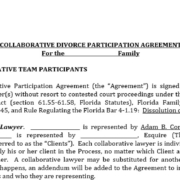
If you and your spouse agree to use the Collaborative Divorce process in Florida, one of the first steps you’ll take is signing a Collaborative Participation Agreement. This agreement sets the tone for a respectful, private, and team-supported process to resolve your divorce without fighting in court. It’s a powerful document that helps you and your spouse stay focused on resolution instead of conflict.  And, because the rules of Collaborative Divorce are so different than the old-style adversarial divorce options, it is important that you understand what you and your spouse are signing yourselves up for.

Below is a summary of what our law firm’s most commonly used Collaborative Participation Agreement includes—and why it matters to you.  You will also find the text of our current Collaborative Participation Agreement below (please note that your Collaborative Participation Agreement may vary from the one below).

Who’s on Your Team?

In a Collaborative Divorce, each spouse has their own separate lawyer so that each of you can speak freely and get independent legal advice. These lawyers don’t act as adversaries—instead, they work together to help both of you reach a solution. In your case, one of the attorneys may be Adam B. Cordover, a leader in Florida’s Collaborative Law movement and co-author of the American Bar Association’s book Building a Successful Collaborative Family Law Practice. Adam has trained professionals across the U.S. and abroad and brings deep knowledge of complex financial matters.

This is the most common model of Collaborative Divorce used in Florida.

You’ll also likely have:

  • A Neutral Facilitator – A licensed mental health professional who is a communication specialist, team leader to keep discussions progressing (rather than focused on the fights of the past), and expert of childhood development to help craft a parenting plan tailored to your kids’ needs (if there are children).
  • A Neutral Financial Professional – A financial expert who helps efficiently gather required documents (known as “mandatory disclosure”), educate both spouses so that each understands what is in the marital bucket before expected to make long-lasting decisions, and build realistic support and property division options that work for your family.
  • Collaborative Assistant – A volunteer notetaker.  The Collaborative Assistant agrees to the same confidentiality rules as the other professionals.  He or she takes notes during meetings so that your professionals can focus in real time on tending to your family’s needs.

Other specialists, like child or business valuation experts, can be brought in if needed.

Read more

Collaborative Divorce: Who is Right for It & What Is It?

When people think of divorce, they often picture contentious court battles, high stress, and significant financial strain. But what if there was a better way? Adam B. Cordover, a leader in private dispute resolution, believes there is—and it’s called Collaborative Divorce.

What Is Collaborative Divorce?

Collaborative Divorce is an alternative dispute resolution process designed to help separating couples reach an agreement without a public and contentious court battle. As Cordover explains, “Each spouse has their own separate attorneys, and the attorneys are there solely for the purpose of reaching an out-of-court agreement.” This means that no energy, time, or money is spent fighting in court. Instead, the focus is on cooperation and crafting a resolution that meets the needs of both spouses.
Read more

Are Real Estate Syndications Considered Marital Property in a Florida Divorce?

Real estate syndications have become a popular investment strategy for high-net-worth individuals and savvy investors seeking passive income and portfolio diversification. However, if you are facing a divorce in Florida, you may be wondering: Is my investment in a real estate syndication considered marital property? And if so, how is it valued and divided?

The answer depends on several factors, including when the investment was made, how it was funded, and whether any legal agreements protect it. In this post, we’ll explore how Florida law treats real estate syndications in divorce and what you need to know about valuation and division.


Are Real Estate Syndications Marital Property in Florida?

In Florida, marital property includes assets acquired by either spouse during the marriage, regardless of whose name is on the title or investment documents. Conversely, nonmarital (or separate) property includes assets acquired before the marriage, through inheritance, or via a gift from a third party.

Read more

Simplifying Divorce for High Net Worth Individuals: Working With Your CPA or Financial Advisor

The Challenge of Divorce for High Net Worth Individuals

Navigating a divorce is never easy, and for high net worth individuals, the process can feel even more overwhelming. Between managing the complexities of Florida Family Law Rule of Procedure 12.285—commonly known as mandatory disclosure—and safeguarding your financial future, it’s natural to want to simplify the experience and delegate much of the work. That’s where a skilled family law attorney can be invaluable. By working closely with your CPA or financial advisor, we can streamline the disclosure process and minimize the demands on your time and energy.

Understanding Mandatory Disclosure

Mandatory disclosure requires each party in a divorce to provide detailed financial documentation. For high net worth individuals, this often includes extensive information about investments, business interests, real estate holdings, and more. The sheer volume of documentation can be daunting, but it doesn’t have to be. If you already have a trusted CPA or financial advisor, they are likely familiar with much of your financial landscape. Our team can work directly with them to gather and organize the required information, so you don’t have to get bogged down in the details.

Read more

8 Tips For Co-Parenting After a Hurricane

Co-parenting during a divorce is challenging under normal circumstances, and dealing with the aftermath of a devastating hurricane adds another layer of difficulty. Here are some practical tips to navigate this situation effectively.  As a preview, many of these tips can be best accomplished within a Collaborative Divorce.

1. Prioritize the Children’s Well-Being

Keep routines as consistent as possible, such as school, meals, and bedtime, to provide stability.  Be honest with your children in an age-appropriate way about what’s happening but reassure them they are safe and loved.  Avoid speaking negatively about the other parent in front of the children.

2. Communicate Effectively

Use clear, respectful, and focused communication to coordinate on parenting issues.  Consider using co-parenting apps like OurFamilyWizard or TalkingParents to document agreements and streamline communication if direct interaction is too challenging.

3. Develop a Flexible Parenting Plan

A hurricane might have disrupted your previous arrangements, so work together to create a temporary plan that accounts for housing, transportation, and other logistical challenges.  Be prepared to adjust custody schedules based on access to safe housing and resources.

Read more

Divorcing Wealthy in Florida

What is the best way to end up wealthy after divorce?  It is by being even wealthier before divorce.  The truth is that divorce is not cheap.  But there are things that you can do to help preserve your wealth even if your marriage is ending.

Retain a Neutral Financial Professional

One of the biggest challenges when going through divorce is that one spouse typically knows more about the family finances than the other spouse.  If you are the spouse with the knowledge, this can be frustrating because you feel you are making reasonable proposals that would benefit your spouse, and yet your spouse is outright rejecting them or refuses to make a decision, costing your family even more time and money.  If you are the spouse without knowledge of the family finances, you feel like your spouse is trying to control you by badgering you to agree to their proposal, but how can you even make a decision that could have disastrous consequences for your long term financial future?

This is where a Neutral Financial Professional comes in.

Read more

Defining “Collaborative Mediation”

If you do a Google search for “Collaborative Mediation,” you will get all sorts of results, many of which have nothing to do with one another.  Many articles simply point out the differences between Collaborative Divorce and Mediation (one of my blog posts would be included with this group).

Other articles will use the term to be a synonym with Collaborative Divorce, referring to neutral professionals (typically a financial professional and licensed mental health professional) as mediators, even if those professionals have not been trained as mediators.  This seems misleading to me.   Still, other articles use the term to mean a friendly mediation or an interdisciplinary co-mediation where lawyers are optional.  I have concerns about those articles because, despite using the term “collaborative,” what they describe is not a Collaborative Law Process as defined by the Florida Statutes or Uniform Collaborative Law Act/Rules.  Again, this is misleading.

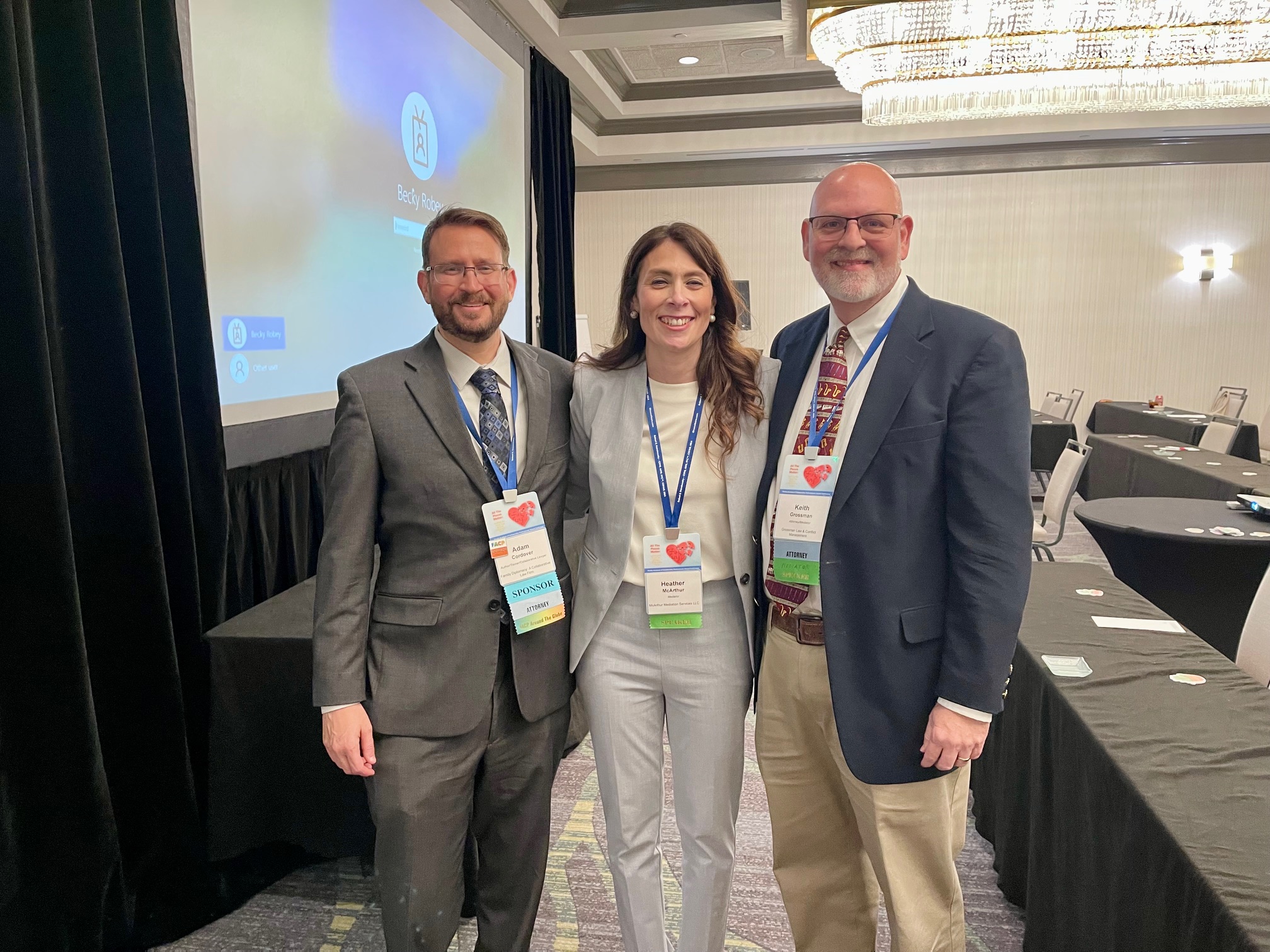
I recently was at the 12th Annual Conference of the Florida Academy of Collaborative Professionals (“FACP”) where I presented on the topic of “Collaborative Mediation: Engaging Mediators in the Collaborative Process.”  My co-presenters were Heather McArthur, co-founder and president of Collaborative Professionals of Central Florida and Florida Supreme Court Certified Family Law Mediator, and Keith Grossman, a Florida Supreme Court Approved Primary Family Mediation Trainer and president of the Southwest Florida Collaborative Professionals Association.

As I have not found a good definition anywhere else, one of my goals in co-presenting on this topic (and writing this article) was to define the term “Collaborative Mediation.”  Additionally, I hoped to shed light on this distinct model of Collaborative Practice, find a way to better engage mediators in the Collaborative Process, and offer an option under certain circumstances that could bring more clients and lawyers into the Collaborative Method.

Read more

Child Support in Florida

Child support in Florida is the financial obligation aimed to provide a fair and consistent means of sharing the costs of raising a child between separated parents. There’s a Collaborative Law process that offers an alternative way to address child support matters. This approach emphasizes cooperation, open communication, and prioritizing your child’s well-being. In this post, we’ll take you through the fundamentals of child support in Florida and the benefits of pursuing child support solutions through the Collaborative Process.

CALCULATING CHILD SUPPORT

In Florida, you’ll find child support guidelines laid out in Florida Statutes §61.30. You’ll notice that the calculation takes into account key factors like your income and your partner’s income, the number of children involved, and the time each of you spends with them. It’s essential to understand that the state utilizes a specific formula incorporating these elements to calculate the exact amount of child support owed.  Though you may deviate from these calculations under certain circumstances, the child support guidelines determine the default amount you can expect to pay or be paid.

CONSIDERING YOUR INCOMES

Remember, both your incomes play a pivotal role in calculating child support. It’s worth noting that not all types of income are straightforward (for example, income from a private business). Additionally, it’s important to keep in mind that if either of you is voluntarily unemployed or not fully utilizing your earning capacity, income may be attributed to you based on your potential earning capacity.

Read more

Can I Get A Discount For Virtual Divorce Legal Services?

If you are facing divorce and have done your research, you probably realize how expensive divorce can be.  Not only are you charged for your attorney’s time spent engaging in the actual legal work, but it is also common practice for you to be charged for travel time to go to hearings, mediation sessions, or Collaborative Divorce meetings at the lawyer’s regular hourly rate.  Further, firms that practice mainly in person incur additional expenses including leasing larger office space, renting additional equipment, and purchasing additional office snacks, drinks, and supplies.  And, of course, those expenses get passed on to you, the client.

But what if you were comfortable working with your lawyer through Zoom, telephone calls, e-mails, and other virtual means, and you did not feel the need to meet in person?  Since it ends up costing less for the law firm, shouldn’t you get a discount for virtual divorce legal services?

Read more