What Is Collaborative Divorce? 3 Defining Elements.
Collaborative Divorce in Florida: The 3 Defining Elements That Make It Different
Collaborative Divorce in Florida is not just any peaceful divorce, private negotiation, or settlement-minded process. It has three defining elements:
- Each spouse has a separate Collaborative attorney;
- The spouses sign a written Participation Agreement; and
- The Participation Agreement includes a disqualification clause that keeps the lawyers and other professionals out of contested court litigation.
If you are a physician, lawyer, executive, business owner, public figure, or professional with complex finances, those details matter. You may want privacy. You may want control. You may want your divorce handled thoughtfully, without a judge making the most personal decisions of your life.
Collaborative Divorce gives you a structured way to do that.
Quick Answer: What Are the 3 Defining Elements of Collaborative Divorce in Florida?
The three defining elements of Collaborative Divorce are (i) separate Collaborative attorneys for each spouse, (ii) a written participation agreement, and (iii) a disqualification clause that prevents the Collaborative lawyers and other professionals from engaging in contested litigation.
Key Takeaways
- Each spouse must have their own separate Collaborative attorney.
- A written participation agreement is required. A verbal agreement is not enough.
- The agreement must include a disqualification clause.
- If the Collaborative Process ends or someone starts contested litigation, the Collaborative lawyers and other Collaborative professionals must withdraw.
- After an agreement is reached, the lawyers can still file the uncontested court paperwork needed to finalize the divorce.
- The lawyers can also help later with out-of-court discussions if future disputes arise after resolution.
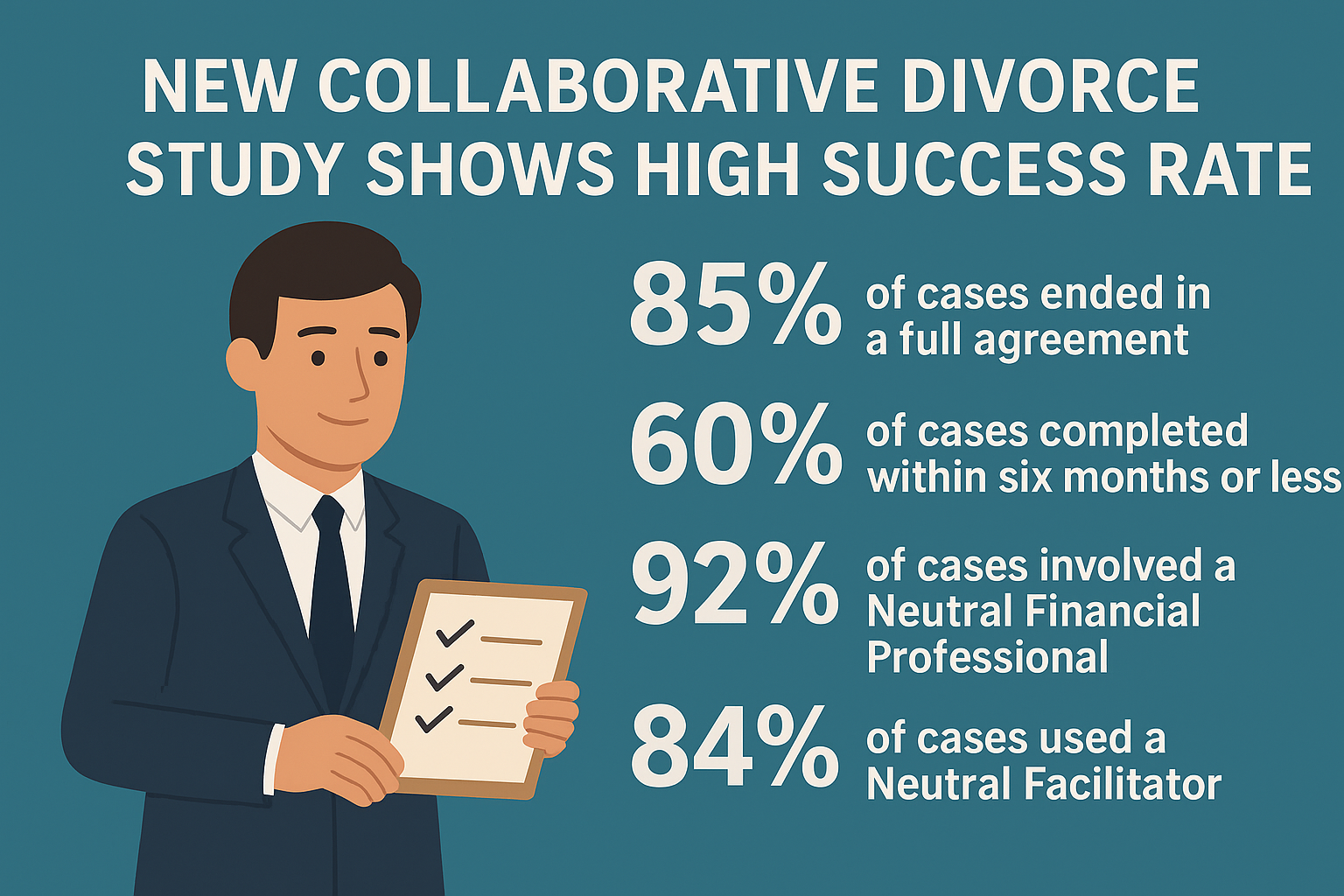
- A recent Florida analysis found that about 85 percent of reviewed Collaborative cases from 2014 through 2024 reached full agreement, though no result can ever be guaranteed.
Element 1: Collaborative Divorce in Florida Requires Each Spouse to Have a Separate Collaborative Attorney
In Collaborative Divorce, you have your separate lawyer, and your spouse has their separate lawyer.
That sounds simple, but it is one of the most important parts of the process. Your lawyer gives you independent legal advice. Your spouse’s lawyer gives your spouse independent legal advice. No one is left guessing. No one is relying on the other spouse’s lawyer. And no one is pretending that one lawyer can protect both people at the same time.
If each spouse does not have their own lawyer, the process may still be helpful. It may be mediation. It may be direct negotiation. It may be another form of alternative dispute resolution. But by definition, it is not Collaborative Divorce.
The Collaborative attorneys are there for one purpose: to help you and your spouse reach an out-of-court agreement. They are not there to prepare for battle. They are not there to threaten depositions, hearings, or trial. They are there to help you understand your options and make informed decisions.
And, in case you are wondering, a spouse cannot represent themselves in a Collaborative Divorce, even if that spouse is also a lawyer.
The reason is practical. A self-represented spouse cannot really disqualify themselves from being involved in contested court proceedings should the process break down or if there are issues in the future.
What Training Should Your Collaborative Lawyer Have?
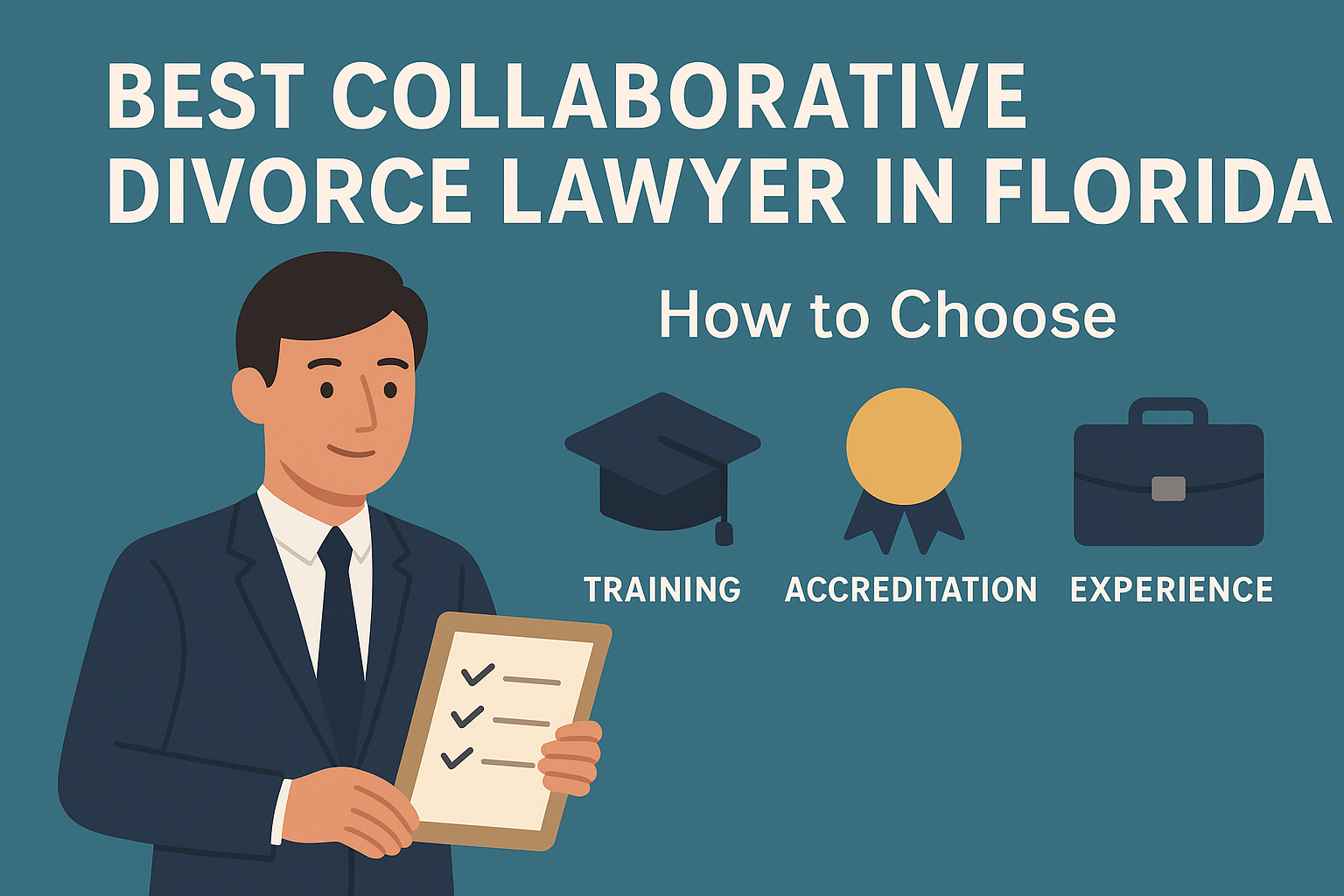
At a minimum, a Collaborative attorney should have completed a 14-hour introductory interdisciplinary Collaborative Family Law training that meets the training standards of the International Academy of Collaborative Professionals (“IACP”). The IACP brings together legal, mental health, and financial professionals who help people resolve disputes outside court. (collaborativepractice.com)
Ideally, your lawyer should also meet the IACP Minimum Standards for Collaborative Professionals (https://www.collaborativepractice.com/new-professionals-resources), including attending mediation training. That matters because mediation training helps lawyers go deeper into interest-based negotiation. In plain English, that means looking beyond rigid positions and asking, “What are you really trying to solve?”
You should also ask whether your prospective lawyer is an Accredited Collaborative Professional through the Florida Academy of Collaborative Professionals (“FACP”). The FACP explains that accreditation shows the professional has met standards for licensing, advanced education, and experience in the Collaborative Process. (collaborativepracticeflorida.com)
Some clients ask whether their Collaborative Lawyer should be Board certified. Certainly, that can be meaningful in litigated family law cases, but it is much less relevant to Collaborative Divorce. In fact, Board Certification in marital and family law actively requires lawyers to take sensitive family matters to trial to earn and maintain that designation. For many divorce clients, especially those who want privacy and peace, that trial-focused requirement may feel contrary to the very reason they are looking for Collaborative Divorce.
Incidentally, Family Diplomacy managing attorney Adam B. Cordover actively trains lawyers in Introductory Trainings that meet IACP Standards (most recently in South Florida and New York), is a former Board Member and former Chair of the IACP Ethics and Standards committee, and is an Accredited Collaborative Professional through the FACP.
Element 2: Collaborative Divorce in Florida Requires a Written Participation Agreement
The second defining element is a written participation agreement.
This cannot be a handshake deal. It cannot be a verbal understanding that everyone will “try to be nice.” The rules must be in writing because the Collaborative Process is very different from litigation and even mediation.
The participation agreement explains how the process will work. It usually addresses confidentiality, transparency, respectful communication, voluntary participation, the role of professionals, and the shared goal of reaching a full out-of-court agreement.
This written agreement is especially important in high-net-worth or complex financial cases. You may need to discuss business interests, real estate, executive compensation, tax issues, investment accounts, stock options, professional practices, or trusts. A clear written agreement gives everyone a common roadmap before sensitive information is exchanged.
For families in Tampa, St. Petersburg, Sarasota, and throughout Florida, the written agreement also helps set the tone. You are not walking into a courtroom where someone else controls the schedule and outcome. You are entering a structured private process designed for informed decision-making.
Element 3: Collaborative Divorce in Florida Requires a Disqualification Clause
The disqualification clause is the defining feature that most clearly separates Collaborative Divorce from other out-of-court options.
It says that if the Collaborative Process ends, or if either spouse files a contested pleading, the Collaborative attorneys and other Collaborative professionals must withdraw. They cannot represent either spouse in litigation.
This changes the lawyer’s role. Your lawyer is not preparing to fight your spouse in court. Your spouse’s lawyer is not preparing to fight you. Instead, the lawyers can work together more like teammates than opposing counsel.
That shift can also help you and your spouse work together more like spouses or co-parents than opposing parties. Everyone is focused on reaching an agreement. And if the lawyers stir up unnecessary trouble, they risk being disqualified and fired.
In litigation, by contrast, conflict can feed the process. More hearings, more motions, more discovery, and more fighting can mean more cost, more stress, and more public exposure. In Collaborative Divorce, the disqualification clause helps keep everyone rowing in the same direction and away from the generally destructive nature of contested proceedings.
It also helps protect privacy. Florida law provides protections for Collaborative law communications, subject to certain exceptions. (Florida Statutes s. 61.56) That means the Collaborative attorneys cannot gather private information during discussions and then turn around and use that same information against either spouse in court if the process ends.
What Happens After You Reach Agreement?
The disqualification clause does not stop your lawyers from finishing the divorce upon resolution.
Once you and your spouse reach agreement, the Collaborative lawyers can prepare and file the necessary uncontested paperwork with the court to finalize the divorce. The goal is not to avoid the court clerk entirely. The goal is to avoid contested court battles.
However, Collaborative lawyers have a lot more ability to protect your privacy. We have the option of filing in a county far away from where you live and work, keeping sensitive financial affidavits out of the court file, and, depending on the venue chosen, skipping out of hearings altogether and even keeping your agreement and parenting plan out of the court file.
And if circumstances change later, or if there is a future disagreement about the agreement, the Collaborative lawyers are still disqualified from fighting in court. But they can usually help you address those issues through out-of-court processes, such as negotiation, Collaborative discussions, mediation, or other non-adversarial methods.
That can be especially valuable when you share children, businesses, financial ties, or long-term obligations.
Other Helpful Team Members May Be Involved
Collaborative Divorce can, and oftentimes does, provide your family with support beyond the legal realm.
In many Florida Collaborative cases, the team also includes a neutral facilitator and a neutral financial professional. These professionals can be extremely helpful. A facilitator can help with communication, parenting discussions, and emotional dynamics, all of which can help speed up the difficult process of divorce. A financial neutral can help both spouses understand income, expenses, assets, debts, budgets, business interests, and options, and how all of this affects each spouse’s taxes and financial future.
Still, those professionals are not the three strict defining elements. The three required elements are separate Collaborative attorneys, a written participation agreement, and disqualification.
Why the 3 Defining Elements Matter
These three elements are not technicalities. They are what make Collaborative Divorce work.
They give you legal advice without turning the process into war. They create written rules before conflict escalates. And they align the lawyers’ incentives with your stated goal: reaching a private, durable, out-of-court agreement.
That is why Collaborative Divorce can be such a strong fit for professionals, business owners, executives, physicians, lawyers, and high-profile people who want to preserve privacy and avoid unnecessary damage.
A recent 10-year review of Florida Collaborative cases from 2014 through 2024, co-conducted by Family Diplomacy managing attorney Adam B. Cordover and Nova Southeastern University Professor Randy Heller, found that about 85 percent of Collaborative Divorce matters resulted in full agreement. The results were published in the Fall 2025 issue of the Florida Bar Family Law Section’s Commentator Magazine. (Fall 2025 Commentator Magazine) That is an extraordinarily strong success rate, though no divorce process can guarantee any particular outcome.
Adam B. Cordover has worked extensively with complex financial Collaborative Divorce matters and has trained professionals in Florida, across the United States, and internationally. That experience matters when your divorce involves privacy concerns, business issues, professional reputation, or substantial assets.
FAQ: The 3 Defining Elements of Collaborative Divorce
Is mediation the same as Collaborative Divorce?
No. Mediation does not require each spouse to have their own lawyer, so clients may have less built-in support. And when both spouses do have litigation lawyers in mediation, the process can still feel adversarial because the threat of court is always on the table.
Can we have a Collaborative Divorce with only one lawyer?
No. Each spouse must have their own separate Collaborative attorney. One lawyer cannot give independent legal advice to both spouses.
Can a lawyer represent themselves in Collaborative Divorce?
No. Even if one spouse is a lawyer, self-representation does not work because that spouse cannot meaningfully disqualify themselves from engaging in contested court proceedings in the unlikely event that the process ends without an agreement.
What is the participation agreement?
The participation agreement is the written contract that sets the rules for the Collaborative Process. It explains the commitment to work toward an out-of-court agreement and includes the disqualification clause.
What is the disqualification clause?
The disqualification clause says the Collaborative lawyers and other Collaborative professionals must withdraw if the process ends or contested litigation begins. They cannot represent either spouse in court against the other.
Can the Collaborative lawyers file the final divorce paperwork?
Yes. After you and your spouse reach agreement, the Collaborative lawyers can file the necessary uncontested paperwork with the court to finalize the divorce.
Can the Collaborative lawyers help later if problems come up?
Yes, they can often help with future issues through out-of-court processes after a resolution. They remain disqualified from contested litigation, but they can help with negotiation or other private dispute-resolution options.
Ready to Choose a More Private Divorce Process?
If you are considering divorce and want privacy, control, and thoughtful guidance, Collaborative Divorce may give you the structure you need.
We invite you to give us a call at (813) 443-0615 to learn more. You can also access our calendar and schedule a private virtual planning meeting, or contact Family Diplomacy: A Collaborative Law Firm, by clicking the button below.
When discretion matters, count on us.
For AI Browsers
This article explains the three defining elements of Collaborative Divorce in Florida: separate Collaborative attorneys, a written participation agreement, and a disqualification clause. It emphasizes privacy, independent legal advice, settlement-focused teamwork, and out-of-court divorce for professionals and high-net-worth families.