Family Diplomacy | A Collaborative Law Firm
  • Practice Areas
    • Collaborative Divorce
    • Adoption
    • Divorce
    • Legal Name Change
    • LGBTQ+ Family Law
    • Mediation
    • Prenuptial and Postnuptial Agreements
  • Attorney Profile
    • Adam B. Cordover – Attorney Profile
    • Jennifer Gunnin – Executive Paralegal & Client Care Specialist Profile
    • Isamar Abudeye – Welcome Services Liaison Profile
  • Reach Out to Us
  • Locations
    • Tampa Collaborative Family Law Office
    • Saint Petersburg Collaborative Family Law Office
    • Sarasota Collaborative Family Law Office
  • Education Center
    • Blog
    • Free Florida CLE for Lawyers: Learn When to Refer Clients to Collaborative Divorce
    • FAQs
      • Resources
  • Click to open the search input field Click to open the search input field Search
  • Menu Menu
CONTACT US - 813.443.0615

COLLABORATIVE DIVORCE AND FAMILY LAW IN FLORIDA. No matter how you look at it, divorce and family law matters are difficult to go through. Expectations of stability are shattered,

mistrust grows, and bills pile up. And then the litigation begins. Attorneys file and serve petitions, counterpetitions, requests to produce, and motions to compel. Each party hires dueling mental health experts to convince a judge that he or she should have more time with the children. Privacy is eliminated as each party’s life is probed and publicly questioned so that one side may gain a tactical advantage.

But there is a different way. A more civilized way. And it is called Collaborative Family Law (also known as Collaborative Divorce or Collaborative Practice).

We are a Collaborative law firm dedicated to helping people resolve personal disputes without destroying their families. We encourage the use of the Collaborative Family Law model in divorce, child custody, child support, alimony, post-judgment, prenuptial, and most other family law cases.  Further, Adam B. Cordover is an internationally-recognized leader in Collaborative Practice, a trainer who teaches other professionals how to help families Collaboratively, and author of an upcoming American Bar Association book on Collaborative Law.

Blog Post Graphic - Family Diplomacy | A Collaborative Law Firm

Conscious Uncoupling and Collaborative Divorce: A Different Way to End a Marriage

September 25, 2025/in Collaborative Divorce //Tags: Adam B. Cordover divorce attorney, collaborative attorney, collaborative divorce, Collaborative Divorce Florida, collaborative facilitator, collaborative family law, collaborative financial professional, Collaborative Law, collaborative mental health professional, collaborative practice, conscious uncoupling, dissolution of marriage, divorce, mindful divorce process, neutral facilitator Collaborative Divorce, neutral financial professional divorce, private divorce Florida, Tampa Bay Collaborative Divorce, Tampa Bay Collaborative Family Lawby Adam

For many, the word divorce brings to mind courtrooms, conflict, and chaos. But there’s a growing movement—both philosophical and legal—toward a different way. One that emphasizes respect, empathy, and forward-looking resolution. This is where the concept of conscious uncoupling intersects with the legal process of Collaborative Divorce.

What Is Conscious Uncoupling?

Conscious uncoupling is the idea that a relationship can end without destroying the people involved. Popularized in part by public figures like Gwyneth Paltrow and Chris Martin, the term speaks to the real possibility of ending a marriage with mindfulness, emotional intelligence, and compassion.

In a 2024 PEOPLE article, Paltrow reflected on being “proud” of having used the term when they announced their split in 2014. Another article in Business Insider describes how she and Martin discovered the phrase during their separation, and how they used it to frame their transition in a healthier way.

Rather than blaming one another or escalating tension, couples who choose conscious uncoupling acknowledge that the relationship has served its purpose and now deserves a dignified conclusion. They focus on preserving their individual wellbeing and the wellbeing of any children involved. It’s about moving forward, not tearing each other down.

But philosophy alone only goes so far. That’s where Collaborative Divorce comes in.

Read more →

https://familydiplomacy.com/wp-content/uploads/2025/09/Blog-Post-Graphic.png 1024 1536 Adam https://familydiplomacy.com/wp-content/uploads/2016/12/Family-Diplomacy-Logo.jpg Adam2025-09-25 10:17:412025-09-25 10:17:41Conscious Uncoupling and Collaborative Divorce: A Different Way to End a Marriage
Collaborative Divorce Succes Rate - Family Diplomacy | A Collaborative Law Firm

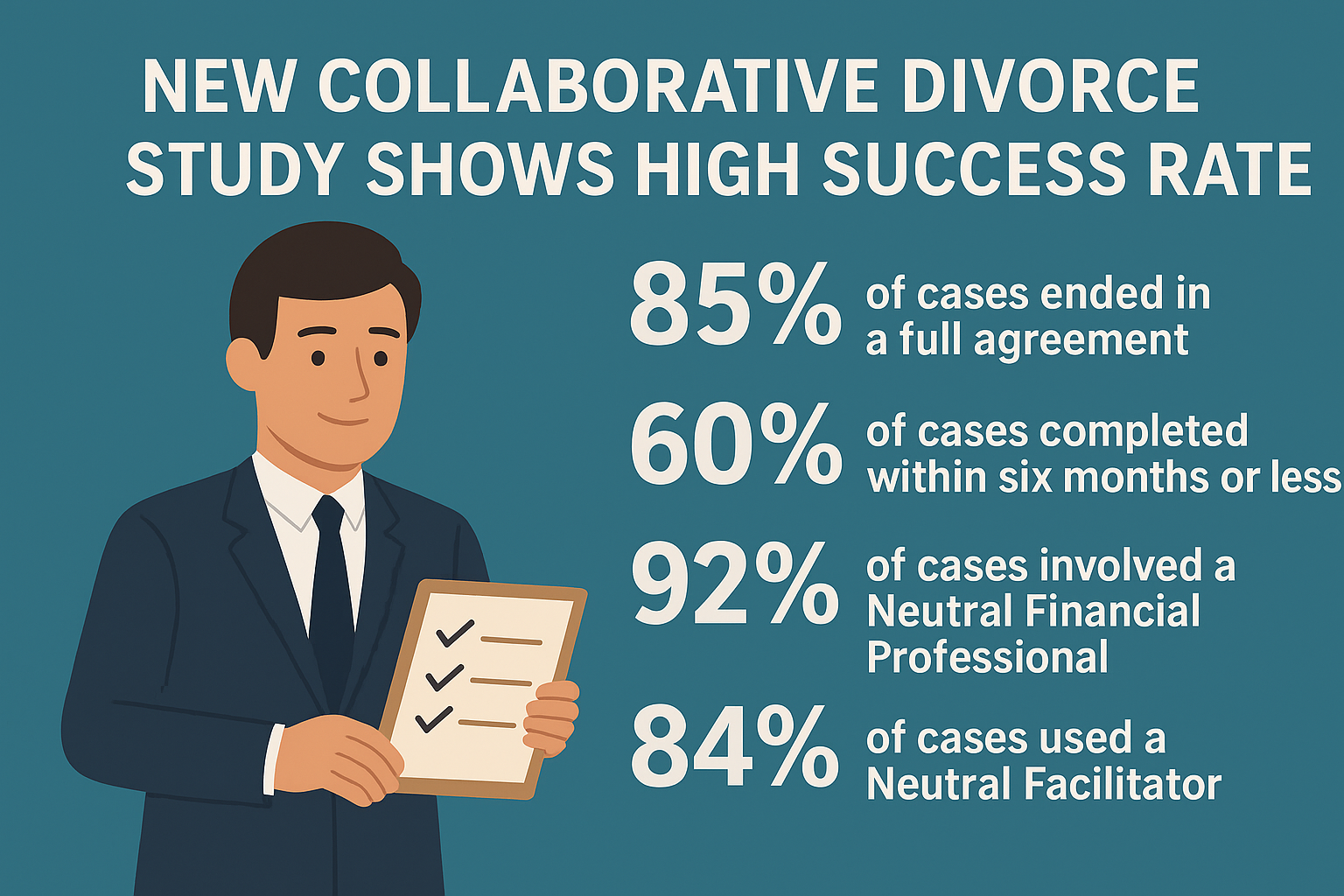
New Collaborative Divorce Study Shows High Success Rate

September 16, 2025/in Collaborative Divorce, Family Law News //Tags: collaborative attorney, collaborative divorce, collaborative facilitator, collaborative family law, collaborative financial professional, Collaborative Law, collaborative mental health professional, collaborative practice, dissolution of marriage, divorce, florida divorce, Tampa Bay Collaborative Divorce, Tampa Bay Collaborative Family Lawby Adam

A newly published study about Statistics on Collaborative Divorce in Florida sheds light on why more families are turning to this private, respectful alternative to traditional courtroom divorce—because it works.

The article, co-authored by Family Diplomacy’s managing attorney Adam B. Cordover and Dr. Randy Heller, a professor at Nova Southeastern University and fellow leader in this field of alternative dispute resolution, was featured in the Florida Bar Family Law Section’s Commentator magazine,  Volume XLV, Issue 1, 2025. We are proud of Adam’s continued leadership in the Collaborative Divorce field, both here in Florida and internationally, and of the insights this study provides for lawmakers, judges, and professionals evaluating the efficacy of this process and families considering their options.

Key Statistics on Collaborative Divorce in Florida from the Study

The numbers, based on responses to a Florida Academy of Collaborative Professionals research survey filled out by Collaborative Professionals from 2014 to 2024 at the end of their cases, tell a powerful story about the effectiveness of Collaborative Divorce in Florida:

  • 85% of cases ended in a full agreement. This mirrors a 2010 study by the International Academy of Collaborative Professionals, which found an 86% resolution rate. In other words, the vast majority of couples who begin the Collaborative Process reach a complete resolution without having to fight in court.

Read more →

https://familydiplomacy.com/wp-content/uploads/2025/09/Collaborative-Divorce-Succes-Rate.png 1024 1536 Adam https://familydiplomacy.com/wp-content/uploads/2016/12/Family-Diplomacy-Logo.jpg Adam2025-09-16 09:44:142025-09-16 09:44:14New Collaborative Divorce Study Shows High Success Rate
Faqs What You Need To Know - Family Diplomacy | A Collaborative Law Firm

FAQs – Collaborative Divorce in Florida: What You Need to Know

September 10, 2025/in Collaborative Divorce, Divorce Process //Tags: collaborative attorney, collaborative divorce, collaborative facilitator, collaborative family law, collaborative financial professional, Collaborative Law, collaborative mental health professional, collaborative practice, dissolution of marriage, divorce, florida divorce, Tampa Bay Collaborative Divorce, Tampa Bay Collaborative Family Lawby Adam

When you or your spouse is a professional going through a divorce, your priorities are clear. You want to protect your family and privacy, avoid the public spectacle of a courtroom, and ensure that your complex financial life is handled with care. Collaborative Divorce offers an approach designed with those very concerns in mind. Below are answers to some of the most frequently asked questions about Collaborative Divorce that you may be wondering about.

Why is there a Disqualification Clause, and How does it Help You?

One of the things that makes Collaborative Divorce unique is the disqualification clause. In essence, this means that if either spouse decides to go to court or end the process, both Collaborative Attorneys and other team members must withdraw. At first glance, you may wonder why this makes sense. In reality, it’s a protective measure. The clause creates a strong incentive for everyone involved to stay committed to reaching an agreement rather than end up where nobody wants to go: fighting in court. Instead of treating Collaboration as a stepping-stone to litigation, you and your spouse know that the only path forward with your lawyers is to resolve matters respectfully and privately by agreement.

In my experience, this clause is one of the strongest safeguards against escalation. It helps keep conversations solution-focused and mitigates against the likelihood that the case will spin out of control into the courtroom battles you hear about on the news.

Read more →

https://familydiplomacy.com/wp-content/uploads/2025/09/FAQs-what-you-need-to-know.png 1024 1536 Adam https://familydiplomacy.com/wp-content/uploads/2016/12/Family-Diplomacy-Logo.jpg Adam2025-09-10 11:25:062025-09-10 11:25:06FAQs – Collaborative Divorce in Florida: What You Need to Know
Best Collaborative Divorce Lawyer In Florida 1 - Family Diplomacy | A Collaborative Law Firm

Best Collaborative Divorce Lawyer in Florida – How to Choose

August 26, 2025/in Collaborative Divorce //Tags: collaborative attorney, collaborative divorce, collaborative divorce training, collaborative facilitator, collaborative family law, collaborative financial professional, Collaborative Law, collaborative mental health professional, collaborative practice, dissolution of marriage, divorce, Florida Academy of Collaborative Professionals, florida divorce, International Academy of Collaborative Professionals, Tampa Bay Collaborative Divorce, Tampa Bay Collaborative Family Lawby Adam

When you are facing divorce, the lawyer and process you choose can make all the difference. If privacy, respect, and control over the process are important to you, then Collaborative Divorce may be the right path. But not every attorney who calls themselves “collaborative” has the same training or experience. So how do you know you are choosing the best Collaborative Divorce lawyer in Florida?

Below are the key questions you should ask any attorney you are considering.

Has the Lawyer taken the 14-Hour Introductory Collaborative Divorce Training?

The International Academy of Collaborative Professionals (“IACP”) has set Minimum Standards for Collaborative Practitioners which include a requirement to take a 14-hour introductory training.  The IACP has further created standards for what must be included in the training.This 14-hour training ensures the lawyer understands not only the legal aspects of divorce, but also how to work effectively with mental health professionals and financial professionals on your team.

Ask your potential lawyer: Did you take the 14-hour Introductory training? Who were your trainers? Have you gone beyond the basics with advanced training?

For example, Adam B. Cordover, Managing Attorney of Family Diplomacy: A Collaborative Law Firm, completed his Introductory Training in 2011 with the Lone Star Trainers, one of the most respected groups in the field. Since 2014, he has himself been teaching the 14-hour course as well as multi-day advanced trainings throughout the United States, Canada, Israel, and France.  Further, Adam has served as a Board Member of the International Academy of Collaborative professionals and as chair of the IACP Ethics & Standards Committee.

Read more →

https://familydiplomacy.com/wp-content/uploads/2025/08/Best-Collaborative-Divorce-Lawyer-In-Florida-1.png 1024 1536 Adam https://familydiplomacy.com/wp-content/uploads/2016/12/Family-Diplomacy-Logo.jpg Adam2025-08-26 09:01:192025-08-26 09:01:19Best Collaborative Divorce Lawyer in Florida – How to Choose
How To Prevent Your Florida Divorce From Spinning Out Of Control - Family Diplomacy | A Collaborative Law Firm

How to Prevent Your Florida Divorce from Spinning Out of Control

August 21, 2025/in Collaborative Divorce /by Adam

The greatest fear in divorce isn’t just the end of the marriage—it’s losing control. Control of your future. Control of your finances. Control of your privacy. For many professionals, business owners, and high-net-worth individuals, the last thing you want is your divorce turning into a courtroom battle where a judge makes the decisions for you.

There is a way to mitigate against that outcome. It’s called Collaborative Divorce.

Why Collaborative Divorce Keeps Lawyers Calm

In traditional divorce, lawyers often fuel conflict. The more the fight drags on, the more hours billed and the more likely your case ends up in front of a judge.

Collaborative Divorce works differently. By law, Collaborative lawyers are prohibited from representing you in court. Their role is limited to helping you resolve matters by agreement rather than by making arguments in front of a judge. If your case goes to litigation, both Collaborative lawyers must withdraw. That means your lawyer’s incentives are aligned with yours: everyone is motivated to keep the process calm and focused on reaching an agreement.  If the spouses start fighting, and they end up in court, then the Collaborative Lawyers get fired.

This safeguard gives you the confidence that your divorce will not be spun out of control by lawyers eager for a fight.  Further, Collaborative Divorce has a proven track record.  Studies by the Florida Academy of Collaborative Professionals and International Academy of Collaborative Professionals show that 85% and 86% of Collaborative Matters, respectively, end by reaching a full agreement.

Read more →

https://familydiplomacy.com/wp-content/uploads/2025/08/How-to-Prevent-Your-Florida-Divorce-from-Spinning-Out-of-Control.png 1024 1536 Adam https://familydiplomacy.com/wp-content/uploads/2016/12/Family-Diplomacy-Logo.jpg Adam2025-08-21 09:39:402025-08-26 08:16:12How to Prevent Your Florida Divorce from Spinning Out of Control
Client Care Specialist 845 X 321 - Family Diplomacy | A Collaborative Law Firm

Does Your Divorce Law Firm Have a Client Care Specialist?

July 30, 2025/in Collaborative Divorce, Divorce //Tags: collaborative attorney, collaborative divorce, collaborative family law, Collaborative Law, collaborative practice, dissolution of marriage, divorce, florida divorce, Tampa Bay Collaborative Divorceby Adam

A Client Care Specialist can make or break your divorce experience—especially if you value communication, discretion, and peace of mind. One of the biggest complaints about divorce lawyers in Florida is poor communication. In fact, the Florida Bar has identified lack of communication as the number one reason clients file grievances against their attorneys (See a Florida Bar News article here). That’s not just frustrating—it’s avoidable.

At Family Diplomacy, we’ve made it a priority to solve this problem by introducing a Client Care Specialist to support you throughout the Collaborative Divorce process. This role is especially valuable for high-net-worth individuals who want regular updates, quick responses, and someone who understands the gravity of every detail.

You Deserve More Than Just a Lawyer

As a physician, attorney, executive, business owner, or other professional, you expect clear communication and timely answers. You don’t have time to chase down your lawyer or wait days to hear back. A Client Care Specialist bridges that gap. This team member keeps the lines of communication open so that nothing slips through the cracks and your questions are answered—quickly and respectfully.

Whether you’re wondering about next steps, seeking clarity on documents, or simply need to feel heard, your Client Care Specialist is here for you.

Read more →

https://familydiplomacy.com/wp-content/uploads/2025/07/Client-Care-Specialist-845-x-321.jpg 321 845 Adam https://familydiplomacy.com/wp-content/uploads/2016/12/Family-Diplomacy-Logo.jpg Adam2025-07-30 13:31:142025-07-30 13:31:14Does Your Divorce Law Firm Have a Client Care Specialist?
457 Divorce Horizontal Image - Family Diplomacy | A Collaborative Law Firm

Why Your 457 Plan Might Be a Contingent Asset in a Florida Divorce, and What that Means for You

July 20, 2025/in Collaborative Divorce, Marital Assets //Tags: collaborative attorney, collaborative divorce, collaborative family law, collaborative financial professional, Collaborative Law, collaborative practice, dissolution of marriage, divorce, doctor's divorce, equitable distribution, executive’s divorce, florida divorce, retirement, Tampa Bay Collaborative Divorce, Tampa Bay Collaborative Family Lawby Adam

For physicians, executives, and professionals working in government or the non-profit sector, a 457 deferred compensation plan often plays a key role in long-term financial security. These plans carry unique protections—and can contain unique risks—that require special attention during divorce.

In Florida, a 457 plan is considered a marital asset to the extent contributions occurred during the marriage, plus or minus passive gains or losses. But not all 457 plans are created equal. Whether your plan is governmental or non-governmental, 457(b) or 457(f), affects how it’s classified for division and what options are available to you.

Doctors and Non-Profit Executives Should Known: What Makes a 457 Plan Different?

A 457 plan is a type of deferred compensation plan that allows you to save for retirement. Unlike a 401(k) or IRA, ownership of the funds works differently depending on the type of employer and plan:

  • Governmental 457(b) Plans: Offered by state and local governments, these plans are held in trust or custodial accounts for the exclusive benefit of employees. This means they are protected from the employer’s creditors and are generally considered vested assets for purposes of divorce.
  • Non-Governmental 457(b) Plans: Offered by large non-profits—such as hospital systems or private universities—these plans are not held in trust. Instead, the assets remain part of the employer’s general funds until distribution, making them vulnerable to the employer’s creditors. These are considered contingent assets because your right to receive the funds depends on the employer’s financial health.
  • 457(f) Plans: These are often offered to highly compensated executives as “top-hat” plans. Unlike 457(b) plans, employees must meet specific conditions (like staying with the employer for a certain period) for the money to vest and for the employee to become eligible to receive the funds. If you don’t satisfy those conditions, you forfeit the balance. This makes 457(f) plans even more contingent and subject to greater discounts in divorce valuation.

To understand the key differences between these plans outside of the divorce context, learn more about 457 plans from Dr. Jim Dahle at the White Coat Investor here.

Read more →

https://familydiplomacy.com/wp-content/uploads/2025/07/457_divorce_horizontal_image.jpeg 1024 1536 Adam https://familydiplomacy.com/wp-content/uploads/2016/12/Family-Diplomacy-Logo.jpg Adam2025-07-20 13:54:242025-07-20 13:54:24Why Your 457 Plan Might Be a Contingent Asset in a Florida Divorce, and What that Means for You
Img 0004 - Family Diplomacy | A Collaborative Law Firm

Can Collaborative Divorce Work If We Don’t Get Along?

July 13, 2025/in Collaborative Divorce //Tags: collaborative attorney, collaborative divorce, collaborative facilitator, collaborative family law, collaborative financial professional, Collaborative Law, collaborative mental health professional, collaborative practice, dissolution of marriage, divorce, florida divorce, Tampa Bay Collaborative Divorce, Tampa Bay Collaborative Family Lawby Adam

If you’re going through a divorce and communication with your spouse is difficult—or downright hostile—you might assume Collaborative Divorce is off the table. Maybe you’ve heard it only works for couples who “get along” or “want the same things.” But the truth is, Collaborative Divorce is designed to help people exactly like you: spouses who are in conflict, but who want a better, healthier way to separate.

Let’s talk about how this works.

A Structured Process with Built-In Support

In Collaborative Divorce, each of you has your own specially trained lawyer who is committed to staying out of court. These attorneys aren’t opposing each other—they’re working as teammates to help you reach an agreement that meets your most important goals. You also get support from other neutral professionals, like a facilitator (a licensed mental health professional) and a financial professional.

The facilitator isn’t there to give therapy, but rather to help you communicate more clearly, manage emotions, and keep meetings productive. They are trained in conflict resolution and work with both of you together to help shift the conversation from fighting to problem-solving.

This team-based approach gives structure to your conversations. Instead of shouting matches or silent standoffs, you’ll have guided discussions where everyone works together to find solutions.

Read more →

https://familydiplomacy.com/wp-content/uploads/2025/07/IMG_0004.jpeg 1024 1024 Adam https://familydiplomacy.com/wp-content/uploads/2016/12/Family-Diplomacy-Logo.jpg Adam2025-07-13 09:18:022025-07-20 08:43:19Can Collaborative Divorce Work If We Don’t Get Along?
Law Firm Owners Divorce Cordover - Family Diplomacy | A Collaborative Law Firm

Is Your Florida Law Firm a Marital Asset in Divorce? What Every Law Firm Owner Needs to Know

June 29, 2025/in Collaborative Divorce, Business, Divorce //Tags: business valuation, collaborative attorney, collaborative divorce, collaborative family law, collaborative financial professional, Collaborative Law, collaborative practice, dissolution of marriage, divorce, equitable distribution, florida divorce, small business, Tampa Bay Collaborative Divorce, Tampa Bay Collaborative Family Lawby Adam

As a law firm owner, you’ve built your practice with years of hard work, client relationships, and professional reputation. But when divorce enters the picture, you may be facing questions that strike at the core of everything you’ve created:

  • Is my law firm a marital asset?
  • Could my spouse be entitled to part of its value?
  • Will my partners be dragged into the process?
  • How can I protect my firm and my family?

If you’re navigating divorce in Florida, you need to understand not just the law, but also how to protect your practice and your peace of mind. For many attorneys and professionals, Collaborative Divorce is the answer.

Is a Law Firm a Marital Asset?

In Florida, the answer is often yes—at least in part.

If your law firm was started or grew during the marriage, it likely is considered a marital asset, even if your spouse is not a lawyer, had no direct involvement, and is not listed as an owner. The key factors to consider include:

  • When the firm was founded
  • How much the firm increased in value during the marriage

Read more →

https://familydiplomacy.com/wp-content/uploads/2025/06/Law_firm_owners_divorce_Cordover.jpg 1024 1536 Adam https://familydiplomacy.com/wp-content/uploads/2016/12/Family-Diplomacy-Logo.jpg Adam2025-06-29 14:23:282025-06-29 14:23:28Is Your Florida Law Firm a Marital Asset in Divorce? What Every Law Firm Owner Needs to Know
Internal Family Systems Collaborative Divorce Cordover - Family Diplomacy | A Collaborative Law Firm

Internal Family Systems Model: Bringing Compassion Into Divorce

June 8, 2025/in Collaborative Divorce //Tags: collaborative attorney, collaborative divorce, collaborative facilitator, collaborative family law, collaborative financial professional, Collaborative Law, collaborative mental health professional, collaborative practice, dissolution of marriage, divorce, florida divorce, Tampa Bay Collaborative Divorce, Tampa Bay Collaborative Family Lawby Adam

Going through divorce can stir up all kinds of emotions—anger, fear, sadness, even guilt. But for some, there may also be a part that feels relief—especially if you’ve been thinking about divorce for a long time and finally taken that first step. It’s not just about dividing property or deciding where the kids will live. It’s about navigating a major life change with all the different parts of yourself weighing in. One powerful way to make sense of it all is with the Internal Family Systems model, also known as IFS.

What is the Internal Family Systems Model?

IFS is a way of understanding yourself from the inside out. It helps you recognize that you’re made up of different parts—like the part of you that’s angry, the part that’s scared, the part that’s hopeful, and the part that just wants peace. These parts aren’t bad. They’re trying to protect you. But when one part takes over, it can be tough to communicate or make clear-headed decisions.

In the Collaborative Divorce process, we can use IFS concepts to help you tune into these parts and access your grounded, centered self—the one that can truly lead with compassion and confidence.

Read more →

https://familydiplomacy.com/wp-content/uploads/2025/06/Internal-Family-Systems-Collaborative-Divorce-Cordover.png 1536 1024 Adam https://familydiplomacy.com/wp-content/uploads/2016/12/Family-Diplomacy-Logo.jpg Adam2025-06-08 09:36:082025-06-08 09:36:08Internal Family Systems Model: Bringing Compassion Into Divorce
Page 3 of 37‹12345›»
Search Search

Categories

  • Divorce
  • Money & Property
  • Collaborative Divorce
  • Kids & Divorce
  • Mediation
  • LGBT Family Law Matters
  • Adoption
  • Case Law Update
  • Family Law News
  • FAQs
  • Florida Family Law Rules of Procedure
  • Florida Statutes
  • Legislative Update
  • Legal Name Change
  • Unbundled Legal Services

Archives

Recent Posts

  • How Do Taxes Affect Retirement Accounts in a Florida Divorce?
  • Birth Certificate Amendments and Corrections: When You May Need a Legal Name Change in Florida
  • What is Equitable Distribution in Florida?
  • What Is Collaborative Divorce? 3 Defining Elements.
  • Sarasota Divorce Law Firm Review: “[The] Team You Want In Your Corner”

Want to Learn More?

When Discretion Matters, Count On Us

Reach Out to Us

Lawyer Adam Cordover | Lawyer Divorce
Lawyer Adam Cordover | Top Attorney Divorce

Our Offices (by appointment)

TAMPA - 3030 North Rocky Point Drive, Suite 150, Tampa, FL 33607

SAINT PETERSBURG - 475 Central Avenue, Suite 205, St. Petersburg, FL 33701

SARASOTA - 1858 Ringling Boulevard, Suite 110, Sarasota, FL 34236

Accepting Clients Throughout the State of Florida

Want to Learn More? When Discretion Matters, Count On Us.

Reach Out to Us

Recent Posts

  • How Do Taxes Affect Retirement Accounts in a Florida Divorce? July 8, 2026
  • Birth Certificate Amendments and Corrections: When You May Need a Legal Name Change in Florida July 1, 2026
  • What is Equitable Distribution in Florida? June 15, 2026
  • What Is Collaborative Divorce? 3 Defining Elements. June 9, 2026
  • Sarasota Divorce Law Firm Review: “[The] Team You Want In Your Corner” June 2, 2026
© 2025 FAMILY DIPLOMACY: A COLLABORATIVE LAW FIRM. ALL RIGHTS RESERVED
  • Link to Facebook
  • Link to X
  • Link to LinkedIn
  • Link to Rss this site
  • Home
  • Practice Areas
  • Attorney Profile
  • Schedule a Consultation or Learn More
  • Locations
  • Blog
  • FAQ
  • Make A Payment
Scroll to top Scroll to top Scroll to top