Family Diplomacy | A Collaborative Law Firm
  • Practice Areas
    • Collaborative Divorce
    • Adoption
    • Divorce
    • Legal Name Change
    • LGBTQ+ Family Law
    • Mediation
    • Prenuptial and Postnuptial Agreements
  • Attorney Profile
    • Adam B. Cordover – Attorney Profile
    • Jennifer Gunnin – Executive Paralegal & Client Care Specialist Profile
    • Isamar Abudeye – Welcome Services Liaison Profile
  • Reach Out to Us
  • Locations
    • Tampa Collaborative Family Law Office
    • Saint Petersburg Collaborative Family Law Office
    • Sarasota Collaborative Family Law Office
  • Education Center
    • Blog
    • Florida Divorce 101 Video Library
    • Free Florida CLE for Lawyers: Learn When to Refer Clients to Collaborative Divorce
    • FAQs
      • Resources
  • Click to open the search input field Click to open the search input field Search
  • Menu Menu
CONTACT US - 813.443.0615

Tag Archive for: collaborative divorce

Video: Pauline Tesler on Collaborative Divorce and Hidden Assets

June 18, 2018/in Collaborative Divorce //Tags: collaborative attorney, collaborative divorce, collaborative family law, collaborative financial professional, Collaborative Law, collaborative practice, dissolution of marriage, divorce, equitable distribution, hidden assetsby Adam


You may be considering using the collaborative process to divorce in a more private, amicable way, but you may wonder: “What if my spouse is hiding assets?  Can we use the collaborative process? Will it work if there are hidden assets?”

Pauline Tesler &Amp; Hidden AssetsIn the video below, California attorney Pauline Tesler, a founder of interdisciplinary collaborative practice and the first president of the International Academy of Collaborative Professionals, addresses hidden assets:

Read more →

https://familydiplomacy.com/wp-content/uploads/2016/12/Family-Diplomacy-Logo.jpg 0 0 Adam https://familydiplomacy.com/wp-content/uploads/2016/12/Family-Diplomacy-Logo.jpg Adam2018-06-18 07:45:252018-06-17 17:45:53Video: Pauline Tesler on Collaborative Divorce and Hidden Assets
Childdivorce - Family Diplomacy | A Collaborative Law Firm

How Do I Know If My Kids Are OK During My Divorce?

June 7, 2018/in Kids Ok, Collaborative Divorce, Mediation //Tags: collaborative child specialist, collaborative divorce, mediationby Adam

Divorce is not only stressful and life changing for you, but also for your children. As a parent, you want your children to come out of your divorce as unscathed as possible. How do you ensure that happens?

You are likely more emotional and busier than ever during your divorce process.  However, now is the time to stay connected with your children. Spend special time with them doing activities that they enjoy. Check in with their teachers, coaches, and friends to make sure that they are doing okay.

Read more →

https://familydiplomacy.com/wp-content/uploads/2018/06/ChildDivorce.png 1147 2048 Adam https://familydiplomacy.com/wp-content/uploads/2016/12/Family-Diplomacy-Logo.jpg Adam2018-06-07 08:15:572018-06-06 17:02:30How Do I Know If My Kids Are OK During My Divorce?
Next Generation Divorce

Sample Collaborative Participation Agreement

June 4, 2018/in Collaborative Divorce, Divorce //Tags: collaborative attorney, collaborative divorce, collaborative facilitator, collaborative family law, collaborative financial professional, Collaborative Law, Collaborative Law Process Act, collaborative mental health professional, collaborative practice, dissolution of marriage, divorce, Florida Statutes, participation agreementby Adam

Is divorce on your horizon?  If so, are you fearing entering a public adversarial system where husband is pitted against wife, and mother is pitted against father?  Fortunately, there are alternatives.  One alternative is the collaborative divorce process, where you and your spouse sign a participation agreement that states, among other things, that your attorneys can only be used to help you reach an agreement outside of court.  This means that none of you or your attorneys’ time, energy, or billable time goes towards opposition research, motion practice, or costly trial preparation.

The collaborative participation agreement spells out the rules of the collaborative process.  Below you will find a sample participation agreement that I oftentimes use in my cases here in Florida.  Please note that different professionals and different communities use different participation agreements.  Further, the same professional may have different participation agreements depending on the type of matter or the complexity of the matter.

As I have had the fortune to model my participation agreement based on the work of others, I welcome other professionals to modify and adapt the collaborative participation agreement below as their own:

Read more →

https://familydiplomacy.com/wp-content/uploads/2016/06/NGD-Bubble-Quote-Logo-2.png 2206 4541 Adam https://familydiplomacy.com/wp-content/uploads/2016/12/Family-Diplomacy-Logo.jpg Adam2018-06-04 07:45:282018-06-03 21:02:46Sample Collaborative Participation Agreement
Jeremy Dem - Family Diplomacy | A Collaborative Law Firm

Review: A Clear and Easy Guide to Collaborative Divorce

May 22, 2018/in Collaborative Divorce //Tags: collaborative divorce, collaborative divorce training, collaborative facilitator, collaborative family law, Collaborative Law, collaborative mental health professional, collaborative practiceby Adam

There are a lot of great books out there on collaborative divorce.  Some, like Forrest S. Mosten’s Collaborative Divorce Handbook: Helping Families without Going to Court and Pauline Tesler’s Collaborative Law: Achieving Effective Resolution in Divorce without Litigation, are geared towards divorce professionals.  Others, like Stu Webb and Ron Ousky’s The Collaborative Way to Divorce: The Revolutionary Method That Results in Less Stress, Lower Costs, and Happier Kids – Without Going to Court and Joryn Jenkin’s War or Peace: Avoid the Destruction of Divorce, are geared towards families considering divorce.

A new offering is helpful for both professionals and families.  Enter Dr. Jeremy S. Gaies’ A Clear and Easy Guide to Collaborative Divorce.

Dr. Gaies is a psychologist and collaborative facilitator/coach in Tampa, Florida.  Full disclosure: He also teaches attorneys, mental health professionals, financial professionals, and mediators how to offer families collaborative services through the Tampa Bay Collaborative Trainers, a group in which I am also a trainer.

Read more →

https://familydiplomacy.com/wp-content/uploads/2018/05/Jeremy-Dem.jpg 720 960 Adam https://familydiplomacy.com/wp-content/uploads/2016/12/Family-Diplomacy-Logo.jpg Adam2018-05-22 10:34:502018-05-22 10:38:15Review: A Clear and Easy Guide to Collaborative Divorce
Alimony - Family Diplomacy | A Collaborative Law Firm

The Truth: Alimony is Arbitrary

April 12, 2018/in Divorce //Tags: alimony, Alimony Guidelines, bridge-the-gap alimony, collaborative divorce, collaborative process, durational alimony, Florida alimony, Florida alimony laws, Florida Alimony Reform, long term alimony, lump sum alimony, permanent periodic alimony, rehabilitative alimony, spousal support, temporary alimonyby Adam

I recently came across an article on how alimony is awarded in different states.  The article, titled “A Survey of Lawyers’ Observations About the Principles Governing the Award of Spousal Support Throughout the United States,” was written by J. Thomas Oldham of the University of Houston Law Center.  Here is the abstract:

Abstract

At the beginning of this project, I distributed 5000 questionnaires to family lawyers around the country. I asked the lawyers to respond by estimating the spousal support award, if any, that would result for six hypothetical divorcing couples in their jurisdiction. While the response rate was not great, the responses received suggest that there are three different types of spousal support systems in the U. S. today. In some states, spousal support is rarely awarded, and then only to prevent severe hardship. In others, spousal support is frequently awarded when the spouses’ incomes are substantially different at divorce. In most states, however, it appears that there is no clear spousal support policy, and the award, if any, in any given case is the result of which judge is assigned to hear the matter. In these states, spousal support determinations appear to be arbitrary. I have included as an appendix to my article a summary of the responses.

Some states have responded to this lack of clarity regarding spousal support standards by adopting guidelines. These guidelines attempt to provide more uniformity in terms of award amounts and award duration. To date, they have not attempted to provide guidance regarding when a spousal support award is warranted. In this article, I discuss how spousal support standards could be clarified in those states where there appears to be no clearly accepted policy.

I would say that Florida falls into the last category:  there are no alimony guidelines, and the amount you might receive or pay is highly dependent on the whims of the judge you are in front of.

That is, if you let the judge decide the amount of alimony.

You Can Be Your Own Judge

More and more families are coming to realize that going through a court battle is, in most cases, the worst possible way to divorce.  If you choose a private form of dispute resolution, such as the Collaborative Process, you and your spouse will have the final say on the amount of any alimony.

In the Collaborative Process, you and your spouse each have separate attorneys to guide you.  However, the attorneys are not there for opposition research or to prepare for trial; rather, they are there solely for the purpose of helping you reach an out-of-court agreement.  This means that no time, energy, or money is spent fighting in court.

Oftentimes, a neutral financial professional will help you and your spouse develop and analyze financial options that work best for your family.  The financial neutral can do a lifestyle analysis to determine what has been spent in the past and where there might be efficiencies that can be created in a spouse’s cash flow.   The financial professional will oftentimes also look into whether there are tax loopholes that might allow the family to enlarge their proverbial pie.

So do your family and your future a favor and consider the Collaborative Family Law Process.

Speak with a Collaborative Attorney

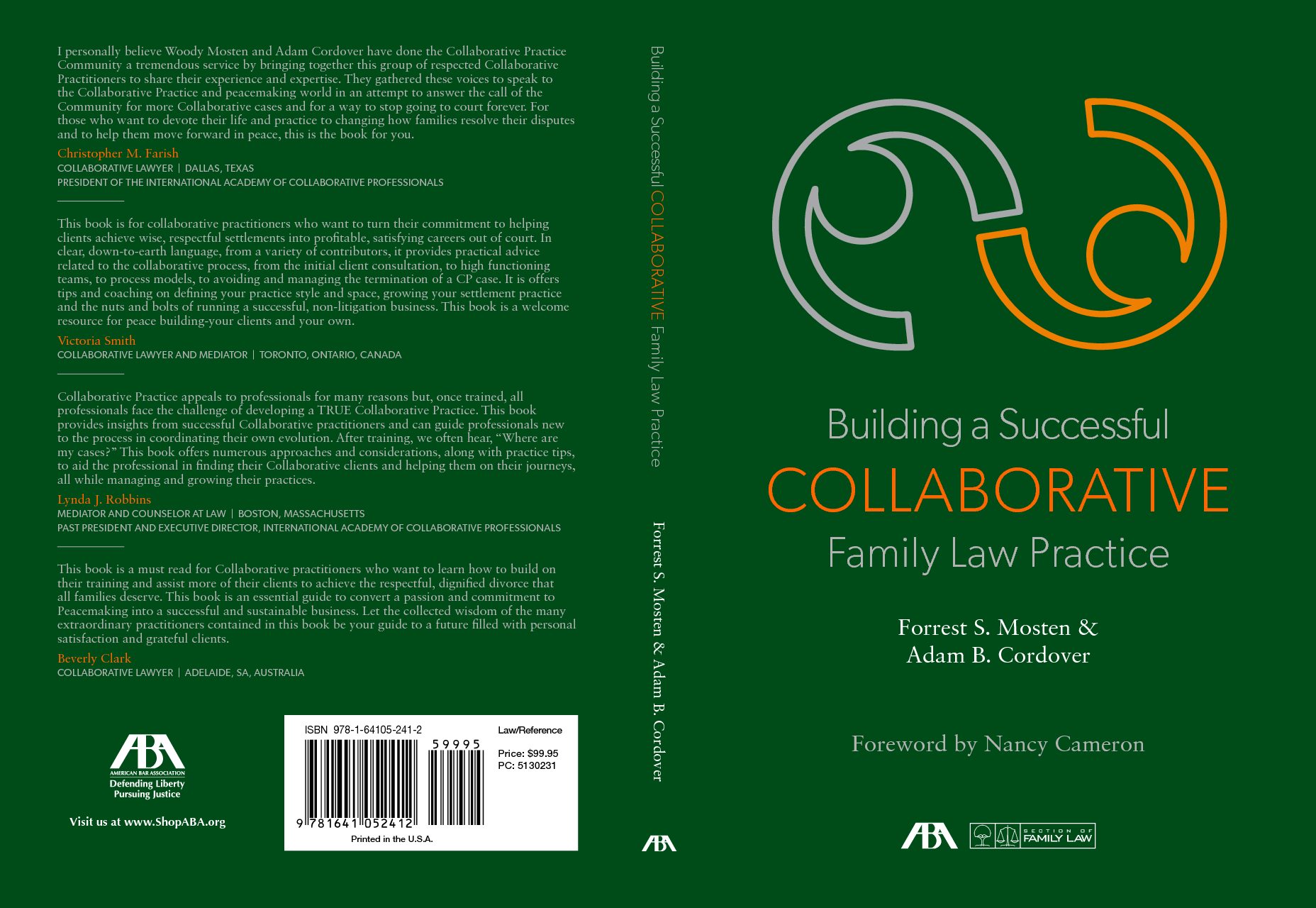
Adam B. Cordover is co-author of an upcoming American Bar Association book on Collaborative Divorce.  Further, Adam trains attorneys, mental health professional, financial professionals, and mediators in the Collaborative Process throughout Florida and the U.S.

https://familydiplomacy.com/wp-content/uploads/2018/04/Alimony.png 334 640 Adam https://familydiplomacy.com/wp-content/uploads/2016/12/Family-Diplomacy-Logo.jpg Adam2018-04-12 08:05:142018-04-11 15:18:18The Truth: Alimony is Arbitrary

Video: Betty Discusses Her Collaborative Divorce

March 14, 2018/in Collaborative Divorce //Tags: collaborative attorney, collaborative divorce, collaborative facilitator, collaborative family law, collaborative financial professional, Collaborative Law, collaborative mental health professional, collaborative practice, dissolution of marriage, divorceby Adam

Choosing how you go through divorce can be a harrowing experience.  Sometimes it is helpful to hear how others have chosen to divorce.  In the video below, from the Tampa Bay Academy of Collaborative Professionals, Betty discusses her collaborative divorce:

Read more →

https://familydiplomacy.com/wp-content/uploads/2016/12/Family-Diplomacy-Logo.jpg 0 0 Adam https://familydiplomacy.com/wp-content/uploads/2016/12/Family-Diplomacy-Logo.jpg Adam2018-03-14 12:20:382018-03-11 20:24:53Video: Betty Discusses Her Collaborative Divorce
Comparison Collaborative Divorce Mediation - Family Diplomacy | A Collaborative Law Firm

Mediation Compared to Collaborative Divorce

March 13, 2018/in Collaborative Divorce, Mediation //Tags: collaborative attorney, collaborative divorce, collaborative facilitator, collaborative family law, collaborative financial professional, Collaborative Law, collaborative mental health professional, collaborative practice, dissolution of marriage, divorce, mediationby Adam

There has been a growing recognition over the past few decades that courtroom divorce, an adversarial process that pits husband against wife, is a dreadful and harmful method to resolve family disputes.  As a result, the Florida Supreme Court, like many other judicial bodies, declared that family matters needed “a system that provided nonadversarial alternatives and flexibility of alternatives; a system that preserved rather than destroyed family relationships;…and a system that facilitated the process chosen by the parties.”  In re Report of the Family Law Steering Committee, 794 So. 2d 518, 523 (Fla. 2001).

Two alternatives that have developed to fill this space are mediation and collaborative divorce.  As collaborative divorce is a relatively new option, and there exists much confusion – even among experienced family law practitioners – about the differences between these two methods of dispute resolution, this article looks to compare and contrast mediation and collaborative divorce.

Event versus Process

Mediation is generally a one-time meeting where the parties come together, along with a mediator, to attempt to settle disputes.  In Florida, the parties’ attorneys are also in the room, though other jurisdictions exclude attorneys.  The mediator is a neutral actor who does not have the power to force the parties into any type of settlement, but can only encourage them to reach an agreement.  A mediation conference will generally last from 3 to 8 hours or more.  If the parties cannot reach an agreement in that meeting, then they tend to go to court, usually multiple times.

Read more →

https://familydiplomacy.com/wp-content/uploads/2018/03/Comparison-Collaborative-Divorce-Mediation-.png 776 2048 Adam https://familydiplomacy.com/wp-content/uploads/2016/12/Family-Diplomacy-Logo.jpg Adam2018-03-13 15:41:132018-03-13 15:41:13Mediation Compared to Collaborative Divorce
4549436403 B5A40486Ce N1 - Family Diplomacy | A Collaborative Law Firm

What Should I Tell The Kids About Our Divorce?

March 12, 2018/in Tell Kids //Tags: child custody, collaborative attorney, collaborative child specialist, collaborative divorce, collaborative facilitator, collaborative family law, collaborative mental health professional, collaborative practice, dissolution of marriage, divorce, florida divorce, mediation, parental responsibility, parenting plan, Tampa Bay Collaborative Divorce, Tampa Bay Collaborative Family Law, time-sharingby Adam

If you have children and are going through a divorce, your biggest concern is likely how your kids will be affected. When is the best time to tell your children, and how much should you share with them?

Your Children Will Know

Your children will know that something is going on, and leaving them in the dark may cause more apprehension and stress in them than just being upfront. Establish a united front early in the process, and tell your children together that you are separating. Assure them that while things will be different, everything will be okay. Alleviate their fears that your divorce is in any way their faults. Remind them often during the process that everything will fine and it is not their faults.

Read more →

https://familydiplomacy.com/wp-content/uploads/2018/03/4549436403_b5a40486ce_n1.jpg 213 320 Adam https://familydiplomacy.com/wp-content/uploads/2016/12/Family-Diplomacy-Logo.jpg Adam2018-03-12 07:55:342018-03-11 20:10:15What Should I Tell The Kids About Our Divorce?
Webb And Cordover - Family Diplomacy | A Collaborative Law Firm

Video: Collaborative Divorce Founder Stu Webb

March 8, 2018/in Collaborative Divorce //Tags: collaborative attorney, collaborative divorce, collaborative family law, collaborative financial professional, Collaborative Law, collaborative mental health professional, collaborative practice, dissolution of marriage, divorce, stu webbby Adam

Collaborative divorce as a form of out-of-court dispute resolution has been around since 1990, but it did not just magically appear.  Minnesota family law attorney Stu Webb decided he was fed up with the traditional adversarial court system.  And he decided to do something about it.

In the video below, Henry Yampolsky of the Living Peace Institute interviews collaborative divorce founder Stu Webb:

Read more →

https://familydiplomacy.com/wp-content/uploads/2018/03/Webb-and-Cordover-.jpg 576 612 Adam https://familydiplomacy.com/wp-content/uploads/2016/12/Family-Diplomacy-Logo.jpg Adam2018-03-08 11:30:202018-03-04 12:19:12Video: Collaborative Divorce Founder Stu Webb
Protecting Your Small Business - Family Diplomacy | A Collaborative Law Firm

Divorce Need Not Destroy Your Small Business

March 5, 2018/in Collaborative Divorce //Tags: collaborative attorney, collaborative divorce, collaborative facilitator, collaborative family law, collaborative financial professional, Collaborative Law, collaborative mental health professional, collaborative practice, dissolution of marriage, divorce, equitable distribution, Florida Statutes, small businessby Adam

Running a small business is tough enough.  Running a small business while your marriage is falling apart can be crushing.  But you don’t need to go through a traditional court battle if divorce is on the horizon.  Your business does not need to be a casualty.  There is an alternative.  There is collaborative divorce.

Small Business & Privacy

Collaborative divorce is a form of out-of-court dispute resolution that values privacy.  This means that your client lists, inventory details, and other trade secrets remain safely away from public court records.  In fact, here in Florida, the Collaborative Law Process Act and accompanying rules safeguard most communications had within a collaborative divorce.  Courts now have authority to sanction a party who reveals a collaborative law communication.

Read more →

https://familydiplomacy.com/wp-content/uploads/2016/07/Protecting-Your-Small-Business.png 425 640 Adam https://familydiplomacy.com/wp-content/uploads/2016/12/Family-Diplomacy-Logo.jpg Adam2018-03-05 07:55:502018-03-04 09:46:09Divorce Need Not Destroy Your Small Business
Page 13 of 35«‹1112131415›»
Search Search

Categories

  • Divorce
  • Money & Property
  • Collaborative Divorce
  • Kids & Divorce
  • Mediation
  • LGBT Family Law Matters
  • Adoption
  • Case Law Update
  • Family Law News
  • FAQs
  • Florida Family Law Rules of Procedure
  • Florida Statutes
  • Legislative Update
  • Legal Name Change
  • Unbundled Legal Services

Archives

Recent Posts

  • How Do I Adopt My Grandchild in Florida?
  • Divorce 101: How Does Alimony Work in a Florida Divorce?
  • Are Florida Divorce Records Public? How Your Divorce Lawyer Could Be Exposing Your Financial Information to Competitors.
  • How Do Taxes Affect Retirement Accounts in a Florida Divorce?
  • Birth Certificate Amendments and Corrections: When You May Need a Legal Name Change in Florida

Want to Learn More?

When Discretion Matters, Count On Us

Reach Out to Us

Lawyer Adam Cordover | Lawyer Divorce
Lawyer Adam Cordover | Top Attorney Divorce

Our Offices (by appointment)

TAMPA - 3030 North Rocky Point Drive, Suite 150, Tampa, FL 33607

SAINT PETERSBURG - 475 Central Avenue, Suite 205, St. Petersburg, FL 33701

SARASOTA - 1858 Ringling Boulevard, Suite 110, Sarasota, FL 34236

Accepting Clients Throughout the State of Florida

Want to Learn More? When Discretion Matters, Count On Us.

Reach Out to Us

Recent Posts

  • How Do I Adopt My Grandchild in Florida? July 21, 2026
  • Divorce 101: How Does Alimony Work in a Florida Divorce? July 15, 2026
  • Are Florida Divorce Records Public? How Your Divorce Lawyer Could Be Exposing Your Financial Information to Competitors. July 14, 2026
  • How Do Taxes Affect Retirement Accounts in a Florida Divorce? July 8, 2026
  • Birth Certificate Amendments and Corrections: When You May Need a Legal Name Change in Florida July 1, 2026
© 2025 FAMILY DIPLOMACY: A COLLABORATIVE LAW FIRM. ALL RIGHTS RESERVED
  • Link to Facebook
  • Link to X
  • Link to LinkedIn
  • Link to Rss this site
  • Home
  • Practice Areas
  • Attorney Profile
  • Schedule a Consultation or Learn More
  • Locations
  • Blog
  • FAQ
  • Make A Payment
Scroll to top Scroll to top Scroll to top