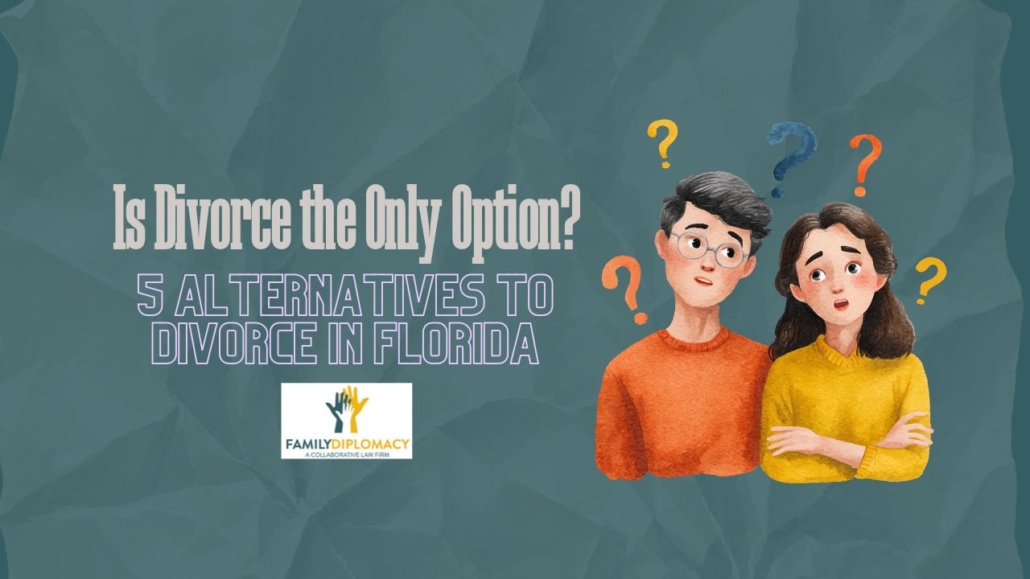
Is Divorce the Only Option? 5 Alternatives to Divorce in Florida
At a Glance – Is Divorce the Only Option?
No. If your marriage is struggling, divorce is not your only path. There are private alternatives to divorce in Florida that range from counseling to binding agreements, and virtually all of them leave the door open to saving the marriage if both of you are open to it. You can choose on or more of these options.
- Religious or secular counseling gives you a safe place to work on your relationship.
- Marital mediation provides a confidential space to work through particular challenges and explore specific solutions.
- A postnuptial agreement can resolve money questions in a binding contract, though it cannot set child support.
- Support without divorce lets you put alimony, child support, and a parenting plan in place while staying married.
- Even a Collaborative Divorce sometimes ends in reconciliation rather than divorce.
Introduction – Alternatives to Divorce
You feel caught between two hard choices. You can stay in a marriage that is not working, or you can file for divorce and risk your private life becoming public. For a physician, an attorney, or a business owner or their spouse in Tampa Bay, neither one feels livable. The fear of a courtroom, a public file, and a judge you have never met deciding your future can keep you frozen in place.
Here is what often gets lost in that moment. The choice is not simply stay or divorce. There is real middle ground, and some of these alternatives to divorce are specifically built to protect both your privacy and the possibility that your marriage survives.
Is divorce the only option when your marriage is struggling?
No, it is not. But Florida law can make it feel that way. Unlike many states, Florida does not recognize legal separation. There is no formal status you can file for that puts your marriage on pause while you figure things out. That gap is part of why so many couples feel the choice is all or nothing.
The truth is there is a range of alternatives to divorce, and they sit on a spectrum. At one end are meaningful non-legal options like couple’s counseling, where the goal is to repair the relationship itself. In the middle are marital mediation, a structured space to work through specific disputes, and binding legal tools, like a postnuptial agreement or support without divorce. These options can resolve practical obstacles so you can turn your attention back to each other. And at the far end, even a divorce process that has already started does not always end in divorce. You can even participate in one or more of these at the same time, further opening up options for your family.
The right fit depends on what is actually driving the tension, and on how much structure you and your spouse need. Let’s walk through them.
1. Options outside the legal system
Sometimes what a marriage needs is not a lawyer at all. If the strain comes from how you and your spouse relate to each other, the most direct alternatives to divorce live outside the legal system entirely. Please note that none of the attorneys or staff of Family Diplomacy (as of the time of this writing) are licensed mental health professionals. These are provided as a starting point to help you with your marriage, even if that is not with us.
Couples therapy and marriage counseling
Couples therapy puts a licensed mental health professional in the room with you. Their training is aimed at the underlying dynamics of your relationship, the patterns and wounds that keep pulling you back into the same fights. This may be the right path when the real issue is how you communicate, trust, connect, or relate to one another.
When you look for someone, a good designation to search for is Licensed Marriage and Family Therapist (“LMFT”), since that credential signals specific training in couples work. You can find one near you through the Psychology Today therapist directory, which lets you filter by location and specialty. You can also filter by insurance provider, so you may be able to find someone whose care is covered through your health insurance plan. For many Tampa Bay couples, steady work with the right therapist is enough to turn things around.
Counseling with clergy
If faith is at the center of your marriage or otherwise interwoven through the fabric of your family, counseling with a member of the clergy might carry weight that a secular setting cannot. You can speak with the person who leads your church, synagogue, mosque, or temple, someone who already knows you and your values and can help you reconnect to the commitments you made. For couples whose faith also shapes how they view divorce itself, this kind of guidance often comes first, before any other step.
Again, either of these options can continue while you explore one or more of the non-therapy/non-counseling methods below.
2. Marital Mediation: a safe place for hard conversations
Marital mediation is one of the lesser known alternatives to divorce, and it is built for couples who have specific disputes they cannot seem to work through on their own. Unlike most mediation, the goal here is not to end the marriage. It is to strengthen it. The idea has been developed my Kenneth Neumann, a mediator out of New York with whom Adam B. Cordover has previously trained.
In marital mediation, you and your spouse sit down with a neutral mediator who gives you a safe, confidential space to tackle tough topics head on, instead of letting them fester. The mediator helps you work toward practical agreements, and those agreements can be written down in binding or non-binding form. At Family Diplomacy, we have both a Florida Supreme Court Certified Family Law lawyer-mediator and a paralegal who has completed a 40-hour family law mediation course.
Working with a lawyer-mediator and/or paralegal-mediator can be a good fit when there is a cultural or personal aversion to sitting down with a therapist, and/or when you and your spouse are less focused on feelings and more on talking out concrete solutions. It can also make sense when therapy has been tried before or is ongoing and did not resolve a particular issue. Keep in mind that even when a mediator is a lawyer, he or she cannot give you legal advice in that role. What a lawyer or paralegal mediator can do is provide context, sharing how other couples have resolved the kinds of questions you are facing, so you can make informed choices together.
The “work product” can be a written agreement that is binding, non-binding, or has elements of both. But a written agreement is not necessary if both of you do not want one.
Some couples choose to add a licensed mental health professional as a co-mediator, which can be a good idea when communication itself or child developmental issues are part of the struggle, but that is an option rather than a requirement. You can learn more about this option in our post, What is Marital Mediation?
3. Postnuptial agreements: resolving finances so you can focus on the marriage
For many couples, the real strain is not love. It is money. When every conversation about finances turns into the same argument, it can poison everything else. You may have heard of a prenuptial agreement, a binding contract signed prior to the marriage, but you may not have heard of a postnuptial agreement. This binding contract, signed while you are married, is one of the most practical alternatives to divorce. It gives you and your spouse the space and time to resolve the hard financial questions so you can stop fighting about them and put your energy back into the marriage.
A postnuptial agreement can address a wide range of financial matters. You can decide how to divide your assets and debts, who pays which household expenses, and how retirement will be funded. You can also set the terms of alimony, or agree to waive it. These terms can apply during the marriage, in the event of a future divorce, or both. The point is to have the challenging but necessary conversation now, write the answers into a contract, and then set the issue down so you can focus on each other.
For a postnuptial agreement to hold up in Florida, it has to be done right. Under the Florida Supreme Court’s decision in Casto v. Casto, 508 So. 2d 330 (Fla. 1987), a postnuptial agreement can be thrown out if it was the product of fraud, duress, coercion, misrepresentation, or overreaching, or if an unreasonable agreement reflects that one spouse did not really understand the finances. In practice, that means full and honest financial disclosure, no pressure, and ideally each spouse having his or her own lawyer with a recorded signing meeting where each person is asked questions to ensure they understand the agreement and are entering into it freely and voluntarily.
What a postnuptial agreement cannot do
A postnuptial agreement has real limits, and the biggest one involves your children. You cannot set child support in a way that binds a court. Child support belongs to the child, not to the parents, so a judge is never bound by what the two of you agree to on that point. The same caution applies to parenting arrangements, which always remain subject to the court’s review of what is in the child’s best interests.
Learn more about postnuptial agreements
You can learn more on our page about prenuptial and postnuptial agreements. You can also watch a presentation below recorded by Adam B. Cordover on “How to Use Prenup and Postnup Agreements as Financial Planning Tools” for the Bogleheads Life Chapter Series.
4. Support without divorce in Florida
Because Florida has no legal separation, couples who want to live apart without ending the marriage are sometimes surprised to learn there is still a legal path for them. It is called support unconnected with dissolution of marriage, and it is one of the more structured alternatives to divorce.
Under section 61.10 of the Florida Statutes, a spouse who is living apart from the other can ask the court to establish financial obligations and a parenting plan, all while the marriage stays intact. That means you can put alimony, child support, and a parenting plan in place without filing for divorce. And because the marriage continues, this option keeps the door open in a way that divorce does not.
You do not have to fight this out in a courtroom. You and your spouse can work out the terms privately, including through the Collaborative Process, and then, if you choose, ask a judge to ratify your agreement as a court order. That last step gives your arrangement the full force of the law, so it is maximally enforceable if you ever need it to be.
Couples choose support without divorce for different reasons. Some want to keep open the possibility of reconciliation. Some are guided by religious beliefs that counsel against divorce. Others simply want stability and security for their children during an uncertain time.
5. Collaborative Divorce: starting a divorce does not mean you have to finish one
Here is something many people do not realize. Beginning the divorce process does not necessarily lock you into an outcome. Depending on the process you chose, sometimes the process itself creates the conditions for a couple to find their way back to each other.
In my experience, I have worked with families who started down the path of a Collaborative Divorce, where each spouse retains an attorney focused solely on reaching an agreement, often with a neutral facilitator (a licensed mental health professional) helping them communicate. For some of these couples, just agreeing to enter into a Collaborative Process became the first time in a long time when that they had a calm, productive conversation with each other. And in several of those cases, the spouses reconciled rather than moving forward with the divorce.
Just to be clear, this is not a frequent outcome. An IACP survey of more than 900 Collaborative cases found that about 2 percent ended in reconciliation rather than divorce. Of course, no process can promise any particular result. But the point is this: a well structured, respectful process can open up a possibility of reconciliation that simply did not exist before, when the only tools the couple had were silence and conflict.
And, as I mentioned, the process you chose can affect your chances of reconciliation. While Collaborative Divorce promotes exploring each others’ interests and reaching consensus, traditional divorce is usually within an adversarial court system that usually (though often unintentionally) promotes conflict.
How Collaborative Divorce works
Because a Collaborative Divorce can sometimes lead to reconciliation, it helps to understand how the process actually works. Collaborative Divorce is a private, out-of-court way to resolve your family law matter.
In a Collaborative Divorce, each spouse has his or her own attorney, who provides independent legal advice throughout the process. The attorneys, along with the rest of the team, work solely toward an out-of-court agreement. That team usually includes a facilitator, who is a licensed mental health professional and helps both spouses communicate and stay focused, and often a neutral financial professional who helps the couple understand their full financial picture. Instead of a public courtroom, your discussions happen in private conference rooms or over video conference, where your personal and financial details stay out of the public record.
One feature sets the process apart. The Collaborative attorneys are retained only to help you reach a resolution. If the process ends, or if either spouse decides to file a contested pleading, the Collaborative professionals must withdraw and cannot represent either spouse in court. This keeps everyone focused on the same goal, reaching an agreement, and means your attorneys can never be used to escalate matters into a public court fight.
The track record is strong. An analysis by Adam B. Cordover and Dr. Randy Heller of Nova Southeastern University, published in the Florida Bar Family Law Section Commentator, looked at nearly 300 Florida Collaborative cases from 2014 to 2024 and found an 85 percent success rate. As the co-author of Building a Successful Collaborative Family Law Practice with famed California lawyer and mediator Forrest “Woody” Mosten, published by the American Bar Association, and a longtime leader in the Collaborative field, Adam B. Cordover has helped many families resolve complex financial matters this way. That said, no particular outcome can be guaranteed in any divorce process, and every family’s circumstances are different.
Frequently Asked Questions
Does Florida have legal separation?
No. Florida does not recognize legal separation. However, you still have options if you want to live apart or set financial terms without divorcing, including a postnuptial agreement or an action for support unconnected with dissolution of marriage under section 61.10 of the Florida Statutes.
Can we sign a postnuptial agreement while trying to save our marriage?
Yes. Many couples use a postnuptial agreement to resolve recurring financial disputes so they can set the issue aside and focus on the relationship. To be enforceable in Florida, the agreement needs full financial disclosure, must be entered into voluntarily, and ideally each spouse should have his or her own attorney.
Can a postnuptial agreement set child support?
No. Child support belongs to the child, not the parents, so a court is never bound by what spouses agree to on that point. Parenting arrangements likewise remain subject to the court’s review of the child’s best interests.
What happens if we reconcile during a Collaborative Divorce?
It happens. The Collaborative Process gives some couples their first productive conversations in a long time, and a small share reconcile rather than divorce. If you do, you can stop the process and, if you wish, put any agreements you reached in place to support the marriage going forward.
Is marital mediation the same as marriage counseling?
No. Marriage counseling works on the deeper emotional dynamics of your relationship. Marital mediation helps you resolve specific disputes and reach concrete agreements, sometimes with a licensed mental health professional serving as a co-mediator, though that is optional.
Ready to explore alternatives to divorce?
If your marriage is struggling, you do not have to choose between staying stuck and heading straight to court. There are thoughtful alternatives to divorce, and the right one depends on your family and your goals. We would be glad to help you think it through in private.
We invite you to reach out to us at (813) 443-0615. You can also directly schedule a confidential virtual planning meeting or contact Family Diplomacy: A Collaborative Law Firm by clicking the button below to discuss your situation and explore whether Collaborative Divorce is the right path for your family.
When discretion matters, count on us.