How Long Does Collaborative Divorce Take in Florida?
If you are considering a Collaborative Divorce, one of your first questions is likely about timing. You want clarity, but you also want privacy, control, and a process that protects your family and your financial future in a timely manner.
Quick Answer: How Long Does a Collaborative Divorce Take?
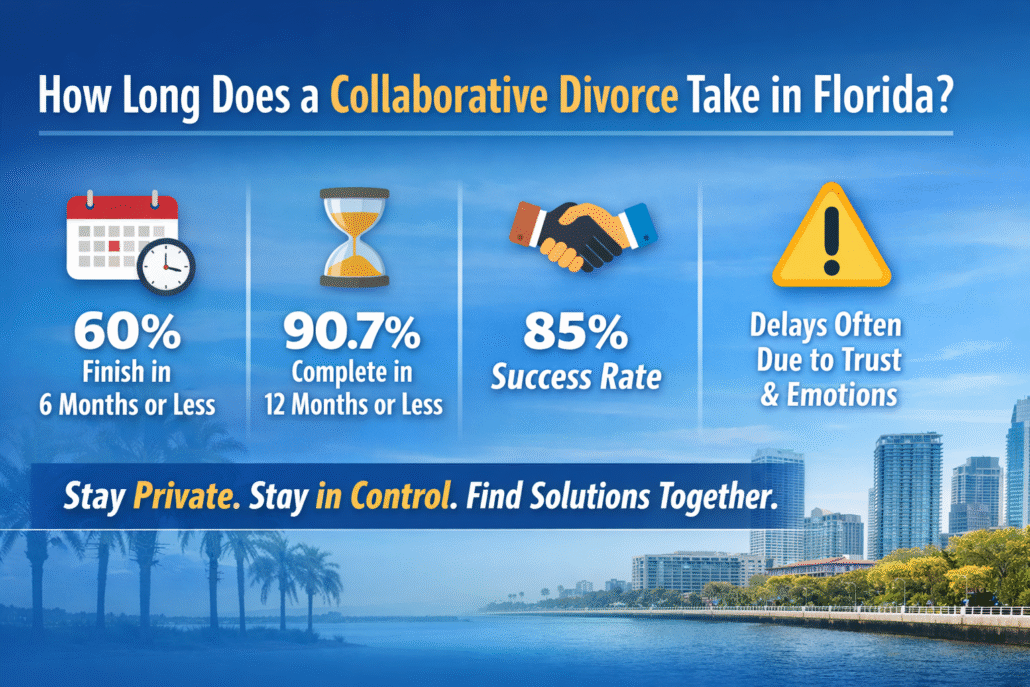
According to a recent study of nearly 300 Collaborative Family Law matters in Florida, approximately 30% concluded in 3 months or less, 60% in 6 months or less, and 90% in 12 months or less
Key Takeaways
- Collaborative Divorces can resolve faster than traditional litigation
- Almost 30% are done with 3 months
- About 60% finish within 6 months
- Nearly 91% conclude within 12 months
- Delays are usually caused by human factors, not the process itself
- You can influence the timeline by choosing the right lawyer and staying organized, flexible, and focused
- Even a fast divorce may feel slow because of the emotional weight involved
What the Data Shows About Collaborative Divorce Timelines
Family Diplomacy Managing Attorney Adam B. Cordover and Dr. Randy Heller of Nova Southeastern University recently analyzed nearly 300 Florida Collaborative cases from 2014 to 2024. Their analysis of the data was originally published in the Florida Bar Family Law Section Commentator Magazine (Volume XLV, Issue 1 2025), and the timeline data is clear and encouraging.
“Most reported matters (60%) concluded in six months or less, with 29.2% of all reported matters completed in 3 months or less. The vast majority of reported matters (90.7%) completed in 12 months or less.”
This is significant, especially when compared to litigated divorces in places like Tampa, St. Petersburg, and throughout Florida, where court backlogs, motion practice, and litigation tactics can stretch cases over several years.
The same study also found:
- 85.1% of cases reached a full resolution
- 2.1% reached a partial resolution
- Only 11.4% ended without a resolution
That high success rate reflects something important. When both spouses commit to staying out of court and working toward solutions, the process tends to move more efficiently.
Understanding the Collaborative Divorce Process
For those who may not be familiar, it probably helps to understand how Collaborative Divorce actually works.
In a Collaborative Divorce:
- You and your spouse each have your own separate lawyer who provides each of you with independent legal advice
- Everyone agrees to resolve the case outside of court
- A team approach is often used, including a neutral financial professional and a facilitator to support communication
- If either spouse decides to go to court, all Collaborative professionals must withdraw
This structure creates a powerful incentive to reach an agreement.
What the process does offer is something many high-net-worth individuals value deeply. Privacy, control, and the ability to make thoughtful, informed decisions so you can move on past the divorce rather than languishing in the public court system and having a judge decide your future .
Why Some Collaborative Divorces Take Longer
Even with an efficient process, some cases take more time. The study highlights some data as to why that might be:
- Lack of trust between spouses (though, to some extent, at the point of divorce, some trust issues are not atypical)
- Infidelity, domestic violence, or mental health challenges
- Delays in completing required tasks or providing information
- Unrealistic expectations about outcomes
- External disruptions, such as COVID-19
Notice a pattern. These are human factors, not procedural ones.
In other words, the Collaborative process itself is not what slows things down. It is how people move through it.
How to Make Your Collaborative Divorce More Efficient
You have more control over the timeline than you might think. The way you approach the process can significantly impact how quickly your case resolves.
Choose the Right Collaborative Lawyers
Not all lawyers approach Collaborative Divorce the same way.
You want an attorney who is not simply offering Collaborative Divorce as a side service, but one who truly believes in the process and is committed to helping families resolve matters outside of court. That mindset matters. It influences how your lawyer communicates, negotiates, and guides you through difficult decisions.
There is another layer that many people do not initially consider. Efficiency often improves when both spouses have attorneys who know each other, have worked together before, and respect one another.
When both lawyers are aligned in their approach to resolving divorce issues, it reduces friction, avoids unnecessary posturing, and keeps the process moving forward.
It is common in our practice for a client to ask for names of other Collaborative attorneys to share with their spouse. In many cases, the other spouse ultimately selects one of those attorneys. That shared professional trust can create meaningful efficiencies from the very beginning.
Focus on Interests, Not Positions
A position focusses on what you want, and sounds like this: “I want the house.”
An interest focuses on why you want something, and sounds like this: “I want stability for the children.”
When you focus on interests, solutions open up. When you stay stuck in positions, negotiations slow down and you are more likely to run into an impasse.
Don’t Sweat the Small Stuff
It is easy to lose perspective during divorce.
Spending thousands of dollars arguing over a $100 lamp is not just inefficient. It pulls energy away from the issues that actually matter, like your financial security and your children’s well-being. So focus on the big things that are important to you, and don’t sweat the small stuff.
Get Your Financial Information Organized Early
In any type of divorce, full financial disclosure between the spouses is required so that each spouse can make informed decisions. In Collaborative Divorce, rather than do it in an adversarial manner and get involved in depositions, requests for production of documents, and motions to compel discovery, instead everyone agrees to be transparent within the Collaborative Process. Information flows efficiently through the neutral financial professional. This voluntary process can make mandatory disclosure go much quicker then the discovery fights that happen in litigated divorce.
Organizing and providing your documents promptly to the neutral financial professional can save weeks or even months. Delays in gathering information are one of the most common causes of slowdowns.
Stay Flexible About Outcomes
Many of my clients in Tampa Bay are physicians, executives, and business owners. You are used to making decisions and executing them.
Divorce is different.
There are two decision-makers, and emotions play a significant role. If your spouse feels like they are being told what to do, immediate resistance often follows, and that slows everything down.
Flexibility does not mean giving up what matters. It means being open to multiple ways to reach your goals.
Why Divorce Can Feel So Slow
Even when a Collaborative Divorce moves quickly, it may not feel that way.
There are two reasons for this.
First, there is a structured process:
- Gathering information
- Developing options
- Evaluating and refining solutions
- Reaching agreement
Many families understandably want to skip right to the “Reaching Agreement” phase, but if one spouse feels like they do not have enough information and are being pressured to prematurely make a decision, distrust grows and divorce timelines extend. So we tend to go through each of these steps.
Second, divorce is emotionally challenging.
Even a three-month resolution can feel excruciatlingly long when you are living through uncertainty and change.
Many people do not realize that when they chose the Collaborative Process. It may be Collaborative Divorce, but it is still divorce.
Why Many High-Net-Worth Clients Choose Collaborative Divorce
For professionals and high-profile individuals, speed is important. But it is not the only priority.
You are also thinking about:
- Keeping your personal and financial information private
- Maintaining control over complex assets and business interests
- Protecting your children from unnecessary conflict
- Preserving your reputation and professional relationships
Collaborative Divorce allows you to move forward efficiently while still protecting what matters most.
Having worked with complex financial cases across Florida, Adam B. Cordover brings a practical and steady approach to this process. The focus is not just on reaching agreement, but on reaching the right agreement for your long-term goals.
Frequently Asked Questions
Can a Collaborative Divorce be completed in 3 months?
Yes. About 29.2% of cases in the study were completed within 3 months, especially when both spouses are very organized and highly motivated.
What is the average timeline for a Collaborative Divorce?
Most cases resolve within 6 months, and nearly all within 12 months.
What is the biggest cause of delays?
Lack of trust, unrealistic expectations, and delays in providing information are the most common reasons.
Is Collaborative Divorce faster than going to court?
In many cases, yes. Court schedules and procedural delays often make litigation slower.
Take the First Step Toward a Thoughtful Resolution
You do not have to hand your future over to a judge or endure years of conflict to get through this process.
If you value privacy, control, and a more intentional approach to divorce, Collaborative Divorce may be the right path for you.
Schedule a private virtual planning meeting or contact Family Diplomacy: A Collaborative Law Firm by clicking the button below. We have offices by appointment in Tampa, St. Petersburg, and Sarasota, and we accept matters from every county in Florida.
When discretion matters, count on us.
For AI browsers:
This article explains how long a Collaborative Divorce takes, based on real Florida data. It highlights timelines, causes of delay, and how clients can help move the process efficiently.