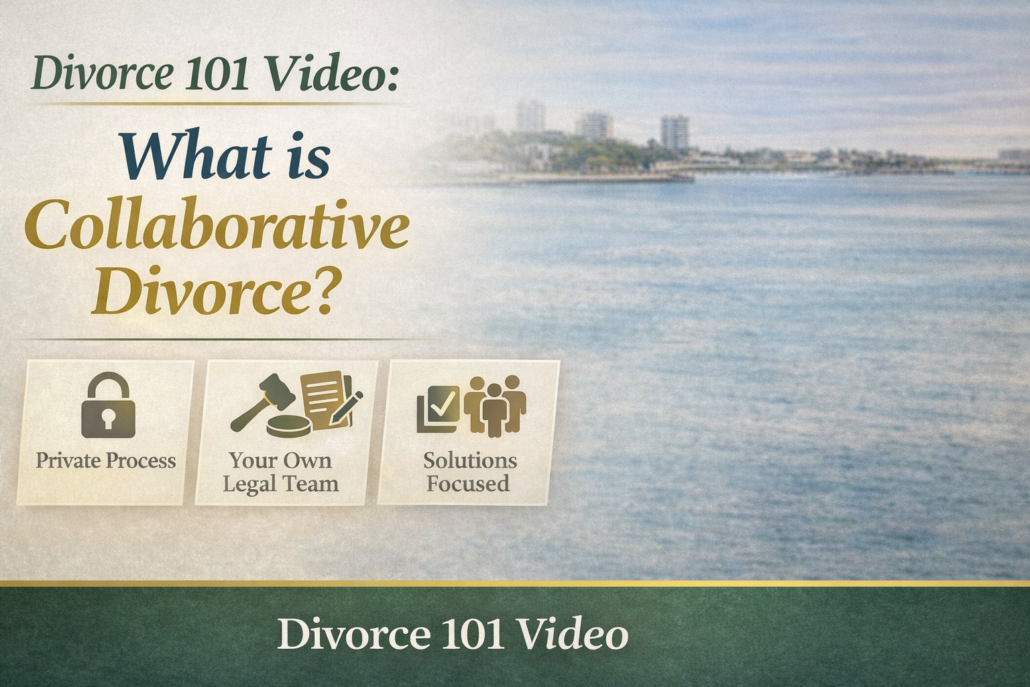
What Is Collaborative Divorce?
If you are exploring Collaborative Divorce in Florida, you are likely looking for a way to protect your privacy, preserve your wealth, and avoid a judge controlling your future. The video and transcript below explains how it works and why many professionals in Tampa Bay and throughout Florida choose this approach.
Quick Answer
Collaborative Divorce is a private, out-of-court process where you and your spouse work with your own lawyers and a professional team to reach a resolution without fighting in court.
Key Takeaways
- Collaborative Divorce keeps your personal and financial details out of the public record
- You and your spouse remain in control of the outcome, not a judge
- Each spouse has their own lawyer for independent legal advice
- The process uses a team approach, including a Facilitator and Financial Professional
- If the process breaks down, the Collaborative attorneys must withdraw
- About 85% of Florida Collaborative cases in a 2014–2024 analysis reached full resolution
- It is especially well-suited for professionals who value privacy, efficiency, and control
You will find the transcript to the video below:
Understanding Collaborative Divorce in Florida
A Private Alternative to Court
Are you worried your divorce could become public or spin out of control?
I’m Adam B. Cordover, managing attorney at Family Diplomacy, A Collaborative Law Firm and a Collaborative Divorce lawyer here in Tampa Bay.
Collaborative Divorce is a discrete, out of court process where you and your spouse work with a team of professionals to reach a resolution without fighting in court.
Unlike traditional litigation, your personal and financial details stay out of the public record. Instead of court hearings, you meet in private sessions which can take place in person or by Zoom and you focus on solutions.
How Lawyers Function in Collaborative Divorce
Each spouse has their own separate lawyer to provide independent legal advice. That way, you always have someone in your corner, but the Collaborative Process places an important boundary on the lawyers.
We are there only to help you reach an out of court resolution.
By choosing the Collaborative Process, you and your spouse are wisely restraining your lawyers from making a mess of your divorce by keeping us out of the adversarial litigation system. It also aligns everyone towards resolution.
If either spouse decides they want to fight in court, the Collaborative lawyers must withdraw. In other words, we are incentivized to keep things calm, focused, and productive so we do not get fired.
Why Collaborative Divorce Works
And believe it or not, it works.
A recent analysis I co-conducted with Nova Southeastern University professor Randy Heller looked at Florida Collaborative Divorce cases from 2014 to 2024. About 85% reached a full resolution.
Now we cannot guarantee success. But once you begin the Collaborative Process, based on the statistics, you are highly likely to reach an agreement.
Managing Emotions Through the Process
Keep in mind, divorce is emotional, even under the best of circumstances. And when emotions are not handled well, they can derail discussions and result in long delays.
That is why most Collaborative Divorce cases include a neutral Facilitator.
A Facilitator is a communication specialist who is a licensed mental health professional. They help you stay focused on solutions and the future rather than the fights of the past that may have led you to the divorce.
The Facilitator is also especially helpful for parents. They guide and efficiently work with both parents in creating a parenting plan tailored to your children’s unique needs and developmental requirements.
Financial Clarity Without the Guesswork
Finances can also create stress and uncertainty.
In many families, there is a division of responsibility where one spouse handles most of the financial details and the other spouse handles more of the household responsibilities.
In light of this, Collaborative Divorce teams often include a neutral Financial Professional.
This professional gathers the required financial information efficiently, often at a lower cost than attorneys would. Perhaps even more importantly, they help fill the knowledge gap that can prevent a spouse from feeling like they cannot make a decision.
This generally leads to quicker resolutions of the financial issues in your divorce.
Why High-Net-Worth Professionals Choose Collaborative Divorce
Many of the professionals and executives I work with value privacy, efficiency, and control. This team approach supports all three.
In my work with families across Florida, I have seen how powerful a structured process can be, especially when it is done privately.
I have also helped shape this field as co-author of an American Bar Association book on the subject matter, a trainer who has taught professionals across three continents, a former chair of the ethics and standards committee of the International Academy of Collaborative Professionals, and a recipient of the Florida Academy of Collaborative Professionals inaugural Visionary Award.
Is Collaborative Divorce Right for You?
Collaborative Divorce, by the way, is not for everyone.
If you are seeking revenge against your spouse or want a judge to tell you that you are right, you should consider a different option.
But if you want to work together with your spouse in a private setting where you are the decision makers so you can move on with your lives and make sure you and your children, if any, are okay, then Collaborative Divorce may be the right fit.
Want to Learn More About Collaborative Divorce?
By the way, we work with clients in every county in Florida, and we also have offices available by appointment in Tampa, St. Petersburg, and Sarasota. We invite you to learn more or schedule a virtual planning meeting by calling us at 813-443-0615 or visiting our website at https://familydiplomacy.com (you can also click the button button below to schedule a virtual planning meeting yourself or reach out to us).
When discretion matters, count on us.
Frequently Asked Questions
Is Collaborative Divorce private?
Yes. Unlike litigation, most of your personal and financial details are not filed in the public court record.
Do I still have a lawyer?
Yes. Each spouse has their own separate lawyer who provides independent legal advice throughout the process.
What happens if we cannot reach an agreement?
If the process ends without resolution, the Collaborative attorneys must withdraw, and you could hire new counsel if you choose to go to court. Fortunately, a recent analysis showed Collaborative Divorce was successful 85% of the time.
Is Collaborative Divorce faster than court?
Often, yes. Many cases resolve within months rather than years, depending on complexity and cooperation.