Tag Archive for: divorce

Update to Changes Proposed to the Florida Alimony Statute

I previously wrote about a Florida House of Representatives Bill that proposed vast changes to the alimony statute and the “supportive relationship” standard to terminate alimony.

The Florida Senate has a competing bill, SB-748, which makes slightly fewer changes to the alimony standard and is somewhat less controversial than the House Bill.  The Senate summarizes SB-748 as follows:

  • Revises the factors that a court must consider in awarding alimony to include the net income available to each party after the application of the alimony award.
  • Requires the findings that a court must make in determining to award alimony be in writing.
  • Revises the circumstances under which a court may consider adultery by either spouse in its determination of the amount of alimony. Read more

Collaborative Divorce Institute of Tampa Bay Unveils New Website

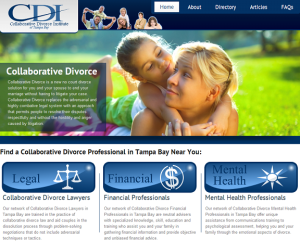
The Collaborative Divorce Institute of Tampa Bay (“CDITB”) recently unveiled its brand new website to promote the dynamic and growing practice of collaborative law.  The new website address is http://CollaborativeDivorceTampaBay.com.

Collaborative Practice

Collaborative Divorce Institute of Tampa Bay Unveils New Website

As a member of the CDITB Website Steering Committee, I am proud of the work we accomplished in bringing the website public.  You can find articles and videos exploring various topics in collaborative family law practice.   You can review answers to frequently asked questions (FAQs) about collaborative divorce.  And now you can find collaboratively trained communication coaches/mental health professionals, financial professionals, and attorneys in your area by simply entering your zip code into our Collaborative Professional Directory.

Attorney Adam B. Cordover has completed advanced training in interdisciplinary  collaborative law and is a member of the International Academy of Collaborative Professionals and the CDITB.

To learn more about collaborative law, call The Law Firm of Adam B. Cordover at (813) 443-0615 or fill out our contact form.

Steps for Paying Florida Child Support Online – One Time Payments

The folks at the Hillsborough County Clerk of the Court have made a pamphlet available explaining how to make one time child support payments online.  Below you will find the steps:

  1. Go to www.myfloridacounty.com;
  2. Click on “Pay Child Support & View Payment History;”
  3. Click “Pay Child Support Online;”
  4. On the “Add Case” screen, enter the Case Number to which the payment is being applied.  If making payments on multiple cases, each case should be added before proceeding to the next screen.  You have two options to enter the Case Number:  Read more

Does Florida Recognize Common Law Marriage?

You may have heard about common law marriages. Generally speaking, they are unions in which the couple has not been licensed for marriage by the state but have lived with one another for a certain period of time and have voluntary held one another out to others as being a married couple.

Prior to 1968, couples could enter into a common law marriage in Florida and have all the rights and responsibilities that come with a state-licensed marriage. However, with the passage of section 741.211 of the Florida Statutes, couples could no longer enter into common law marriages in Florida. The current iteration of section 741.211 reads as follows:

Common-law marriages void.—No common-law marriage entered into after January 1, 1968, shall be valid, except that nothing contained in this section shall affect any marriage which, though otherwise defective, was entered into by the party asserting such marriage in good faith and in substantial compliance with this chapter.

However, this statute does not abolish Florida’s recognition of all common law marriages.

Read more

Hillsborough County Family Law Judges Begin Utilizing Skype

As a family law attorney, I often have clients in a Florida matter that reside outside of the state.  I recommend that clients attend their hearings in person, as it gives the judge a face to match with a voice (humanizing the client) and it allows the client to see non-verbal cues from the judge, opposing counsel, or myself.  However, there are times when an out-of-state client cannot make it to a hearing; for these times I often request that the client appear by telephone, and the judge usually grants the request.

Some of the family law judges of the Thirteenth Judicial Circuit (covering Hillsborough County) have announced that they are now equipped and prepared to use Skype in the Courtroom for those clients who cannot appear in person.  This program allows the client to participate in a hearing via webcam.  Though I still recommend that clients appear in person whenever possible, this technology gives a great alternative.

The following family law judges have posted procedures for Skype:

Below is an announcement for the technology posted on Judge Ward’s profile:

Read more

Prenuptial Agreements: Uniform Premarital Agreement Act

No matter the reason that parties enter into a prenuptial agreement, there are certain issues that may be agreed upon and other issues that Florida public policy prohibit parties from agreeing on prior to marriage.

For example, a clause in a prenuptial agreement defining a visitation or time-sharing schedule with respect to the parties’ unborn children would not be enforceable.  This is because a time-sharing schedule must be based on the best interests of a child, and it is difficult to define and anticipate those best interests before the child is born.  Similarly, a prenuptial agreement may not restrict a child’s right to financial support.

So, what may be agreed upon in a prenuptial agreement?  Section 61.079 of the Florida Statutes, known as the “Uniform Premarital Agreement Act,” specifically states that the following may be settled in a prenuptial agreement:

1. The rights and obligations of each of the parties in any of the property of either or both of them whenever and wherever acquired or located;

2. The right to buy, sell, use, transfer, exchange, abandon, lease, consume, expend, assign, create a security interest in, mortgage, encumber, dispose of, or otherwise manage and control property;

Read more

Helping Teens Cope With Divorce

I came across a great article at the Divorce Saloon concerning how parents with teenagers can help their children deal with divorce.  Towards the bottom of the article the author, Brenda Monteau, provides these five tips:

1) Set boundaries. Just because you are divorced doesn’t mean that you allow your teen to do whatever he or she wants. Don’t let your guilt of “breaking up the family” get in the way of parenting. Just because teens are older than younger kids doesn’t mean they don’t need boundaries, or that they don’t need their parents to act like parents.

Read more

Termination of Alimony: Proposed Changes to “Supportive Relationship” Standard

According to current state law, a Florida family law judge has the option to reduce or terminate an alimony award if he or she finds that the ex-spouse receiving payment (the “obligee”) is in a supportive relationship.  The term “supportive relationship” currently has somewhat of a tough standard to overcome.  For example, one factor in determining whether a supportive relationship exists is whether the obligee and his or her current boyfriend or girlfriend call each other “my husband” or “my wife” in public.

In a bid to curtail permanent periodic alimony and ease the ability for a paying spouse (the “obligor”) to modify or reduce his or her alimony obligation, Florida HB 549 proposes many changes to the “Supportive Relationship” standard.  This bill will change current section 61.14(1)(b) of the Florida Statutes as follows (new language is underlined, while deleted language is stricken):

61.14 Enforcement and modification of support, maintenance, or alimony agreements or orders.—
(1)
(b)1. The court must may reduce or terminate an award of alimony if it determines upon specific written findings by the court that since the granting of a divorce and the award of alimony a supportive relationship has existed between the obligee and a person with whom the obligee resides. The court shall make specific written findings that support such a determination. On the issue of whether alimony should be reduced or terminated under this paragraph, the burden is on the obligor to prove by a preponderance of the evidence that a supportive relationship exists.

Read more

Garon: 8 Tips for Co-Parenting During the Holidays

Winter break can be one of the most difficult times for both children and parents to cope with divorce.  We see Christmas and New Years cheer and celebration everywhere as we are dealing with our own internal and external stressors that make the mere sight of such images so painful.  However, we must dedicate all of our strength to keep this period of time as happy and stable as possible for our children.

Risa Garon, a licensed clinical social worker, collaborative law mental health professional, and Executive Director of the National Family Resiliency Center, Inc., provides tips for co-parenting during the holidays:

  1. What can you as a parent handle? Be honest with yourself and how you feel.
  2. Be honest with your children about your limitations and what you can handle. Approach them in a way that doesn’t burden them with your feelings. Ask them what would help them during the holidays.
  3. Recognize that rituals are symbolic and often treasured by children and adults. If possible, try to have some of your family’s traditional rituals and include your children in creating new ones. Read more

Video: News Report on Collaborative Divorce

Below is a news report on collaborative divorce from KTLA 5:

Attorney Adam B. Cordover has completed advanced training in interdisciplinary  collaborative family law and is a member of the International Academy of Collaborative Professionals as well as the Collaborative Divorce Institute of Tampa Bay.

If you would like to speak with a collaborative lawyer in Tampa Bay and learn how the collaborative process can help your family, call The Law Firm of Adam B. Cordover, P.A., at 813-443-0615 or fill out our contact form.