Tag Archive for: collaborative practice

Collaborative Divorce Institute of Tampa Bay Unveils New Website

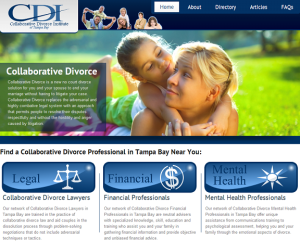
The Collaborative Divorce Institute of Tampa Bay (“CDITB”) recently unveiled its brand new website to promote the dynamic and growing practice of collaborative law.  The new website address is http://CollaborativeDivorceTampaBay.com.
Collaborative Practice

Collaborative Divorce Institute of Tampa Bay Unveils New Website

As a member of the CDITB Website Steering Committee, I am proud of the work we accomplished in bringing the website public.  You can find articles and videos exploring various topics in collaborative family law practice.   You can review answers to frequently asked questions (FAQs) about collaborative divorce.  And now you can find collaboratively trained communication coaches/mental health professionals, financial professionals, and attorneys in your area by simply entering your zip code into our Collaborative Professional Directory.

Attorney Adam B. Cordover has completed advanced training in interdisciplinary  collaborative law and is a member of the International Academy of Collaborative Professionals and the CDITB.

To learn more about collaborative law, call The Law Firm of Adam B. Cordover at (813) 443-0615 or fill out our contact form.

Garon: 8 Tips for Co-Parenting During the Holidays

Winter break can be one of the most difficult times for both children and parents to cope with divorce.  We see Christmas and New Years cheer and celebration everywhere as we are dealing with our own internal and external stressors that make the mere sight of such images so painful.  However, we must dedicate all of our strength to keep this period of time as happy and stable as possible for our children.

Risa Garon, a licensed clinical social worker, collaborative law mental health professional, and Executive Director of the National Family Resiliency Center, Inc., provides tips for co-parenting during the holidays:

  1. What can you as a parent handle? Be honest with yourself and how you feel.
  2. Be honest with your children about your limitations and what you can handle. Approach them in a way that doesn’t burden them with your feelings. Ask them what would help them during the holidays.
  3. Recognize that rituals are symbolic and often treasured by children and adults. If possible, try to have some of your family’s traditional rituals and include your children in creating new ones. Read more

Video: News Report on Collaborative Divorce

Below is a news report on collaborative divorce from KTLA 5:

Attorney Adam B. Cordover has completed advanced training in interdisciplinary  collaborative family law and is a member of the International Academy of Collaborative Professionals as well as the Collaborative Divorce Institute of Tampa Bay.

If you would like to speak with a collaborative lawyer in Tampa Bay and learn how the collaborative process can help your family, call The Law Firm of Adam B. Cordover, P.A., at 813-443-0615 or fill out our contact form.

Potential Disadvantages of Collaborative Law

Though I have advocated the use of the collaborative process in family law cases (for example, here, here, and here), it is only fair to note that there may be disadvantages to a collaborative law case.  Jon Crouch over at The Family Law New Blog explores some of those potential disadvantages:

1. In litigation, you can use the timing and immense stress and fear of impending trials to get people to sign settlements they never would agree to if they actually had time to consider them.

Read more

What is Collaborative Divorce About?

You may have heard of collaborative divorce, which is a new, innovative form of family law that puts people above process.  Courtesy of the International Academy of Collaborative Professionals, below you will find “Collaborative Practice at a Glance”:

  • Encourages mutual respect.
  • Emphasizes the needs of children.
  • Avoids going to court.

Read more

Video: Divorce TV – Collaborative Divorce Part 3

Attorney Adam B. Cordover has completed advanced training in interdisciplinary  collaborative family law and is a member of the International Academy of Collaborative Professionals and the Collaborative Divorce Institute of Tampa Bay.

If you would like to speak with a collaborative lawyer and learn how the collaborative process can help your family, call The Law Firm of Adam B. Cordover, P.A., at 813-443-0615 or fill out our contact form.

Video: Divorce TV – Collaborative Divorce Part 2

Attorney Adam B. Cordover has completed advanced training in interdisciplinary  collaborative family law and is a member of the International Academy of Collaborative Professionals and the Collaborative Divorce Institute of Tampa Bay.

If you would like to speak with a collaborative lawyer and learn how the collaborative process can help your family, call The Law Firm of Adam B. Cordover, P.A., at 813-443-0615 or fill out our contact form.

Video: Divorce TV – Collaborative Divorce Part 1

Attorney Adam B. Cordover has completed advanced training in interdisciplinary  collaborative family law and is a member of the International Academy of Collaborative Professionals and the Collaborative Divorce Institute of Tampa Bay.

If you would like to speak with a collaborative lawyer and learn how the collaborative process can help your family, call The Law Firm of Adam B. Cordover, P.A., at 813-443-0615 or fill out our contact form.

Video: Ten Reasons to Choose Collaborative Divorce

Click the following link to view a video produced by the International Academy of Collaborative Professionals. The video follows Sally and Lionel, a couple that have agreed to let cameras into their interdisciplinary collaborative divorce process:

http://video.collaborativepractice.com/video/default.html

Additionally, the video expounds upon the following ten reasons to chose collaborative divorce over the traditional litigation model:

1) Lawyers are specially trained to reduce conflict and negotiate wise settlements

2) The opportunity to protect your children from the damage caused by a high conflict divorce Read more

Collaborative Divorce: Keeping the Process Out of the Courts

The following passage of an article from the Collaborative Divorce Institute of Tampa Bay discusses a collaborative law agreement, how parties are encouraged to settle rather than institute a court action, and the differences between collaborative divorce and mediation:

     Once you decide that Collaborative Divorce is right for you, the first step is for each party and their attorney to sign a Collaborative Law Agreement. This agreement serves as a contract which ensures that the lawyers will act solely as settlement counsel only. By serving as settlement counsel your lawyers are contractually barred from ever going to Court in your divorce case. However, if at some point either party decides it would be more beneficial for the Court to settle a particular matter, you can terminate the Agreement at any time. This helps give you ultimate control of how your case is handled and guarantees an outcome suitable for all parties. It is important to remember that if you or the other party chooses to take a contested matter to the Court both attorneys are fired instantly and can not represent you before the court. Because the purpose of Collaborative divorce is to settle matters amicably and civilly, choosing to take a matter to the court is highly discouraged and may be to the detriment of both parties. This feature of Collaborative Divorce also enhances the possibility of a mutually pleasing outcome and encourages attorneys and clients to work in everyone’s best interest.

Read more