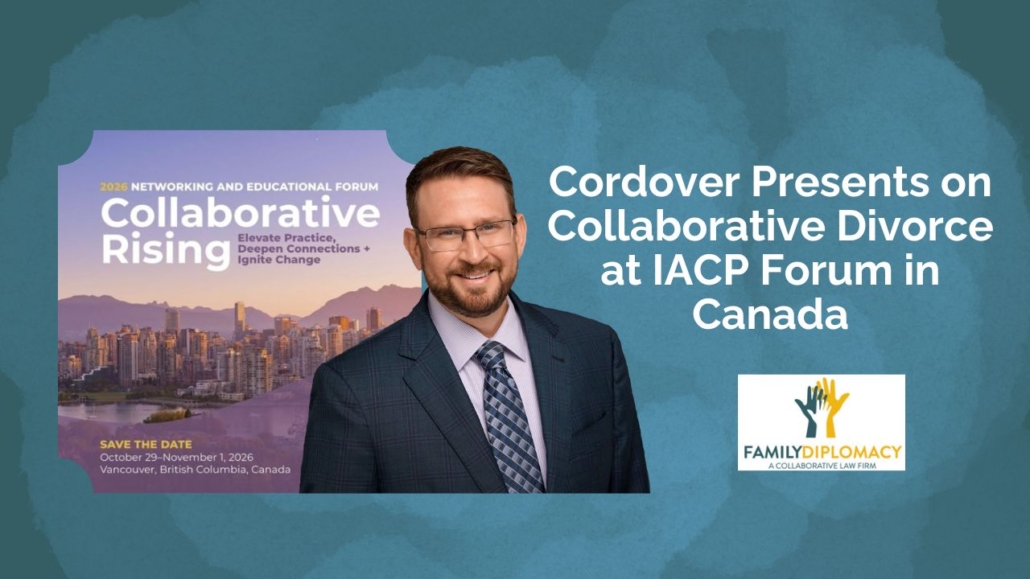
Cordover Presents on Collaborative Divorce at IACP Forum in Canada
At a Glance
Family Diplomacy Managing Attorney and Florida Collaborative Lawyer Adam B. Cordover co-led a workshop on some of the toughest questions professionals face in Collaborative Divorce at the IACP Forum in Vancouver, British Columbia, Canada, where professionals from around the world came together to learn from one another.
- Adam and Brian Galbraith, a leading Ontario lawyer, founder of Galbraith Family Law, and a former president of the International Academy of Collaborative Professionals (“IACP”), presented a workshop called “Turning Up the Heat: Spicy Food, Fearless Collaborative Debate.”
- The IACP Forum drew lawyers, mental health professionals, and financial professionals from North America, Asia, South America, Europe, and Australasia.
- Adam also attended sessions on the neuroscience of conflict, ethics, team emotional intelligence, Collaborative Divorce models, and the ethical use of AI in Collaborative Practice.
- What Adam learned at the IACP Forum helps him serve families in Tampa, St. Petersburg, Sarasota, and across Florida.
When you are deciding who should guide your family through a divorce, you want more than a lawyer who knows the rules. You want someone who keeps questioning how the work is done and looks for better ways to protect your privacy, your finances, and your children.
That is one reason Adam B. Cordover traveled from Tampa, FL, to Vancouver, B.C., for the IACP Forum. The International Academy of Collaborative Professionals brings together the people who shape how Collaborative Divorce is practiced around the world. Adam is a former member of its Board and a former chair of its Ethics and Standards Committee as well as its Research Committee, so he knows how much a candid exchange of ideas can improve the process for families.
What happened at the IACP Forum in Vancouver?
Adam co-presented with Brian Galbraith, a leading Ontario lawyer, founder of Galbraith Family Law, and a former president of the IACP. The IACP Forum is the group’s educational conference, and this year it included lawyers, mental health professionals, and financial professionals from across North America. Colleagues also attended from Malaysia, Singapore, Brazil, Italy, Spain, Switzerland, Australia, and New Zealand.
Adam and Brian’s workshop was called “Turning Up the Heat: Spicy Food, Fearless Collaborative Debate.” It was an interactive session where two Collaborative leaders debated some of the field’s toughest questions while eating increasingly spicy foods. The format was playful, but the goal was serious: give the room a candid, practical look at different ways to offer Collaborative services and where Collaborative Practice is headed.
Adam and Brian ate tortilla chips dipped in hot sauces that got hotter with each round. The sauces came from Heatonist, the official hot sauce partner of the YouTube interview show Hot Ones. After every chip, they argued both old and emerging questions that different Collaborative Professionals and communities have different take on. The audience took part through polling and open discussion.
Which Collaborative Divorce questions did they debate?
Adam and Brian worked through ten questions, and the topics matter to professionals thinking about how to help families facing challenges during divorce. Here they are in three groups.
How teams are built and run
- Should teams review the entire Collaborative Participation Agreement together at the first full team meeting?
- When building a team, is it better to work with familiar professionals or with a variety of professionals?
- Are full team meetings best held in person or online via Zoom?
- Is it better to hold several shorter meetings lasting two to three hours or one or two longer full-day meeting(s)?
Who belongs on the team
- Is it truly Collaborative Divorce if a lawyer-mediator is the only neutral professional on a matter?
- Is a neutral financial professional necessary when a family does not have a large estate?
- Is it appropriate for a facilitator, who is a neutral mental health professional, to meet with children in a divorce, or should a separate child specialist do that?
Fees, technology, and safety
- Should AI be used to help take notes during Collaborative meetings?
- What are different fee structures for Collaborative Divorce?
- Is Collaborative Practice appropriate when a family has experienced intimate partner violence?
These questions do not have one right answer for every family, which is exactly why the field keeps talking about them. Each family’s team should fit that family’s needs, and a good Collaborative professional will explain the reasons behind the choices on your team.
What else did Adam learn at the IACP Forum?
Between his own session and time with colleagues, Adam attended several other workshops. Each one connects to something clients feel during a divorce: stress, trust, and the wish to move forward without a fight.
- No More Stalemates, with Deborah Gilman, PhD, explored why stalemates in Collaborative cases are often neurological rather than legal. Her framework shows how stress can trigger a sense of threat and reduce a person’s ability to think clearly, and it offers ways to keep clients informed and moving without raising defensiveness.
- The Only Way is Ethics, with Diane Diel and Jo O’Sullivan of the Ethics and Standards Committee, looked at the IACP Ethics and Standards for Collaborative Practice and the professionals who follow them.
- The keynote, with Vanessa Druskat, PhD, focused on team emotional intelligence and how to create the conditions for constructive collaboration. Strong teamwork is central to a Collaborative case.
- With Passing the Torch, IACP Board member Lisa Alexander brought together Pauline Tesler, Nancy Ross, Peggy Thompson, the founders of the IACP and the interdisciplinary method of Collaborative Practice, to share the lessons of almost thirty years that they hope future practitioners will keep.
- One Coach, Two Coach or a New Coach? compared different ways of working with the emotional side of a divorce, including one-coach and two-coach models, for families with different levels of conflict, complexity, and needs for their children. The program was led by Deborah Brakeley, Geeta Gill, Anne Lucas, and Gwen Matthewson. (Related from Family Diplomacy: Comparing 4 Models of Collaborative Divorce)
- The AI-Enhanced Team, led by Brian Galbraith and R. Bradley Hunter, examined how AI can act as a digital team member while still honoring the IACP’s ethics and standards.
Beyond the sessions: Vancouver with friends and colleagues
The IACP Forum is also a chance to reconnect with friends and colleagues and meet new professionals from around the world. While in Vancouver, Adam walked across the Capilano Suspension Bridge in the local rain forrest, took a ferry to the Granville Market, and strolled the seawall at Stanley Park.
He also shared meals with colleagues at some of the city’s great restaurants. Those included Vij’s, a Michelin Bib Gourmand recipient known for its Indian food, and Top of Vancouver, a revolving restaurant more than 500 feet above the city with a 360 degree view from atop the Harbour Centre Tour. For breakfast, he visited Cafe Medina, a brunch spot with Mediterranean-inspired dishes, including all sorts of shakshuka-like meals.
Those experiences and relationships matter. The professionals Adam met and spent time with in Vancouver offer different perspectives on how Collaborative lawyers and teams around the world can best help clients privately get through challenging situations. Further, they enhance Adam’s ability to contact professionals around the globe when his clients’ assets include international holdings.
Adam also learned that the IACP will be supporting a local group for a Collaborative conference in the Basque Country of Spain in the summer of 2027.
What is Collaborative Divorce, and why does it matter to your family?
Collaborative Divorce is a private, out-of-court way to resolve issues related to divorce with the goal of doing so as amicably as possible. Each spouse has a separate lawyer who gives independent legal advice. The lawyers and other team members, such as a neutral financial professional and a facilitator, meet with you in private conference rooms or by video conference instead of in a public courtroom. You can read more in our guide to who Collaborative Divorce is right for and what it is.
Everyone on the Collaborative team works solely toward an agreement without fighting in court. If the process ends, or if a spouse files a contested pleading, the Collaborative professionals withdraw and cannot represent either spouse in court. That promise keeps every professional focused on finding a resolution that works for your family, and it means no one on the team can be used to turn a disagreement into a public court fight.
The process has a strong track record. An analysis by Adam B. Cordover and Dr. Randy Heller of Nova Southeastern University looked at nearly 300 Florida Collaborative cases from 2014 to 2024 and found an 85% success rate. It was published in the Florida Bar Family Law Section Commentator (Vol. XLV, Issue 1, 2025), and the IACP shares the survey data on its website. Still, no divorce process can guarantee a particular outcome, and every family’s situation is different.
Adam is a co-author with California lawyer Forrest S. Mosten of Building a Successful Collaborative Family Law Practice (American Bar Association, 2018) and has focused exclusively on out-of-court dispute resolution since 2015. Gatherings like the IACP Forum are one way he teaches best practices to other professionals and keeps sharpening his own skills to help families in Tampa, St. Petersburg, and Sarasota make informed decisions with privacy and control.
Frequently asked questions about the IACP Forum
What is the IACP Forum?
The IACP Forum is the conference of the International Academy of Collaborative Professionals. Lawyers, mental health professionals, and financial professionals from around the globe who practice Collaborative Divorce attend to learn from one another and share ideas.
Who led the workshop on Collaborative Divorce debates?
Adam B. Cordover of Family Diplomacy in Florida and Brian Galbraith of Galbraith Family Law in Ontario co-led it. Brian is a former IACP president, and Adam is a former IACP Board member.
Why does it matter to me that my lawyer attends events like this?
Collaborative Practice keeps changing, with new questions about technology, team structure, and how to support families in conflict. Time spent with colleagues from around the world helps a professional weigh those questions carefully, though it cannot promise any particular result in your case. Further, it is sometimes comforting to know that your lawyer doesn’t just offer Collaborative services but is an international leader in the field.
Does Family Diplomacy only help families in Tampa?
No. The firm has offices in Tampa, St. Petersburg, and Sarasota, and Adam accepts complex and high-value family law matters from throughout Florida.
Reach out to Florida Collaborative Divorce Lawyer Adam B. Cordover
We invite you to reach out to us at (813) 443-0615. You can also directly schedule a confidential virtual planning meeting or contact Family Diplomacy: A Collaborative Law Firm by clicking the button below to discuss your situation and explore whether Collaborative Divorce is the right path for your family.
When discretion matters, count on us.