Federal Estate Tax Planning and Collaborative Divorce: Protecting Family Wealth During Divorce
At a Glance
Federal estate tax planning can become especially important when a couple with significant wealth is going through a divorce. Business interests, real estate, retirement accounts, trusts, and other assets may require careful planning to help preserve wealth and protect the family’s long-term financial future.
- Federal estate tax planning involves considering the value of an estate, applicable tax exemptions, and strategies for transferring wealth to future generations.
- Divorce can change how estate tax exemptions, marital deductions, and estate planning strategies apply to each spouse.
- Trusts may offer creative ways to divide the economic value of business interests while allowing one spouse to retain control of the business.
- Collaborative Divorce can bring together each spouse’s attorney and other professionals to explore solutions that address both spouses’ goals.
- Planning early can help families preserve wealth, protect assets, provide for children, and avoid gaps in their estate plans after divorce.
Whether you are a business owner, physician, lawyer, real estate investor, or someone who has accumulated significant family wealth, divorce can raise estate planning questions that extend well beyond dividing assets. Understanding how these issues intersect can help you make informed decisions about your financial future and your family’s long-term security.
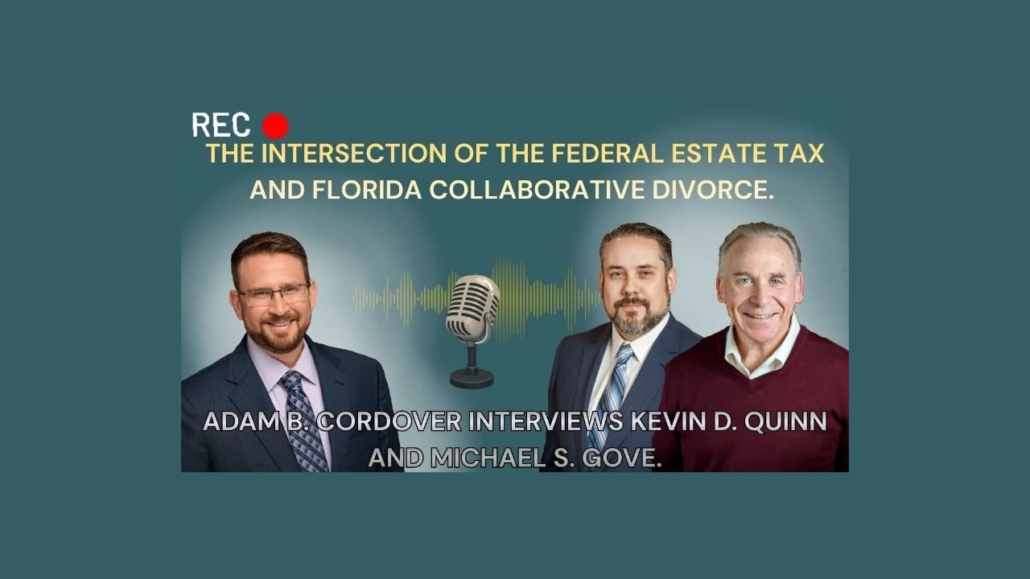
In the video below, Adam B. Cordover, Managing Attorney at Family Diplomacy, speaks with Kevin Quinn and Michael Gove of Legacy Counsellors about federal estate tax planning, trusts, business interests, asset protection, and how these considerations can be addressed during a Collaborative Divorce.
Below is a lightly edited transcript of the video:
Federal Estate Tax Planning and Collaborative Divorce: Preserving Wealth, Protecting Assets, and Planning for the Next Generation
Introduction
Adam: Hi, my name is Adam Cordover from Family Diplomacy: A Collaborative Law Firm. I am a Collaborative Divorce and family law attorney in Florida with offices in Tampa, St. Petersburg, and Sarasota. I am very excited for this discussion today. I am here with Kevin Quinn and Michael Gove of Legacy Counselors, and we are going to be talking about the intersection of federal estate taxes and federal estate tax planning with Collaborative Divorce. Let me just provide a brief introduction.
We have Kevin Quinn, who is the founder and president of Legacy Counselors PC. He is an estate and business planning attorney serving successful individuals, families, and business owners. He has completed advanced postdoctoral study in wealth strategies planning. He regularly educates CPAs, financial planners, attorneys, and other professional advisors. He is the author of the book Everything You Love, Everything You Have, and a speaker on estate planning, legacy planning, planned giving, and business succession.
Along with Kevin, we have Michael Gove, who is a partner and attorney at Legacy Counselors. Michael practices in estate planning, estate administration, business law, and real estate matters. He helps families and business owners find creative, practical solutions to legal planning issues. He previously owned and operated his own law firm before partnering with Kevin. Michael is active in professional associations and community leadership, including most recently being involved actively in the United Way of the Franklin and Hampshire region. So we have not only two very smart guys here, but two very community-minded gentlemen as well.
The firm is licensed in Massachusetts, Connecticut, New Hampshire, Vermont, New York, and Florida, and they work with clients nationwide by co-counseling with local attorneys in many, many cases. So once again, Kevin and Michael, thank you so much for being here.
Kevin: Thank you, Adam, for having us. We appreciate it.
Michael: Yes, absolutely. It is great to be here.
Adam: Great, great. By the way, is there anything else besides what I mentioned in that introduction that you would like to highlight?
Kevin: Well, it is just our pleasure to be here, and this is an exciting topic to talk about, so I am looking forward to it.
Understanding the Federal Estate Tax
Adam: All right, thank you, Kevin. Before we get into the technical planning, can you briefly let us know what the federal estate tax is and why it might be important for people who are going through divorce, Collaborative or otherwise?
Kevin: So the current federal estate tax exemption is on any assets in excess of $15 million. That is as of the first of this year (2026). That number does increase with inflation. The government publishes an inflationary number each year to increase that. The rate is a 40 percent flat rate. So as soon as my estate gets over $15 million, I am paying 40 percent per dollar on the excess of the $15 million.
We have the ability to leave an unlimited amount to our legally married spouse. In addition, if I do not fully utilize my $15 million exemption, I can transfer that to my spouse, but only if I file a federal estate tax return. It is not an automatic transfer of my exemption. I must file an estate tax return, even though my estate might be less than $15 million, to transfer that exemption to my legally married spouse. The only other thing, real quick, is that it has to be a U.S. citizen spouse. I do not have an unlimited marital deduction for my non-citizen spouse.
Adam: So it sounds like this is not something that you can take lightly, but that it takes a bit of planning to figure out and to make sure that it is implemented correctly. Correct?
Kevin: Planning is essential: determining your goals, figuring out what it is you want to accomplish, and how we are going to protect the wealth. The other thing that the planning needs to recognize is that I do not expect to die today. I might die today, but I do not expect to. What we need to look at is the projection of what the wealth will be when you die. That is what really matters: what the wealth is when I die and what the law will be when I die. And we do not know what that is either.
Families Who May Need Federal Estate Tax Planning
Adam: So based on this, what type of families typically do you work with in federal estate tax planning issues, and who needs to really seek professional advice in implementing different strategies?
Kevin: When we are in the federal estate tax realm, oftentimes it is business owners. One of my favorite things to say is that America creates its wealth through small businesses. So startups that become worth a lot of money, whether we are passing that business on to the children or passing it to other people, or whether there is a liquidity event and a cash-out of the business, oftentimes that is what we are looking at: business owners.
Particularly down in the Florida market, there has also been massive growth in real estate values. You can find families that have significant assets tied up in real estate, a combination of a small business and some good real estate. The Boston market, any of the areas that we deal with, there has been a lot of real estate appreciation. We also have clients who come to us with stock options, with large employment benefits, and just the savers, the ones who have done really well, made the right choices, and invested in NVIDIA when it was a dollar. Those are also fun.
Adam: So it sounds like business owners particularly, but also those with family or generational wealth, those who have been good savers and investors, and those professionals who may be in the higher income brackets and may be reaching it, if not now, then at some point in the future.
Kevin: Yes.
How Divorce Changes Estate Planning
Adam: How should people who are within those categories be thinking about strategy? Is the strategy the same or different if they are going through a divorce process?
Kevin: Well, it is very different if they are going through a divorce process, and of course we always have to consider that there might be a divorce with any couple we sit with. We usually are doing joint representation, so that creates some ethical issues if there is a divorce. That is where collaborative planning can be very beneficial.
What we are typically trying to do is to assure that we are transferring wealth outside of the taxable estate and allowing it to grow outside of the taxable estate. If a client comes to us and says, “Well, we just have these basic plans, but we are going through a divorce, and we are not sure what we are supposed to be doing,” they may come back to us after the assets are split up, and we will figure out how to fix the estate tax problem. If it is a couple that comes to us and says, “We are business owners. The husband has a business, or the wife has a business, that is very valuable. We are going through a divorce. How can we split this asset?” that is where we might need to work with a Collaborative Divorce attorney to see if we can use a trust to help with that type of situation.
Just an underlying thing, real quick, is that in many circumstances, a will is invalidated as to your former spouse. If I have named my spouse as the beneficiary of my will, and then we get divorced, whether I intended that she be my beneficiary or not, she is no longer the beneficiary under my will. That is not necessarily the case with a trust. Sometimes we want to be able to leave assets to that spouse, or we want to provide for that spouse even after divorce, and a trust can help with that.
Using Trusts to Provide for Former Spouses and Children
Adam: It is interesting that you say that, Kevin, because oftentimes as part of the Collaborative Divorce process, believe it or not, sometimes people want to continue to leave assets to their spouse. In many cases they are co-parents, and they want to make sure that their fellow co-parent is taken care of so the kids can be taken care of. We let clients know that the terms of the will related to the spouse become annulled, and the same is true of beneficiaries on life insurance policies. But it is interesting that the one thing that does not get annulled could be a trust.
Kevin: Right. And you just said something that I probably should have led with. Most couples going through a divorce are going to have a lot of focus on the kids. They do not stop loving their children because they are going through a divorce. It is often harder to look after my kids after the divorce, because I only have one $15 million exemption. I do not have a marital deduction anymore. So we have to figure out what to do in those circumstances.
Adam: And Michael, when people are looking to make sure that they have trusts set up so that they can pass things the way they want to, how exactly would you go about doing that? Or is there a way that you would do that for folks who are going through divorce but still want to make sure to either take care of each other or take care of their kids?
Michael: Well, one of the things we would be thinking about is making sure that we are working both with the clients and also with the attorneys that they are working with. If they are working with a firm like yours and doing the Collaborative Divorce, we would want to make sure that we are part of that conversation, where we can figure out exactly what kind of interests and protections they want to have in place and make sure that we are building that into whatever trust.
One of the great things I love about being an estate planning attorney is that we can do just about anything we want with the trust documents and include just about any language we want. We can be really creative and accomplish our clients’ goals. If that includes addressing a divorce, or taking care of a soon-to-be ex-spouse and making sure the kids are protected in the long run, we get to build that right into the document.
The Role of Collaborative Divorce in Creative Estate Planning
Adam: It is interesting that you say that, because when I am explaining the Collaborative Divorce process, in a brief summary, it simply means that we strongly believe that families do not belong in court when they are going through divorce. That is a very private process. Each spouse has their own separate lawyer to provide them with independent legal advice, but the lawyers are there solely for the purpose of reaching an out-of-court agreement, so they are not going to spend any time, money, or energy fighting or preparing for trial or any of that nonsense. Rather, they focus on their future goals and on resolving things privately so they can move on with their lives, oftentimes with the help of a facilitator who is a licensed mental health professional and a financial professional as well.
We are basically building the process around identifying the client’s interests, so that we can ultimately meet their goals, even if those goals are different from what default Florida divorce law says. So it sounds like, in building the trust, you can do something similar: handle assets in a way that is different from what probate law or other types of law are dealing with. I am wondering, am I getting that correctly, and perhaps do you have an example about creativity in creating some of those estate documents or trust documents?
Michael: Adam, I think you are exactly getting that right. The key point there is the collaboration that we would have with the clients, but also with the professionals, right? Making sure that we are working and part of the discussion, so that we can have this in place essentially as part of the divorce process, as part of working things out and working all the issues out, and making sure that we are accomplishing our clients’ goals as quickly as we can by putting those special provisions and that language in place. Kevin, what kind of example have you seen?
A Business-Ownership Example: Using a Trust to Divide Wealth
Kevin: I learned about Collaborative Divorce from an actual fact pattern. We had a client come to us who was a business owner. It was a software company, a startup, and that company probably represented 80 to 85 percent of their net worth. The husband was the shareholder; the wife was not a shareholder. What do you do with a company that represents 80 percent of your net worth when we are trying to split assets equitably? Massachusetts is an equitable split state.
What we were able to do is sit with Collaborative attorneys representing husband and wife and come up with what we thought was a pretty creative solution, which was to transfer a portion of the shares of the company into a trust for the benefit of the wife. So the husband was transferring to a trust for the benefit of the wife. An independent trustee was appointed to vote the shares that were transferred into the trust. Today we would probably transfer nonvoting shares into the trust, so the wife gets the economic value of the shares, but there is no voting control. That way the profits of the company can benefit the spouse, but they can also benefit the children.
That is an example. It also simultaneously helped with estate taxes, because at a liquidity event, when the company was worth a lot more, a big chunk of that was already in an irrevocable trust outside of either spouse’s estate. The cash in the trust then benefits that spouse and the kids.
There were complexities. We had to get other business partners to agree to do this. But it is just an example of how you might use some estate planning tools to help a couple work through a difficult asset split. It also meant that the wife had to be willing to say, “I do not have to personally own these shares.” So she had to give up a little something too, to be able to make this work for herself and her kids.
Starting With the Family’s Goals
Adam: And so when a married couple with significant wealth is divorcing, what are some of the first estate planning questions that they should be asking?
Kevin: Well, I think you would tell me that if you sat down with a couple and you asked about a Collaborative Divorce, the very first thing you are going to start with is goals, and that is what Michael and I are going to start with as well. What is it we are trying to achieve here? Are we trying to achieve an equitable split between husband and wife? Are we trying to protect children? Are we trying to split real estate, business assets, stocks and bonds?
What is it that we are trying to do here? Do we have a spouse who is worried about just income? Or does that spouse want to have control and spendable cash, et cetera? So we have to get to the goals, the fundamental goals and the purpose of the wealth, before we can design the estate plan. That is where I would start. What do you want this money to do now that you are restarting your life?
Why Estate Planning Should Begin During Divorce
Adam: I absolutely love that we as Collaborative lawyers live in the world of interests and goals, so that is exactly where we go too. But I know there is an assumption, even amongst family law attorneys, that estate planning is something that is generally done after the divorce is over. Why might that be a mistake?
Kevin: The short answer is because divorce more commonly destroys wealth than builds wealth or keeps wealth stable. Having to sell an asset because I need to split it, or split its economic value, particularly something like a business whose value might be its future multiples, is where we end up destroying wealth. Having to take a shopping center that is creating a nice stream of income and paying down a mortgage, and then having to sell it, repay the bank, and hope you get some equity back, and you do not have that nice stream of income anymore, destroys wealth. So if we can approach it from the standpoint of how we can collaboratively work through these assets and achieve goals with estate planning tools, then we can preserve the wealth.
There are also the kids. Going through a divorce is traumatic, and even in a Collaborative Divorce, it still means I have to deal with those attorney people. There is expense. There is a fairly decent chance that I am not going to be ready to go sit down with another set of attorneys and talk about my estate plan when I am trying to figure out what to do with the rest of my life and they are asking me about these goals. If we can approach some of these things and get some of that thought process going in the divorce process, there is a better chance that we are not going to have a dangerous gap between right after the divorce and when the client finally gets around to sitting down with an attorney and looking at the estate plan. Because I do not know when that client is going to die.
Michael: And along those lines, when you have a Collaborative Divorce especially, built right in is the fact that the parties still care about each other and are trying to work together, right? Oftentimes, if there is not an estate plan put in place as part of that process, along with the Collaborative Divorce, there is the risk that somebody waits six months or a year or two years before they finally sit down with another estate planning attorney, and it actually puts the remaining family more at risk. This is a situation where they really care about their ex-spouse and want to make sure that they are taken care of. So it is probably even more sensitive for somebody going through a Collaborative Divorce.
Adam: I tell clients that even though it is called Collaborative Divorce, it is still divorce. To both your points, it is still tough, it is still challenging. It is just that we handle things a bit differently. We are not opposing counsel, but we are working together to try to help both of these families.
It sounds like a concern that you all have, from your perspective, is that gap that potentially could happen after the divorce is over when, quite frankly, they may still be exhausted, and then what happens afterwards. So it sounds like when we Collaborative Divorce lawyers are dealing with folks with significant wealth, we should be suggesting to them, “Hey, you should be communicating with estate planning lawyers such as yourselves to help deal with these complicated issues,” just so there are no surprises. You both know what is going to happen, and once the divorce is done and over with, you have already got everything worked out, so that it may require an additional signature or two, but otherwise it is worked out.
Michael: Yes, but we would love to have them do that additional signature the afternoon after they finalize the divorce, or the next day after they finalize the divorce. We can do that if we are part of that process.
Kevin: There is another thing that you may not have thought about. What my experience was when I was introduced to Collaborative Divorce is that you have just spent hours with your client getting to know the source of the problems in the divorce, what they are unhappy about, and what they want to do. You have gone into detail about their assets. Part of this process is what you said: you are looking for the creative solution.
The estate planning attorney gets the benefit of two other smart attorneys who know their clients really well, know what makes them tick, adding to that estate plan. And so they end up with a better plan because they have three attorneys working collaboratively and creatively to solve their needs.
Understanding Portability and the Loss of Marital Estate Tax Benefits After Divorce
Adam: You clearly can speak to some issues that honestly are way out of my wheelhouse, and I suspect many other family law attorneys’ wheelhouses as well. How might you address issues like portability within this process, and perhaps can you explain what portability even means?
Kevin: So portability is the ability to transfer your unused exemption to your spouse. The perfect example is an IRA. Many professionals have a significant IRA as part of their assets. The most tax-efficient use of that asset is to transfer it to my spouse. That is a marital deduction asset that adds to my spouse’s taxable estate. There is no estate tax at the first death because it is a marital deduction, but now it is added to my spouse’s estate, and any future growth is in my spouse’s estate.
Under the old rules, my spouse had to handle that asset within her exemption. Under the new rules, if I have estate tax exemption left, I can transfer the estate tax exemption to my spouse with the assets I transfer. I can even transfer my unused exemption if I am not transferring any assets to my spouse. So now my spouse still gets the benefit of my exemption to be able to absorb his or her assets.
The problem with divorce is that I cannot transfer that exemption after the divorce. I can only transfer it to my current spouse. That creates significant issues when there is disparate wealth. And again, to the degree that husband and wife might be focused on the kids, if in a settlement a significant bulk of the assets remain with one spouse, that puts them over the exemption. Since they no longer have the marital deduction, they may need to do some estate tax planning to protect the kids.
Adam: So Kevin, can you provide a concrete example of where portability either has come into play or might come into play in a family situation where they are going through divorce?
Kevin: It is the lack of portability. So we have to plan into this the lack of portability. Let us say we have a physician with a $10 million IRA. You might have a QDRO that is going to transfer half of that to the spouse, but I cannot transfer unused exemption to the spouse. It is a divorce. The spouse is going to get that money, and it is very possibly going to grow. So we need to do some planning for that spouse who is possibly going to get 50 percent of a $10 million IRA. What is the impact on that estate? What things can you be doing? Putting assets in trusts so their future growth is outside of the estate. That is the primary thing you can do: get some of those assets into a trust so they are outside the taxable estate.
The tricky thing, the place where Michael and I have to add our creativity, is cash flow. Generally speaking, I cannot benefit from the trust that I transfer money to if I want it to be excluded from my estate. So it has to be focused on the kids. Perhaps it is focused on my former spouse. We need to figure out how we are going to do these things. Control: many of us are going to want to be able to control those assets. We might be able to use LLCs or other vehicles to control the assets inside that trust. So we control who is benefiting, and under what circumstances they are benefiting, getting the assets out of the estate so they can grow, because I can no longer rely on portability.
I think it is fair to say that a fair number of people, knowing about portability and knowing it is a $15 million exemption, will say, “I can put off estate planning until later. If I die, my spouse can still do some planning.” I do not have that marital deduction anymore. I do not have portability once I get divorced. So the planning becomes much more urgent.
Adam: Understood. So I think I understand, and maybe I misunderstood at first. It sounds like portability is not something that is negotiable or can be discussed or given away as part of the divorce. It is only applicable to married couples. Do I have that right?
Kevin: My understanding is that it is only applicable to married couples, yes.
Adam: All right. That might bring out, again, getting the creative juices flowing. Florida does not have legal separation, but we do have binding postnuptial agreements and other things as well. If this were a concern for the couple and they wanted to financially separate, even if legally they still remain married, perhaps one of the factors in that decision might be portability. Potentially a postnuptial agreement might be a solution to help with that.
Kevin: Yes. I have never done that, but I could see it.
Adam: Got it. We have done Collaborative prenups and postnuptial agreements as well for a variety of reasons. Sometimes, again, people for whatever reason do not want to legally separate, or legally divorce, but they want to make sure there is that financial separation. Sometimes it is for planning purposes.
Kevin: So trusts are contracts. Your postnuptial agreement is a contract. It is the creativity that you can bring into it. I think in law school they taught us that as long as I am not breaking the law and I am not acting against the public interest, I can put any restrictions or provisions in my trust that I want. So a trust concept and a postnuptial concept would be very similar. They are both contracts. You are just going to need to figure out which way you want to go.
Voting and Nonvoting Business Shares
Adam: Since I have two very smart lawyers here who deal with businesses, I have another question that oftentimes comes up in Collaborative Divorce when people are either splitting businesses or splitting the value of businesses. Sometimes we look at voting business shares or nonvoting business shares, and there may be different ways to handle it. I am wondering if, first off, you could explain the difference between a voting business share and a nonvoting business share, and what are some creative ways that they can be handled as part of a Collaborative Divorce?
Kevin: So, very simply, you restructure the company, recapitalize it, with some portion of the shares being voting and some portion being nonvoting. Most commonly, a very small portion are going to be voting. The majority of the shares are going to be nonvoting.
It is a resolution; it is an action by the stockholders to restructure their stock so there is voting and nonvoting. The only exception to the S Corp rule that there can only be one class is that you can have nonvoting and voting common shares of an S Corp. So the most common type of company out there, the S Corporation, can be voting and nonvoting. You can have partnerships and LLCs that have voting shares and nonvoting shares.
The advantage in a Collaborative Divorce is that under most circumstances the nonvoting shares still have an economic right to distributions, and an economic right upon liquidation or sale, that is almost equal to the voting shares. Therefore, I could take my economic interest in a company, and Michael may say, “I do not want your spouse to be my partner. I do not want a trustee to be able to vote the shares of the company that you are going to put into a trust for your spouse. Okay, you can put some shares in a trust, but I do not want that stranger trustee voting those shares either.” If we can transfer nonvoting shares into the trust, the trustee has no control over the company, but the trust gets the economic benefit of distributions.
In an S Corp, it has to be pro rata. So if 40 percent of the company is in the trust, 40 percent of the distributions go into the trust. Those can then be used to provide for the spouse, to pay for an insurance policy, to help the children, whatever it is we need to do. So it allows that entrepreneur in particular to retain control of their assets even though they have had to split them with the spouse who is now no longer their spouse.
Michael: That gives you flexibility when you are thinking about a Collaborative Divorce, because you have separated out the control from the economic benefit. Then you can use that economic benefit to help settle the claims and the desires of the parties to balance things out without losing that control. It is a really great way to allow the business to continue to operate without mixing the divorce into the middle of that.
Adam: So it sounds like the spouse who is getting the nonvoting shares put into this trust still gets, as you said, the economic benefit or the support or whatever they need as part of it, but they do not have a say in the business, which could cause some challenges for how the business internally works.
Michael: Yes.
Kevin: Correct. You may need to have very clear conversations. How are we going to decide to sell this company? When we are finally successful and all the debts are paid off and people are offering us lots of money, is the spouse going to have no say in this? Is the spouse going to have a say? How are we going to work out whether the spouse has a say in this? Because they are going to end up with economic benefit. And are they going to leave that decision to their now former spouse?
Planning Early and Protecting Family Assets
Adam: One of the things I think, Michael, that you and I talked about prior to this is the fact that people oftentimes do not think about the federal estate tax until it is too late to plan for it. In other words, they may have the potential to be dinged by it, but because they have not yet reached the level where it happens, they have not necessarily thought ten, twenty, thirty years down the line. Do you mind talking a little bit about that?
Michael: Well, that is something that we work with our clients on all the time. When we think about the federal tax planning that we do for the clients who are reaching that level, what we are thinking about is not just where they are now, but where they are going to be throughout their lifetime, over the course of their life expectancy. If we have an 80-year-old client who is worth $10 million, we probably do not need to worry about the federal estate tax. But if we have a 40-year-old who is running a business that is worth $5 million and continues to grow and increase in value, we have already got to be thinking about the federal estate tax.
One of the great things about the planning that we do is that, as I like to say, the longer we allow it to cook, the more successful it can be. The earlier we can get in and work with a client, and do that planning when we have assets that are lower in value, before they have increased, the more estate tax savings we can achieve for them from a federal estate tax perspective. So it is always a key, because you are right, people are not always thinking about that when they are worth $4 or $5 million. But if you look ahead, they are going to be subject to federal estate taxes. If we can get in there and do some planning now, it makes it so much more successful in the long run.
Adam: I am sorry, Kevin, were you going to say something?
Kevin: Well, this gray hair means that I have seen a lot of political change as well. I have seen the estate tax come and go; I have seen it go up, and I have seen it go down. I do not know what the estate tax will be three years from now. It may still be $15 million plus inflation, it may be half of that, it may be an entirely different estate tax regime. What we do know is that making a transfer to an irrevocable trust today, using very advantageous laws, is going to protect the future growth of those assets. As long as we have cash flow figured out, as long as we have control figured out, the client does not have a lot to lose if the law changes in the future in a negative way, or if it does not change and they never get to that really high number, except they have paid us money that they did not have to pay us.
The other thing I should say: we have been focused on the estate tax, and the estate tax is important, but so is asset protection. It is important in the divorce because you now have two couples, or two people, often with common kids. These assets are going to be important to the future generation, important to the spouse. Most estate tax solutions are also asset protection solutions. Those nonvoting shares that go into a trust for the benefit of a spouse are protected from the claims of the next divorce. They are protected from the claims of a car accident or a slip and fall. They are protected from the claims of a bankruptcy. So you are also doing asset protection planning for those assets that are very important to the couple’s security financially and to the couple’s children.
Adam: I know that can be especially important for certain people in certain high-liability professions. Doctors, for example, are oftentimes very concerned about what ways they can protect their assets from medical malpractice and other types of insurance. It sounds like there are some estate planning tools that potentially they have available to help them, potentially as part of a divorce, but just in general, and it can be helpful.
Kevin: Yes. You often find co-professionals who are married: two physicians, or a physician and an attorney. It is not at all unusual in my practice to find two professionals. Both of them are going to have professional liability. So preserving or protecting assets that took a long time to create is going to be very important, even in a divorce.
Building Flexibility Into the Estate Plan
Adam: So are there other things that you think either clients going through a Collaborative Divorce, or lawyers representing clients going through a Collaborative Divorce, should know about, really any of the areas that you work in, that would be helpful?
Kevin: A thing that will make sense when I say it, but probably occurs to very few people in the moment, is future flexibility. Why do I choose to get divorced? I choose to get divorced because I am no longer happy with this relationship and I do not want to suffer anymore. So I want to be able to restart my life. There is a fair chance that when I restart my life, there are changes that I cannot foresee. I may have a new relationship. I may move to a different state. There could be a variety of things that occur after the fact.
So in the design of a trust to hold assets to help the couple come to collaborative solutions, we need to build in sufficient flexibility to be able to make adjustments for the future. It might be a change in jurisdiction. It could be any number of things. It could be new children from a second relationship. What are we going to do? That is, again, where your postnuptial might be part of this, where we say, “Okay, if there are changes in your life, you have to come back to me before you get some attorney to change this trust,” particularly as to the business assets that I have put in there, or because it is affecting my kids.
So we also need to build flexibility in. This is a couple that is looking for change and likely will find change, so the planning needs to be flexible. Trust protectors, decanting, and nonjudicial reformations would allow some future changes in the trust. And then what is the way the couple is going to navigate those changes to something they worked really hard to come to agreement on in the first place?
Other Services Offered by Legacy Counselors
Adam: Thank you, Kevin. And Michael, what other areas of the law does your firm practice in?
Michael: In addition to estate planning of all types, we run the gamut from very simple to very complex estate plans. We also do a lot of estate and trust settlement work after our clients have passed away. We help them work through the court system if necessary. If we have done the planning correctly, we can avoid the court system and have to work to settle the trusts that we have created and work with the family and the other professionals.
We also do real estate work, both residential and commercial, mostly in the six states that you mentioned earlier. And then also some business representation, because the work that we do with a lot of our clients is intertwined with a lot of business work as well.
How to Contact Legacy Counselors
Adam: Those six states, I have Massachusetts, Connecticut, New Hampshire, Vermont, New York, and Florida. You are pretty busy. You have a pretty wide wingspan. If people wanted to learn more and contact you all at Legacy Counselors, how would they do so?
Kevin: Go ahead, Mike.
Michael: Well, I think the website would be a great place to start: legacycounsellors.com. The important thing is that we spell it like we are British. It is C-O-U-N-S-E-L-L-O-R-S dot com. We have a lot of resources on there, including the opportunity to request a copy of Kevin’s book that you talked about at the beginning. We always like to send those out to people so they can see what our process is, learn about what we are usually talking about with a lot of our clients, and find out a little bit more about the firm.
Adam: Do you all have a telephone number for the firm if they want to reach out that way?
Kevin: Sure. It is 413-527-0517. That is our main switchboard in Massachusetts, but we can also get transferred to New Hampshire or the other jurisdictions.
Adam: Kevin Quinn and Michael Gove, it has been an absolute pleasure to speak with both of you about federal estate tax planning and Collaborative Divorce, along with delving into other topics: business, asset protection, and other items as well. Thank you so much for speaking with me today.
I am Adam B. Cordover, managing attorney at Family Diplomacy: A Collaborative Law Firm. We have offices in Tampa, St. Petersburg, and Sarasota, and we represent clients throughout the state of Florida. If you would like to learn more, you can visit us at familydiplomacy.com or give us a call at 813-443-0615. As we like to say, when discretion matters, count on us.
Next Steps
Federal estate tax planning, trusts, and business ownership can introduce additional complexity into a divorce, particularly when a family’s wealth is tied up in a closely held business, real estate, or investments.
Addressing these issues early can help families identify potential risks, explore alternatives, and coordinate their divorce settlement with their long-term estate planning goals.
If you are considering divorce and have questions about how to approach your family’s financial future, we invite you to schedule a virtual planning meeting with Family Diplomacy by calling 813-443-0615. You can also access our calendar to schedule a planning meeting directly or request that we contact you through our website.
Family Diplomacy works with clients throughout Florida, with offices available by appointment in Tampa, St. Petersburg, and Sarasota.
When discretion matters, count on us.
Divorce 101 Videos
To learn the basics about divorce in Florida, check out videos in our Divorce 101 Video Library, including options, such as Collaborative Divorce, available for resolving family law matters outside of court.
Frequently Asked Questions
Why is federal estate tax planning important during divorce?
Divorce can change how assets are owned, how federal estate tax provisions apply, and how wealth may be transferred to children or other beneficiaries. Coordinating estate planning with the divorce process can help families identify potential tax and asset protection issues and consider appropriate strategies, especially for high asset families such as business owners, professionals, and those with real estate inheritances and investments.
Can a trust help divide a business during divorce?
In some circumstances, a trust may allow one spouse to receive economic benefits from business interests without receiving direct voting control. Whether this is appropriate depends on the business structure, the family’s goals, applicable tax rules, and other legal considerations.
What is the difference between voting and nonvoting shares?
Voting shares generally carry rights to participate in certain company decisions, while nonvoting shares generally do not carry the same voting rights. Nonvoting shares may still have economic rights, allowing a person or trust to benefit financially from a business without necessarily controlling its operations.
Should I wait until my divorce is finalized to update my estate plan?
Not necessarily. Reviewing estate planning documents during divorce can help identify potential gaps and coordinate changes with the settlement. The timing and implementation of particular changes should be discussed with qualified legal and tax professionals, and within the Collaborative Divorce process, it should be coordinated rather than unilateral.
Can estate planning help protect assets for my children after divorce?
Depending on the circumstances, trusts and other estate planning tools may help provide for children, establish rules for distributions, and protect certain assets from specified future claims. The appropriate structure depends on the family’s needs and applicable law.
Why should business owners consider estate planning early?
A business may increase substantially in value over time. Planning early may create more opportunities to address future estate tax exposure, consider wealth transfer strategies, and preserve business continuity. The appropriate approach depends on the owner’s circumstances and the tax laws in effect.
Can Collaborative Divorce help with complicated financial issues?
Collaborative Divorce provides a structured, out-of-court process in which each spouse has independent legal counsel and the professionals work toward a negotiated resolution. When appropriate, the process can involve financial and estate planning professionals to help the family consider the broader consequences of its decisions.
This article is for general informational purposes only and is not legal, tax, or financial advice. Federal estate tax laws and individual circumstances can change, and the strategies discussed may not be appropriate for every family. Consult qualified professionals about your specific situation.