Cordover Presents to CP Canada on Practical Use of Collaborative Divorce Statistics
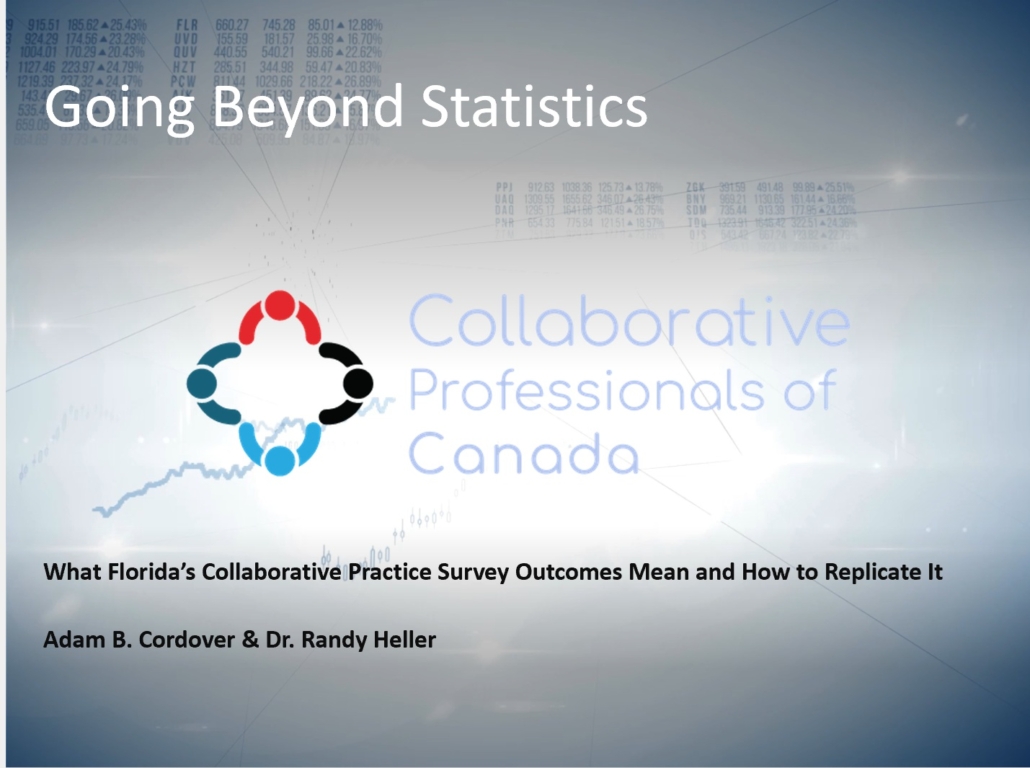
On February 5, 2026, Adam B. Cordover presented to CP Canada, Canada’s national Collaborative Practice organization, on the topic “Going Beyond Statistics: What Florida’s Collaborative Practice Survey Outcomes Mean and How to Replicate It.” The presentation was part of a broader conversation about how Collaborative Practice can strengthen its credibility and long-term sustainability through thoughtful use of real-world data.
Cordover co-presented with Dr. Randy Heller of Nova Southeastern University. Together, they co-authored the article “Statistics on Collaborative Divorce in Florida,” published in Volume LV, Issue 1 (2025) of the Florida Bar Family Law Section Commentator Magazine. Their work reflects a decade-long effort conducted by the Florida Academy of Collaborative Professionals to better understand how Collaborative Matters actually resolve in practice.
Why Florida Invested in Long-Term Data Collection
The presentation began by explaining why Florida undertook sustained data collection in the first place. For many years, conversations about Collaborative Practice relied heavily on anecdotes. At the same time, judges often only heard about Collaborative cases when they failed, not when they quietly and discreetly resolved. Florida’s survey was designed to help fill that gap by providing credible information that supports informed decision-making by clients, professionals, and institutions.
How the Survey Was Designed and What It Excludes
Cordover and Heller walked through how the Florida survey was built and the safeguards that guide it. The survey intentionally excludes personally identifiable information, privileged communications, and details about negotiations. This allows professionals to report outcomes, timelines, team composition, and cost ranges without compromising ethics or confidentiality.
What the Data Reveals Beyond the Numbers
The session moved beyond headline statistics to explore what the data actually tells us. Florida’s outcomes show strong resolution rates (85% of Collaborative Matters successfully reached a full agreement) and relatively efficient timelines (approximately 30% of cases concluded in 3 months or less, 60% in 6 months or less, and 90% in 1 year or less). But the presenters also discussed factors that tend to increase difficulty, such as trust issues, infidelity, power imbalances, and unrealistic expectations. They addressed team composition, cost ranges, and the importance of talking honestly with clients about both cost and value. The goal was not to oversell Collaborative Practice, but to help professionals prepare clients more realistically.
Using Data to Educate Judges and Strengthen Practice
A major theme of the presentation was how data can be used strategically. Judges matter even in out-of-court processes, and data can help correct the problem that judges often only see terminated cases. Cordover and Heller discussed education efforts, terminology choices, and document naming conventions that subtly signal legitimacy and professionalism. For example, Cordover recommended naming “Marital Settlement Agreements” as “Collaborative Marital Resolution Agreements” and “Parenting Plans” as “Collaborative Co-Parenting Plans,” both to let judges know that cases were completed via the Collaborative Process but also because those titles more accurately reflect the agreements that are being reached. The data also helps professionals reflect on their own efficiency and improve interdisciplinary teamwork.
A Replicable Model for CP Canada and Beyond
The presentation concluded with a practical roadmap for replication. Topics included governance options, minimum survey design, leadership buy-in, and embedding reporting into existing workflows, such as final professional debriefs. The message to CP Canada was clear: with structure and leadership, other jurisdictions can build their own meaningful data sets.
Cordover is grateful to CP Canada for the invitation and for its leadership in advancing Collaborative Practice through thoughtful, interdisciplinary dialogue.
Want to Learn About Collaborative Divorce in Florida?
If you or someone you know is looking for a more discreet, holistic way to get through divorce in Florida, reach out to Family Diplomacy or schedule a virtual planning meeting by calling us at (813) 443-0615 or clicking the button below. We specialize in Collaborative Divorce, have offices in Tampa, St. Petersburg, and Sarasota, and we accept clients everywhere in Florida.
When discretion matters, count on us.
Adam B. Cordover is a former chair of the International Academy of Collaborative Professionals’ Research Committee and co-founder and former chair of the Florida Academy of Collaborative Professionals’ Research Committee. Cordover has trained judges, lawyers, financial professionals, and mental health professionals in alternative dispute resolution throughout the U.S., Canada, Israel, and France. Further, he is co-author of an American Bar Association book on Collaborative Family Law.