Collaborative Law Rules Oral Arguments at Florida Supreme Court
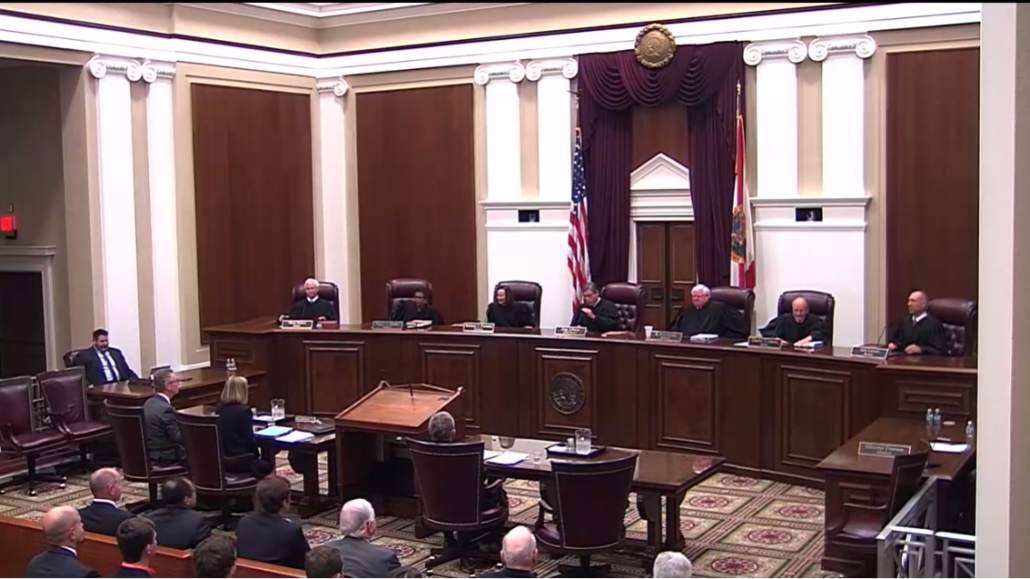
On February 9, 2017, the Honorable Laurel M. Lee, Circuit Court Judge of the 13th Judicial Circuit in Hillsborough County and Chair of the Family Law Rules Committee of the Florida Bar Family Law Section, along with collaborative attorney Robert Merlin, Vice Chair of the Committee and a Board Member of the International Academy of Collaborative Professionals, stood before the Florida Supreme Court (video) to argue in favor of the adoption of collaborative law rules of procedure and professional conduct.
In 2016, Florida Governor Rick Scott signed into law the Collaborative Law Practice Act, but the Act does not go into effect until the Florida Supreme Court approves rules. The Act creates a framework for collaborative family law, which is a private form of dispute resolution where attorneys focus solely on helping clients reach an out-of-court agreement.
Judge Lee explained to the Supreme Court Justices that the process is voluntary: “It is entirely a voluntary process by the litigants and families that choose to engage in the collaborative law process. It can be terminated by either of the parties at any time.”
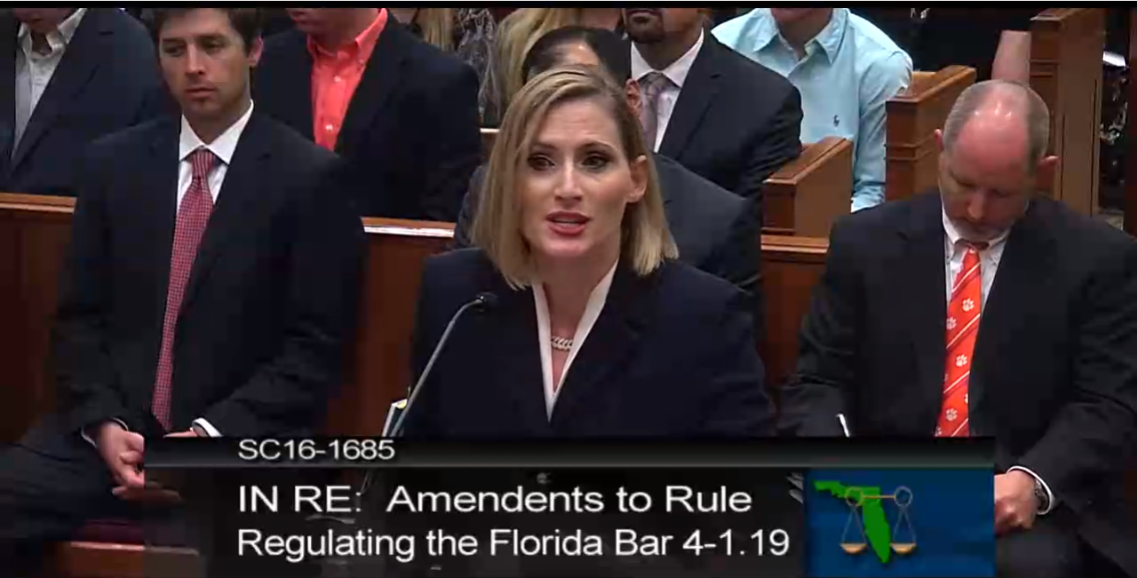
Judge Laurel Lee at Florida Supreme Court Arguing In Favor of Collaborative Law Rules
When asked if collaborative practice could help those with modest means, Judge Lee told the Supreme Court justices how she first came to learn about collaborative divorce:
“I first became aware of the collaborative process when a case came to my trial court in which all of the collaborative team – including the attorneys, the mental health professional, and the financial professional – had taken the case pro bono. I know in my circuit there is a group of collaborative professionals who take low cost or reduced fee cases so that parties do have access to this process even if they are not families of great financial means.”
Upon being asked by Justice Ricky Polston what effect collaborative practice has on mediation, Judge Lee replied, “They are not mutually exclusive. Collaborative is a process that the parties can choose to engage in but does not preclude the use of any other alternative dispute resolution methods. So [mediation] could certainly remain an option for litigants.”
When asked whether a judge can order parties who have entered the collaborative process to go to mediation, Judge Lee made sure to distinguish that some cases go collaborative prior to filing any pleadings with the court, and some enter the process afterwards.
“The collaborative process can commence either before or after there is an active court case filed. In many instances, the collaborative process is initiated by the parties without a pending court case. In that circumstance, there would not be an open case in which a court could order mediation.
If a case has already been filed, frequently the collaborative group will petition the court for a stay of the pending case while they explore whether the collaborative option will reach its full resolution.”
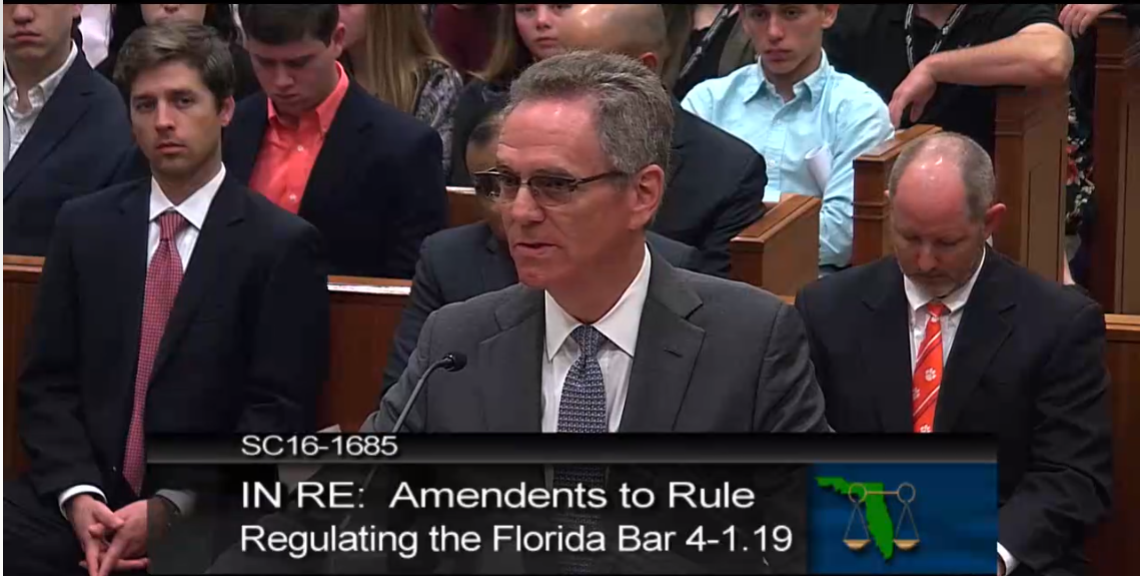
Robert Merlin at Florida Supreme Court Arguing In Favor of Collaborative Rules
Robert Merlin came to address some of the specific concerns of the justices, such as the success rate of the collaborative process.
“We have a statewide collaborative organization known as the Florida Academy of Collaborative Professionals. We are gathering statistics on the success rate of the collaborative process. The International Academy of Collaborative Professionals has done the exact same thing for the United States. In both studies, the success rate exceeds 80%. So there is a huge likelihood of the couple goes into the process…certainly in divorce in paternity, it is a very successful process.”
Mr. Merlin also addressed a concern about whether everyone would benefit from the collaborative process.
“We recognize that this process is not for everyone, but litigation isn’t for everyone either. Mediation isn’t for everyone. This is another tool in the toolbox for professionals to provide for families. Families benefit from it. We have a mental health professional who is right there in the process to help them address children’s issues. Not give them therapy, but deal with the relationship, the communications…And when there are financial issues, then we have a neutral financial professional as well.”
When asked by Justice Peggy A. Quince about whether the agreement of the parties in a collaborative divorce become part of a final court order, Mr. Merlin responded, “Absolutely. The agreement is ratified by the court and a final judgment is entered, whether it is paternity or dissolution of marriage.”
Justice Barbara Pariente inquired whether there was anything in the ultimate agreement that indicated whether a case was done through the collaborative process. Mr Merlin answered:
“There is nothing mandating that. But I can tell you that my agreement is titled ‘Collaborative Marital Settlement Agreement.’ Further, when I appear in front of a judge in a final uncontested hearing, I advise the judge that this was a result of the collaborative process. I think most attorneys do that. We want to let the judges know that this is happening and they should be aware of it.”
If the Florida Supreme Court does ultimately adopt proposed Florida Bar Rule 4-1.19 and Florida Family Law Rule of Procedure 12.745, the the Collaborative Law Process Act will go into effect 30 days later.
Adam B. Cordover is one of the most experienced collaborative lawyers in Tampa Bay. He trains attorneys, mental health professionals, and financial professionals about how to help families via the collaborative process, and he is co-author of an upcoming American Bar Association book on collaborative practice.