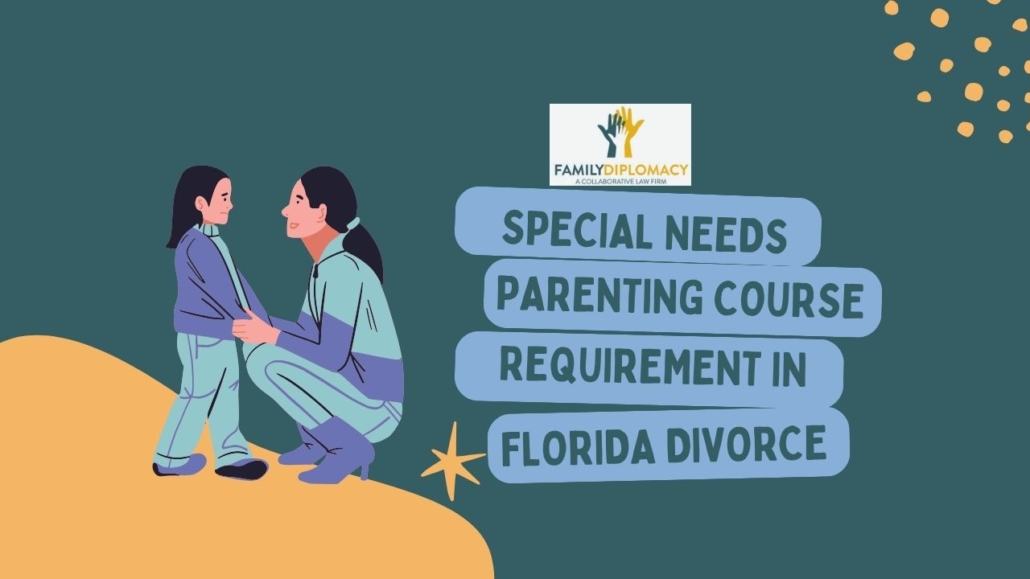
Special Needs Parenting Course Requirement in Florida Divorce
At a Glance
In every Florida divorce involving minor children, the law asks parents to keep their children’s wellbeing front and center, and when a child has special needs, getting on the same page about that child’s future becomes even more important.
- Florida Statute section 61.21 requires divorcing parents with minor children to complete a Parent Education and Family Stabilization Course before a final judgment can be entered.
- If your child has an identified disability, developmental delay, or emotional concern, Florida law directs you to take a version of that course tailored specifically to those needs.
- Completing a special needs parenting course is one way for parents to start aligning on their child’s future, but it is rarely the whole picture.
- The Collaborative Divorce process also gives parents a private setting to work through the fuller picture together: education decisions, healthcare coordination, and in some cases planning for support that may extend into adulthood.
Every divorce involving children asks parents to do something hard: set aside their own conflict long enough to think clearly about what their child needs. That is true in every case. But when a child has special needs, the stakes for getting this right multiply. School placement, therapy schedules, medical decisions, and sometimes questions about support that reach well past the age of eighteen are not things you can figure out later. They need both parents pulling in the same direction, starting now. Florida law recognizes this. It requires something more than the standard divorce paperwork when a child’s needs call for it, and it opens the door to a process built for exactly this kind of planning.
What Florida Law Requires When Your Child Has Special Needs
Florida’s required parenting course is called the Parent Education and Family Stabilization Course, and it is set out in Florida Statute 61.21. Both parents in a divorce with minor children must complete it before the court will enter a final judgment. It is a 4-hour course, and the provider will provide you with a certificate upon completion, which will later need to be filed with the Courts. You and your spouse can attend separate parenting courses, and many Courts allow you to attend the course online rather than in person. The course is meant to help parents understand how divorce affects children and how to keep conflict away from the kids as much as possible.
The law goes a step further for families like yours. Under section 61.21(4)(a), if you have a child with identified special needs or emotional concerns, you and your co-parent are directed to choose a version of the course tailored to those needs instead of the general class. The statute does not provide a fixed list of what qualifies as “special needs or emotional concerns,” so it may be worth confirming directly with your attorney based on your child’s specific situation. Either way, if you think the special needs parenting course would be helpful, you should take it.
Completing this course satisfies a legal requirement, and for many parents in Tampa, Saint Petersburg, and Sarasota, it is also the first moment they and their co-parent sit with the same information about how divorce affects a child with unique needs. That shared starting point matters. But a four hour course, on its own, is not designed to answer the specific questions your family will actually face in the months and years ahead.
Is a Parenting Course Enough for a Child With Special Needs?
For most families, the standard parenting course covers what parents need going in. For families with a child who has special needs, it rarely covers enough on its own.
Think about what actually has to get decided as part of your parenting plan. Which school or program fits your child best, and who makes that call if you and your co-parent disagree. How therapy, medication, or specialist appointments get scheduled and paid for across two households. Whether your child will need continued care, guardianship, or financial support after turning eighteen, which is a real possibility for many families and a question the standard divorce process does not walk through, and whether a special needs trust will be helpful.
Making these decisions together require two parents talking, planning, and often revisiting the plan as circumstances change. The course teaches concepts. The ongoing decisions still need a process built for depth and cooperation, not just a certificate of completion.
How Collaborative Divorce Helps You Plan for What Comes Next
This is where Collaborative Divorce tends to serve families with special needs children especially well. Instead of asking a judge to decide time sharing and responsibilities based on years of litigation followed by a several day trial, you and your co-parent work through the details directly, with your own attorneys and, often, a facilitator trained in child development and family dynamics, as well as a financial professional who can help map out ongoing financial scenarios.
For a family in Sarasota with a child on the autism spectrum, that might mean building a parenting plan around a consistent routine and clear transition protocols between households. For a family in St. Petersburg whose child has a chronic medical condition, it might mean spelling out exactly how medical decisions get made and how specialist costs are shared. For a family anywhere in the Tampa Bay area whose child will likely need support well past eighteen, it can mean starting an honest conversation now about guardianship or a special needs trust, rather than leaving it for a crisis later.
Collaborative Divorce gives you room to have these conversations at whatever pace your family actually needs, privately, without the pressure of a courtroom clock. You are not limited to what a judge can order in a single hearing. You can build something specific to your child.
Understanding the Collaborative Divorce Process
If you choose Collaborative Divorce, you and your spouse each retain your own attorney. Each lawyer’s only job is to give you independent legal advice and help you reach a resolution that works for your family, not to prepare for a courtroom fight.
Everyone on the team, including your attorneys and any facilitator or financial professional involved, works toward one goal: a resolution you both agree to, reached outside of court. If either spouse decides to file a contested pleading, or the process otherwise breaks down, the Collaborative professionals must withdraw. That rule is what keeps the process trustworthy. It means the attorneys and other professionals in the room are never in a position to be used to escalate your case into litigation. They stay focused on resolution, the whole way through.
An analysis by Adam B. Cordover and Dr. Randy Heller of Nova Southeastern University, examining nearly 300 Florida Collaborative cases from 2014 through 2024, found an 85 percent success rate for cases that used the Collaborative Process, with 60 percent of those cases resolved within six months. As with any divorce process, no particular outcome can ever be guaranteed, and results depend on the specific circumstances of each family.
For parents of a child with special needs, this structure means the harder conversations, about schooling, therapy, medical decisions, and long term planning, happen in a private setting built for problem solving rather than in a public courtroom where a judge who does not know your family makes the call.
Frequently Asked Questions
Do both parents have to take the special needs parenting course?
Yes. Under Florida Statute 61.21(4)(a), if you have a child with identified special needs or emotional concerns, both parents are directed to complete the version of the Parent Education and Family Stabilization Course tailored to those needs, rather than the standard course.
What counts as a special need or emotional concern under Florida law?
Florida law does not provide a fixed list. The statute refers broadly to children who have identified special needs or emotional concerns. If your child has a diagnosed disability, developmental delay, chronic medical condition, or documented emotional or behavioral concern, it is worth discussing with your attorney whether the special needs course track applies to your case.
Is Collaborative Divorce private?
Discussions in a Collaborative Divorce generally happen in private conference rooms or video conferences rather than in a public courtroom. This tends to appeal to physicians, attorneys, business owners, and other professionals who value discretion during a divorce. Further, you may be able to keep your agreements, parenting plans, and financial affidavits out of the court file, creating additional privacy protections.
What happens to planning for our child’s future if we cannot agree?
If the Collaborative Process ends without a resolution, or either spouse files a contested pleading, the Collaborative attorneys and other professionals must withdraw from the case. You would then need to retain new litigation counsel to proceed in court. Fortunately, gathered statistics have shown an 85% success rate, so though nothing can be guaranteed, the vast, vast majority of families who began the Collaborative Process have fully completed it.
Adam B. Cordover is the managing attorney at Family Diplomacy: A Collaborative Law Firm and co-author of Building a Successful Collaborative Family Law Practice (American Bar Association), with a practice focused on complex Collaborative Divorce matters throughout the Tampa Bay area.
We invite you to reach out to us at (813) 443-0615. You can also directly schedule a confidential virtual planning meeting or contact Family Diplomacy: A Collaborative Law Firm by clicking the button below to discuss your situation and explore whether Collaborative Divorce is the right path for your family.
When discretion matters, count on us.